

Leslie Glustrom gets support of her contention that Xcel Energy has gotten into the habit of redacting information in its filings that should really be public
by Allen Best
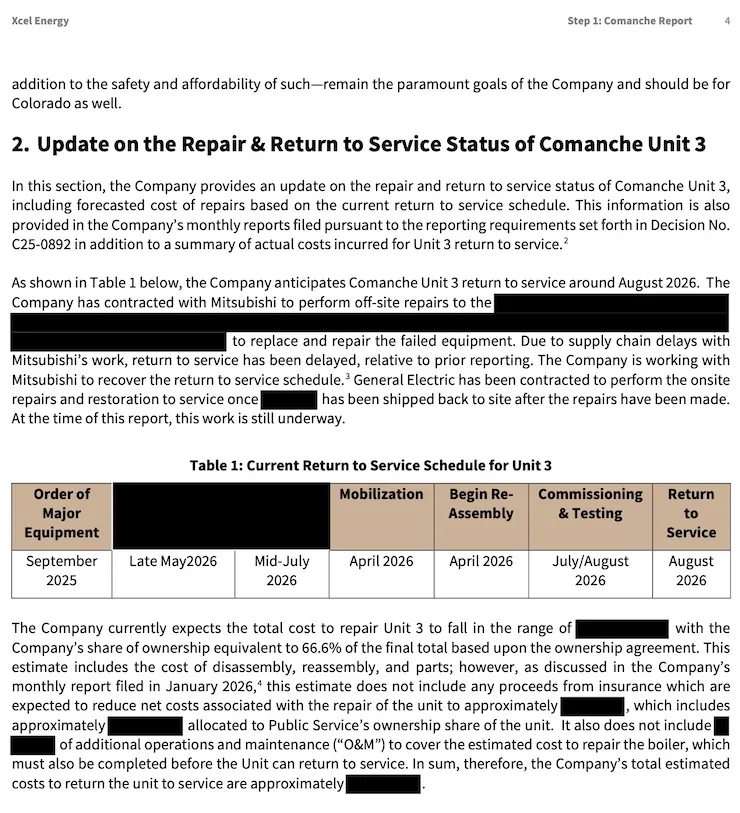
The page you see below is part of a report by Xcel Energy to the Colorado Public Utilities Commission that was filed on March 2. You will immediately notice that some words, sentences and more have been marked out. Redacted is the formal word.
The report is about Comanche, the coal-fired generation station at Pueblo where Xcel operates two units. Xcel operates both but one of them, Comanche 3, is owned in conjunction two electrical cooperatives, Sedalia-based CORE and Glenwood Springs-based Holy Cross Energy.
Comanche 2 was to have been retired in December, but last August Comanche 3 broke. It has had that habit over the years. Xcel asked for, and got permission from, the PUC to keep operating Comanche 2 while it investigated its options about Comanche 3.
Just what are those options? Key numbers are hidden from public view in the report, and Leslie Glustrom, thinks that’s just not right. There is evidence that others agree that the habit of redacting information from public view, while justified in many situations, has become a habit carried too far.
Screenshot
Glustrom, in a Colorado Open Records Act request filed in March, asked for the information. The PUC denied the request. Yesterday, she filed a request with the PUC to exercise its statutory authority to hem in Xcel’s tendency to redact information that she believes should be public.
Xcel’s filings, she said, “have been heavily redacted with virtually no explanation of why the cost to repair the Pueblo Unit 3 coal plant or the emissions from the Pueblo Unit 2 coal plant and other key information related to this situation should be treated as confidential.”
Glustrom refuses to use the name that Xcel gave the coal units, Comanche, believing it a dishonor to name a coal plant after a Native American tribe. However, Pueblo is also the name of a Native American tribe, although the name in that case is Spanish and assigned by the Spanish to tribes who lived along the Rio Grande rivers in the 1500s, when the Spanish colonizers arrived.
Comanche, on the other hand, is a phonetic respelling of the name used by the Utes. It means something along the lines of “enemy” and “stranger.” The Comanche people have their own name for themselves. Like the name of many groups of people translated into English it means “the people.”
As for her filing. Glustrom cites the PUC Rules of Practice and Procedure. The PUC, she said, has “clear authority to determine whether information submitted” by Xcel Energy is “truly confidential.”
In an interview yesterday, Glustrom said she understood the need for confidentially in some matters. “A lot of times the redactions kind of make sense.” She cited the case of when Xcel reports bid prices from scores of entities.
In that case of redactions, the PUC commissioners and staff can see the numbers, as can those of parties given intervenor status, provided they don’t share the information with others.
“I get that,” said Glustrom. “But this is information about repairing Unit 3 and emissions from Unit 2. We will know the emissions in a year because they are reported to the EPA. As for Unit 3, costs, we will know in due time, because Xcel will come to the commission and say that this is the only prudent thing to do and this is the capital cost.”
That capital cost, added Glustrom, will go into the rate base — the costs used to determine how much money Xcel can charge its customers.
“It’s very hard to fathom how the cost to repair (the unit) or the emissions or the other information they have redacted qualifies as a trade secret. I can’t figure out an argument. Let’s get it out in the public and have it discussed. Let’s not let them get out the Magic Maker and use it wherever they want.”
Glustrom got support from several speakers at the PUC open forum at the commissioners weekly meeting on Wednesday.
“I know that the public has access to everything I say and every decision I make. This radical transparency is expected of local governments because we exist to serve the needs of the public,” said Ridgway Mayor John Clark in representing the Colorado Communities for Climate Action.
“Strong justification must be given for any redacted information,” Clark added.
Eric Frankowski, executive director of the Western Clean Energy Campaign, accused utilities of exploiting loopholes to keep this kind of information secret when it really shouldn’t be.
“Colorado law is vague in defining what qualifies as confidential ‘commercial’ or ‘financial’ information, and utilities like Xcel use their battalions of lawyers to exploit this lack of clarity. They basically can claim any information that doesn’t support their bottom line or threatens their image is a trade secret and hide it. And they do so, sometimes arbitrarily.”
Frankowski cited an example in a proceeding where Xcel sought PUC approval to extend the life of four gas plants it had planned to retire. “For one of those plants, it provided specific data on the capital and O&M expenditures that would be incurred for keeping it open. For three of them, it redacted the very same information. Why?”
Arbitrary redactions are happening with other information, too, added Frankowski.
As with Glustrom’s filing the next morning, Frankowski said that the PUC’s own rules allow it to decide for itself whether the confidentiality was needed.
A few minutes later, PUC Chairman Eric Blank suggested the PUC would be receptive to the arguments about unnecessary redactions — but indicated that it should come through an existing intervenor such as the Colorado Energy Office or the Office of the Utility Consumer Advocate.
Joseph Pereira, the new director of the Utility Consumer Advocate, told Big Pivots in an interview that he believes Glustrom’s objections provide an opportunity for “everyone, including our office, to think at the start of these proceedings, are we leaning toward transparency first?”
Certainly, in many cases, more transparency is justified, although even in the case of some emissions data, a case can be made for redactions.
THE UCA, said Pereira, is now discussing with Xcel representatives about what they are willing to unseal. The company’s decisions will determine whether the UCA will move forward with the action suggested by Blank.

- Jared Polis on money spent on wildfire risk - October 15, 2026
- Xcel’s Robert Kenney on storage and other thoughts - October 14, 2026
- Solar-powered ski lifts in Colorado? - October 14, 2026


Yes Xcel does make magic in many of its rate cases but I think the article title and text are meaning to say Magic Marker, as in the sharpie pen used by our favorite president.
Thank you for highlighting these Sharpie pen redactions and the lack of transparency by Xcel. This is especially important with huge facilities like Comanche 3 that are performing far below their advertised level with ratepayers expected to keep handing Xcel money.