
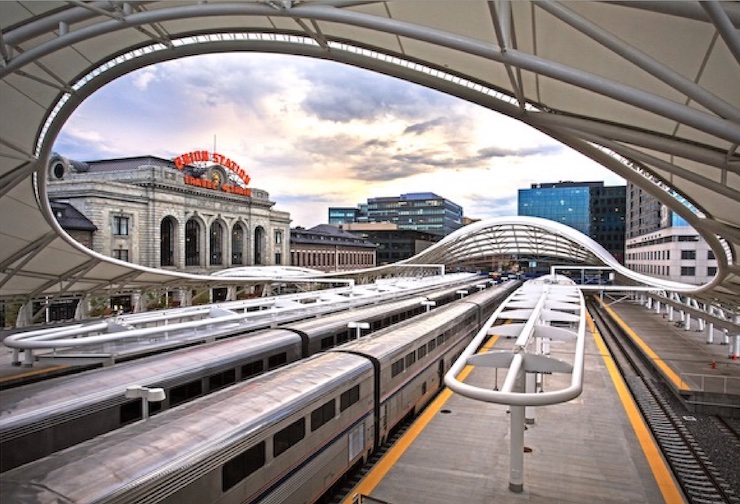
Using existing tracks now devoted to freight instead of building new infrastructure matters entirely in these coming trains between Denver and Fort Collins.
by Allen Best
The Front Range Passenger Rail District last week announced plans for three daily round-trip trains between Fort Collins and Denver beginning in 2029. The last passenger service ended in 1967, a year when radios were playing the Beatles’ “Penny Lane” and Jimi Hendrix’s “Purple Haze.”
In time, the rail district aims for 10 round-trip trains daily along the Front Range to Pueblo, but eventually connecting to New Mexico and Wyoming. In a separate initiative, Colorado expects to begin daily passenger service through the Moffat Tunnel to Granby in November. Extension of service to Steamboat and Craig is the ultimate goal.
Do we really think 19th century technology, if updated, can deliver answers to 21st century challenges?
Rails proliferated across Colorado during the late 19th century. Three railroad companies competed furiously to haul Leadville silver ores. Two companies vied to tap Aspen’s wealth. Durango, Holyoke and Granby are just three of many towns created directly as a result of railroads.
Then came the internal-combustion engine. Roads were difficult but gradually improved. In 1930, the state began clearing the road over Berthoud Pass during winter, a milestone. It was Colorado’s first motorized year-round crossing of the Continental Divide.
Passenger trains began disappearing, although gas rationing caused an uptick in ridership during World War II.
In the 1950s, as a small child, I once was put on a Union Pacific train by a grandmother in Sterling for delivery to my waiting mother in Fort Morgan. Passenger trains still mattered.
Then, in the early 1960s, bulldozers arrived at Fort Morgan to blade a route for Interstate 76. Similar work was underway along the Front Range for I-25. By the mid-1960s, the four-lane highway between Fort Collins and Denver was complete. Not coincidentally, the Colorado and Southern passenger rail service along the northern Front Range was suspended in 1967. So were passenger trains between Pueblo and Glenwood Springs. The last train between Craig and Denver ran in 1968.
What has changed? Why might people will want to ride passenger trains along the Front Range?
First, if FasTracks has been far from perfect, it has strong moments in metropolitan Denver. A home run — or hat trick, if you will — has been the ease these trains have provided in getting to Avalanche, Nuggets, and Rockies games.
Bustang, the state-funded bus service that now connects Colorado from Durango to Sterling, Lamar to Craig, has also been a big success. It’s a cheap way to travel if, for example, you are in Salida and need to get to Denver to see a doctor. The buses are comfortable and efficient – as long as there are no traffic jams.
We do have traffic jams. We keep expanding I-25 and other highways, and it never seems enough. Highway expansion is also costly.
State transportation planners at first assumed new and expensive infrastructure would be needed for Front Range rail transit. “Fifteen years ago, when we were thinking about Front Range rail, we were thinking about virgin track. It was $15 or $20 billion, and it was pie in the sky,” said Herman Stockinger, deputy director of the Colorado Department of Transportation, at a Denver meeting last Saturday. “It was never going to happen.”
The cost of adding rail to the I-70 corridor from Denver westward to Vail and beyond was estimated at $21 billion, also a deal killer.
The agreement announced last week allows passenger trains to use BNSF Rail tracks. Freight traffic, including coal trains, has declined. The still-plentiful coal trains south from Denver will subside as the coal plants at Pueblo, Fountain and other places retire in coming years.
Passenger rail has many skeptics. Once you get to Fort Colins, for example, how do you get to your ultimate destination if it’s three, five or however many miles away? And can you really get to your destination city, say Longmont, as fast or almost as fast as driving? Rail advocates have answers, none completely satisfying.
Intriguing is potential for new technology. Will self-driving cars allow us to use existing highway and road infrastructure more efficiently?
We may never see passenger trains between Aspen and Glenwood Springs again, or to Crested Butte, Minturn, or Limon. But who knows? Colorado’s population growth is slowing, but nobody is leaving.
Some rail fans are driven by nostalgia. My interest is more practical. I have experience taking the trains from Olde Town Arvada to DIA. It’s vastly cheaper than driving and about as fast. You can enjoy the trip, read your phone, or chat it up with a companion. Plus, nobody will careen past you at 110 mph, scaring you spitless. That’s worth something, too.

- An astonishing year for heat in Colorado - October 23, 2026
- And what if Ken Salazar had become president? - October 22, 2026
- The miracle of soil and its challenges - October 21, 2026

