

Climate scientist explains how we’re stacking the odds for lesser Colorado River flows. Still, we may need the big dams even more.
by Allen Best
Jonathan Overpeck’s keen interest in the Colorado River Basin had diminished only slightly since when he lived in Tucson. There, he taught at the University of Arizona for more than 20 years.
“I worried a lot about the fact that the value of my house probably depended on the climate and what it was doing,” Overpeck, an interdisciplinary climate scientist, told Big Pivots in an interview on Dec. 13.
Now he’s in Michigan, where he became dean of the University of Michigan’s School for Environment and Sustainability.
After picking up a degree in geology, Overpeck added additional credentials on his way to becoming an expert on climate change, climate-vegetation interactions, earth history, environmental science and sustainability.
He has authored or co-authored over 230 publications, among them a paper in 2017 with Colorado State University’s Brad Udall. See: “The twenty-first century Colorado River hot drought and implications for the future.”
That 2017 paper said that rising temperatures resulting from human activities were at least half the story of the declined flows in the Colorado River. However, they did not try to address the impact of rising atmospheric concentrations of greenhouse gases on precipitation in the basin.
This year, he teamed up with Udall for a chapter in “Dancing With Deadpool,” a product of the Colorado River Research Center. This time, they conducted no original research but instead pointed to two new studies that strongly suggest that declined precipitation in the Colorado River Basin can also be attributed to human activities.
“Dancing With Deadpool” was issued in early December with the annual Colorado River Water Users Association in mind. The annual conference, which is being held at Caesar’s Palace in Las Vegas this week, draws attendees from across the seven-state basin. The publication’s eight chapters seek to inform the path forward for sharing of the Colorado River’s declined flows.
The chapter written by Overpeck and Udall delivers a clear message that water managers should not expect flows to improve over the long term. Yes, some years may be above average. It’s even conceivable that the two big reservoirs, Mead and Powell, will fill again someday. Unlikely, but not impossible. But the odds are increasingly being stacked against good runoff, Overpeck told me in a 50-minute interview. And the scant snowfall in the mountains so far this year that attendees saw when flying from the Front Range of Colorado is part of that trend
Following are excerpts from that interview.
Being located two time zones removed from the Colorado River Basin, has that changed your perspective in any way?
It has changed my perspective. I felt like I had a lot more personal stake in the Colorado River and the climate of the Southwest when I lived there. I worried a lot about the fact that the value of my house probably depended on the climate and what it was doing.
So, I was getting increasingly worried, because climate change kept proceeding without seemingly any concern on the part of politicians in Arizona. Periodically, you’d get someone like (Gov. Janet) Napolitano who would take climate change seriously. For the most part, politicians weren’t taking climate change that seriously.
I study climate and hydroclimate, particularly drought, around the world and on all the continents except Antarctica. I haven’t just worked in the Southwest. What we’re seeing in Arizona is a great example of what we’re seeing increasingly in many places around the world, particularly those drier, more drought-prone places, but other places, too.
One of my students really dug into the climate of the Amazon, one of the wettest places on the planet. It, too, is getting drier. This is due primarily to rising temperatures coincident with changes in atmospheric circulation, again driven by climate change.
In some places, including the Colorado River Basin, snow is our natural reservoir, and it’s really declining quickly in response to both temperature and precipitation change induced by human caused climate change.
You may have partly answered the next question, which has to do with the study published in February 2017 by you and Brad Udall that concluded that warming temperatures were a strong driver of the so-called drought in the Colorado River Basin. You called it hot drought. How would you summarize your conclusions?
Temperature and precipitation are both important. In 2017 we knew with great confidence that as long as we continue to put greenhouse gasses into the atmosphere, primarily carbon dioxide from the burning of fossil fuels, the planet will continue to warm. We know that with great confidence. There’s no doubt about it.
Working over the years leading up to 2017 with quite a large number of colleagues, the consensus was that the Colorado River was going to respond to warmer temperatures with lower flows, and for a variety of reasons.
We knew some of those reasons then. We know a hell of a lot more now about the temperature effect. We have a strong consensus that as long as these temperatures increase, we’re going to get more reduced flows of the Colorado River.
The warming atmosphere can hold more moisture. Over land, it has to get that water from soil and vegetation. We call that evapotranspiration. The atmosphere is able to demand more moisture from the land surface as it warms, and that demand can go up at about 7% per degree C of warming.
Another big factor, as the atmosphere warms, is that the growing season gets longer. Spring comes earlier and fall lasts longer. Plants are more rapidly moving moisture from the soil into the atmosphere for longer periods of time. Those two factors are important.
Another big effect of warming is the land itself. We have less snow on the ground, particularly in the shoulder seasons. This year is a great example. Because of that, in the upper Colorado River Basin, the landscape is darker. That darker surface leads to more heating.
These and other factors translate into warmer temperatures and hence lesser flows. So, in 2017 we wanted to say, hey, we know with great confidence that if precipitation stays the same, we’re going to get lower flows. If precipitation goes down, obviously we’ll get lower flows. We’re going to need more increased precipitation to counterbalance the warming temperatures.
But in 2017, we were not able to say with any confidence what precipitation was going to do in the future. We were starting to get a sense of that. But there was, in the climate science community, a lot of great debate, a lot of exploration, a lot of modeling, a lot of observation.

Mountain snow has generally diminished since this photo was taken in July 1997 on Bald Mountain looking down on I-70 and Vail. Photo/Allen Best. Top, Jonathan Overpeck delivering a lecture. Photo/.Dave Brenner
Eight years later, we have a much better handle on what the precipitation is likely to do. We don’t know with the near perfect confidence that is associated with the temperature effect. But we are gaining confidence that climate change is contributing to that decreased precipitation.
Just in this last year, some studies have been published indicating that the sea surface temperatures in the Pacific, which primarily control the precipitation in western North America, are changing in a way that contributes to increasingly dry conditions.
In the Colorado basin we’re basically stacking the odds against wet and stacking them in favor of drier conditions. That’s certainly what we’ve been seeing. It may change year to year, but the odds are we’ll get more dry years than wet years.
Brad and I and some others are writing another paper on this. But the thing we just published with the Colorado River Research Group is a preview of that very important finding, and we just wanted to get that out in time for the Colorado River Water Users Association meeting this week as the states, the federal government and Mexico decide what we will do about the short-term disaster that seems to be emerging even in this year. How are we going to deal with that?
We’re at that point now where the doctor has said, “You have a problem.” We know what the problem is. We don’t just want to treat the symptoms. We know the cure.
Science is getting very clear now that climate change is the biggest enemy of good flows in the Colorado River, and, for that matter, the whole climate of the Southwest and West. It’s the reason we’re getting the big wildfires. It’s the reason the state of Washington is getting unprecedented flooding right now. All of this is supercharged by climate change.
What was the reaction to your 2017 paper? Do you think there is a greater understanding now of the role of the warming atmosphere in the declined flows on the Colorado River?
In 1999, a few people in the water business were making fun of me and mocking me for being worked up about prolonged drought, but I knew I was right, so it didn’t really affect me. By 2017, after 18 years of drought, we were getting broader buy-in.
I think the water managers, whether they’re federal or state, totally understand the problem. I think the farmers, growers, producers, I think they understand. I think the ranchers understand. Frankly, I think everyone understands that climate change is a problem because everybody is experiencing the increasing temperatures and the decreasing precipitation. And, you know, these people manage resources for a living, and they’re good at it.
The problem is that it’s become political. We see that in spades coming out of the White House. The current president of the United States made it clear in the election that if the oil industry gave him money to get elected, he would do whatever they wanted. And what they want is to ignore climate change, because it threatens their businesses.
We all know the grip that the president has on his party, and he has made it less easy to talk about climate change as a real threat among a lot of Americans. That’s a real problem in mobilizing society to deal with the problem like we were during the Biden administration. We made huge strides during the Biden administration.

Powell Reservoir, a creation of Glen Canyon Dam, is currently about 27% full, according to the Lake Powell Waer Database. It has dropped 31.8 feet in the last year. Photo/U.S. Bureau of Reclamation
I think we’re in an irreversible transition now to a world of low carbon energy, but it’s slowed down by these politicians.
In the basin, you have the blue states, California, New Mexico and Colorado. Utah is a red state but amazingly open to science. Arizona, where 70% of citizens know there’s a problem, is controlled by politicians who don’t want to cross the fossil fuel industry or the president, I guess.
It’s particularly unfortunate, Allen, because the region has the opportunity to be one of the most successful economic engines based on renewable energy. Got tons of sun in the Southwest. We’ve got lots of wind opportunity up on the Colorado Plateau. It’d be so easy to solve — do their part for solving climate change and make a lot of money doing it. It would mean more affordable energy too.
But the politics have really — I’ll use the term because it is appropriate —trumped the science in the minds of too many political leaders in our country right now.
Do you think that this understanding of climate can have a role very directly in the negotiations about how seven states and Mexico share this shrinking river?
I like what Eric Kuhn says in “Dancing with Deadpool.” He suggests we need to consider a proportional based system like they have for the Murray-Darling Basin in Australia. There, when there’s a flow reduction, everyone gets a percentage change in their allocation. And when there’s an increase, they get an increase according to their percentage of the total allocation.
You know, I think that’s where we’ll end up, personally. But how we’ll get there, I just don’t know, and I do think the warped politics of climate change will interfere with the negotiations and quite possibly lead to less desirable outcomes than we need.
Last winter started very, very, very, very slowly in the San Juan Mountains of Colorado and never amounted to much. The northern mountains of Colorado got some pretty good snow, but the runoff altogether in the Colorado River at Lee Ferry was only 55% of the longer-term average.
That pattern — drier in the south and somewhat normal in northern Colorado — was hypothesized 20 years ago. What can we now say about the regional impacts of climate change in the basin?
The northern tier of the West has been getting wetter. In the southern and central tiers, right out onto the high plains, it’s been getting drier. You know, storm tracks, on average, are just moving north, and you see that in both hemispheres. It’s complicated, because you have all sorts of topography influencing where the storms track. But on average, that’s what’s happening.

Runoff some years can still be a sight to behold in Glenwood Canyon. Photo/Allen Best
You mentioned earlier the project that you and Brad are working on now. Could you go into that just a bit more? What is the research question?
Our 2017 report suggested that as it warmed that the flows of the river would decline. Has that happened? The answer is unequivocally yes.
We also wonder with our better models, better science understanding, better data, longer time series of observed and instrumental data, whether we can get a handle on what’s really going on with precipitation?
It’s clear now the precipitation is going down. So the big questions are, is that due to natural variability? Is it just going to rebound, or is it forced by climate change? Is it going to continue to go down and stay down?
Our goal was to do a very comprehensive synthesis of existing research. And when you do that, some recent research points to external forcing as being the dominant control of the sea surface temperature pattern in the Pacific that controls the precipitation in the Colorado River headwaters.
It’s also the study that Victoria Todd did with a bunch of climate scientists, including Tim Shanahan, one of my former students, looking at the ancient climate of the last 10,000 to 11,000 years in the headwaters. See: “North Pacific ocean atmosphere response in Holocene and future warming drive southwest US drought”
They discovered that the period from about 11,000 to 6,000 years ago was much drier in Colorado and northern New Mexico. They were able to conclude, using models and understanding of climate, that this drier time was driven primarily by an external forcing, a change in the Earth’s orbit. And they concluded, based on their work, that this external forcing was changing the North Pacific pattern the way it’s changing now.
Today, it’s not the orbit that’s changing. Instead, it’s the greenhouse gas concentrations and the tropospheric aerosol loading, both pollution from burning of fossil fuels, that are causing the change.
I think those two things put together, in addition to a lot of other work that’s been done since 2017, give us the confidence to say the odds are getting stacked against higher river flows because of climate change. The odds favor lower runoff in the future because of climate change.
With lesser flows do we need different infrastructure? Maybe, does the idea of doing away with one of the big dams actually does make sense? Do you have any thoughts you might want to share?
Thank goodness for the big infrastructure, particularly Lake Mead and Lake Powell, the two biggest reservoirs in our country. They have enabled the Southwest to get through the drought so far relatively unscathed.
Some farmers have had to cut back and make sacrifices for the rest of us. There have been a lot of wildfires and a lot of other things happening that are not so good. But the taps haven’t run dry like they have in places where they’ve run out of rain and groundwater.
The infrastructure isn’t just the big dams. It’s also the fact that we are able to pump abundant groundwater in the Southwest, and unfortunately, we’re using it up without thinking. So that’s another very big issue that we should be talking about.
Let’s go back to your question. Each of these reservoirs is now about 30% full. We know the evaporation out of those reservoirs is significant.
So if we could instead just put all the water in one reservoir, there’d be less surface area and thus less evaporation. That sounds good. I’m pretty sure we’re not going to fill both reservoirs again. But if I still had my house in Tucson, I wouldn’t bet my house on it, because when it comes to precipitation, we have less confidence than we do with the temperature, and it is possible that we could get a 10-year run of above-normal precipitation and fill these reservoirs again.
It’s also very clear that as the atmosphere warms up, when it does rain, it can rain in a lot more intense fashion. You see this in Washington state right now, and Texas last summer.
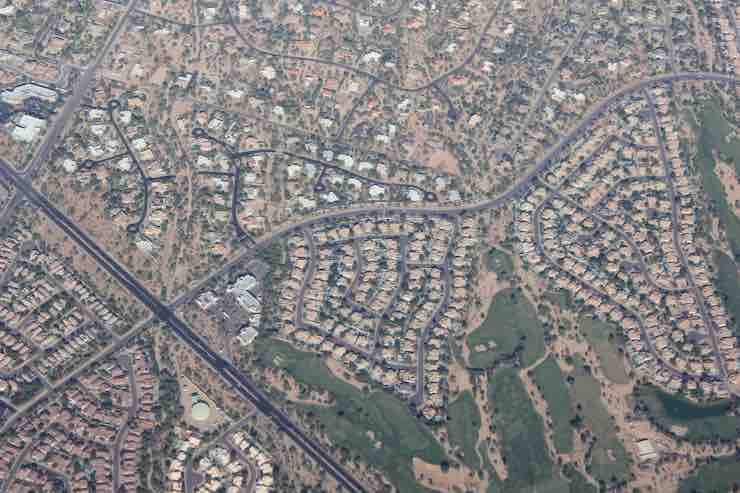
Metropolitan Phoenix from maybe 10,000 feet. Photo/Allen Best
Scientists working on paleo-hydrology have discovered evidence of much greater floods of the Colorado River in recent Earth history. And the only way that could happen, in my mind, would be if these big thunderstorm complexes parked over the basin in a way that unprecedented rainfall, perhaps coincident with rapid snowmelt, produces unprecedented flooding.
Climate change is making the odds of intense precipitation higher. It’s crystal clear. We know that with confidence.
So what would happen if we filled the big reservoirs up again and we got one of these really catastrophic rainfall events, maybe coincident with a big spring snowmelt? We really would be at risk if we didn’t have both big dams for flood control. One dam might not be enough.
I really don’t think it’s the time to take out the Glen Canyon Dam. I just would hate to lose that extra security. Because if we take out that dam it might put Hoover Dam at risk, and that could really be disastrous for the Southwest, for all the cities, in the lower basin. The water supply for Las Vegas, San Diego, Phoenix, and Tucson from the Colorado would be pretty much gone.
So we lose a lot of water to evaporation from those two big reservoirs. On the other hand, we actually might need them for flood control? Is that a way to see this?
Yes. I think in this era of more intense precipitation, we really have to pay attention to flood control as well as water supply. Both are important, and both will be increasingly difficult as long as climate change is allowed to continue.

- Rural vs. urban in a panel at History Colorado - January 10, 2026
- A hiccup for coal on its farewell tour in Colorado - January 8, 2026
- Three glimpses of pivots underway in Colorado - January 4, 2026





Thank you.
I must wonder if promoters of fossil fuels have children or grand children?