Research on Niwot Ridge, west of Boulder, finds declining “juvenile recruitment’ to population of pikas
Scientists have long predicted that climate change might threaten pikas in Colorado and other Western states. In some places, it already has, mainly in places with warmer summer temperatures or where winter snowpack appears to be insufficient for insulating pikes from extreme cold.
But could they disappear from Colorado’s high country altogether as warming continues? Rocky Mountain National Park ranks as among the state’s highest locations. One 2016 study predicted that pikas could disappear entirely from the park by the 21st century’s end.
A new study led by researchers from the University of Colorado provides evidence it is happening on nearby Niwot Ridge.
Niwot Ridge lies along the Continental Divide northwest of Boulder and 10 to 15 miles south of Rocky Mountain National Park. Scientists had studied pika populations from 1981 to 1990 and again from 2004-2020. For this new study, they returned to the same area to count pikas.
These new researchers had to look harder. In a paper published in a journal, “Arctic, Antarctic and Alpine Research,” they reported that “recruitment “of juveniles to this site seems to have plummeted since the 1980s. In other words, these populations are becoming dominated by older adults, with fewer juvenile pikas being born, or migrating in, to take their place.
Visitors to the montane and alpine zones of Colorado’s mountains are familiar with the small, fuzzy creatures that live amid the talus slopes. They often issue loud squeaks at the approach of hikers.
“It’s a fun encounter when you’re hiking on a trail in the Rockies and a pika yells at you,” said Chris Ray, lead author of the study and a research associate at the Institute of Arctic and Alpine Research (INSTAAR) at CU Boulder.
Pikas are cold-adapted mammals related to rabbits and hares but about the size of rats. They are fuzzy and have rounded ears. Relics of the last ice, they can be found exclusively atop mountains in the western United States. A closely related species is found in Asia, particularly China and the Himalaya.
In Colorado, pikas can be found above 8,000 feet, or about the elevation of Vail, to the tallest 14,000-foot peaks. They especially favor talus slopes, places of broken rock. Scientists have identified pikas as a climate change indicator species because of their apparent dependence on the disappearing cryosphere. The cryosphere includes Colorado’s above-treeline locations, where the ground is frozen much of the year.
Although still broadly distributed throughout its former range, the pika has been lost from many warmer and lower-elevation habitats, as several scientific studies have documented.
If still found on Niwot Ridge, the numbers have declined. Ray and her colleagues can’t yet pinpoint the reason why at this one site. However, summers have been warming.
“The habitats where pikas live are our water tower,” Ray said. “The permafrost, or seasonal ice, that’s underground here melts later in the summer and helps replenish our water supplies at a time when reservoirs are draining.”
From 1981 to 1990, Charles Southwick, a former professor at CU Boulder, set out to follow the pika populations at Niwot Ridge. His team trapped and tagged pikas.
Ray has studied these animals in the American West, from Montana south to Colorado, for more than 35 years.
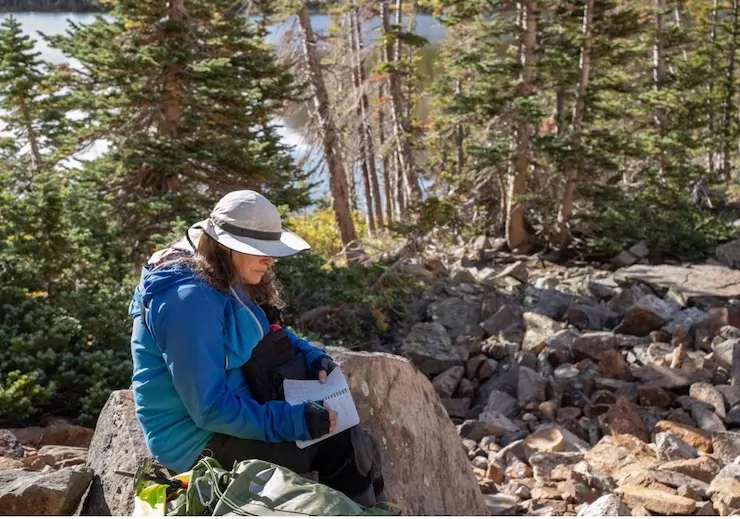
Chris Ray makes notes during a pika survey in the Indian Peaks Wilderness Area. Photo/Gabe Allen, INSTAAR. Top photo/ Steve Torbit, U.S. Fish and Wildlife Service
“Pikas are useful as a study system because they’re so visible and conspicuous, and they’re one way to get a handle on what changes are happening in alpine ecosystems,” Ray said.
In the current study, she and Jasmine Vidrio, a former undergraduate at CU Boulder, compared their findings to what Southwick saw decades earlier.
The results were disturbing.
Based on the researchers’ calculations, the proportion of pikas they trapped that were juveniles fell by roughly 50% from the 1980s to today — suggesting that younger pikas could be growing rarer on Niwot Ridge.
Ray explained that pikas may be especially vulnerable to climate change, in large part because they can only survive in a narrow range of temperatures.
“Pikas don’t pant like a dog. They don’t sweat,” she said. “The only way they can release their metabolic heat is to get into a nice, cool space and just let it dissipate.”
The researchers can’t conclusively link the possible decline of pikas on Niwot Ridge to warming temperatures. They also aren’t sure how widespread this trend is in the West.
But Ray noted that her results support previous predictions that juvenile pikas may have trouble migrating through the Rockies as temperatures continue to warm. To cross from one mountain habitat to another, pikas first have to climb down in elevation, facing hot conditions in the process.
She recalls one pika she encountered at the start of her career in the 1990s. She nicknamed the male Mr. Mustard because he had yellow tags on his ears.
“He was an adult when I trapped him, and he lived for nine more years,” Ray said. “I don’t see that anymore, so I do think things are changing.”
This was adapted from a story by Daniel Strain posted at CU Boulder Today on Nov. 18.

- A troubling climate change for this alpine critter - December 4, 2025
- Might good come from the NREL name change? - December 2, 2025
- We need coal but can we afford Comanche 3? - December 1, 2025