State awards $75,000 to operator of the Paonia Creative District as part of the just transition effort
by Allen Best
Paonia and the North Fork Valley have long had apple, peach and pear orchards. Farther up the valley a few miles coal miners have toiled at several of Colorado’s largest mines. Majestic Mount Lamborn towers over them all.
Beginning in the late 1970s, while both coalmining and fruit remained vital parts of the economy, Paonia began gaining a reputation for something else. The most prominent trigger was likely the decision by Ed and Betsy Marston to take on the work of publishing High Country News, a regional environmental publication hitherto published in Wyoming.
Over the decades, the complexion of the North Fork Valley has changed. The orchards remain. And West Elk, one of three coal mines operating just 20 years ago, continues to export coal. It is one of Colorado’s largest mines. How much longer will it operate? Hard to say. The Trump administration efforts to revive the market for coal may extend the life a few years, but it’s hard to imagine the mine operating for 20 more years.
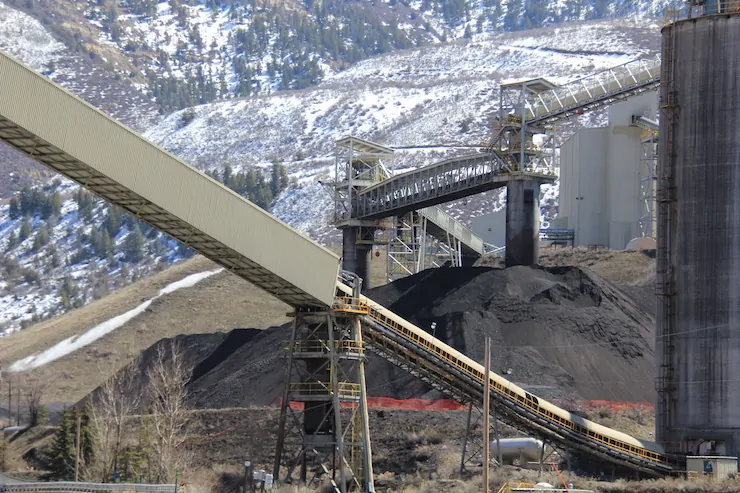
Only the West Elk Mine continues to extract coal in the North Fork Valley. Photo/Allen Best
As for Grand Avenue, the main street of Paonia, it is artsy and funky. Drawn by the scenery, the warm but not hot climate, and the small-town ambience, artists, writers, and thinkers have been arriving in Paonia and nearby Hotchkiss. The late Joe Cocker decided to spend the last few decades of his life at nearby Crawford. It has also attracted many refugees from cities and the resort valleys of the Western Slope. Most of the coal miners have left.
Symbolic of this transition was arrival of Solar Energy International, a non-profit created to train solar workers and provide expertise, in 2012. It was founded in Carbondale in 1991.
Real estate prices have been rising, but not to the levels of resort valleys or even many places along the Front Range. The average Paonia home as of mid-2025 was $454,481.
But the North Fork Valley remains a place in transition. It is a cultural transition, too. Even last year, after the 2024 presidential election, you could see a large yard sign in Paonia saying, “*uck Biden.” Boulder, it’s not, nor Telluride.
To help the North Fork Valley figure out its economic future, Colorado has announced a new award of $75,000 to help fund a full-time executive director for the North Fork Valley Creative Coalition during the next three years. The coalition manages the Paonia Creative District.
The coalition estimates that a full-time executive director will expand the organization’s capacity to support local communities, resulting in business support for more than 120 additional creative businesses and nonprofits and an additional 150 local vendors and 40 regional musicians.
A lot of bang for the buck, if this is a realistic projection.

Wildflowers and butterflies on a rainy day in Hotchkiss during October 2024. Photo/Allen Best
The money comes from the Colorado Office of Economic Development and International Trade. Embedded in that agency is the Office of Just Transition, which was created by state legislators during their landmark 2019 session. Legislators were clear about the need to abandon coal-fired combustion but also help coal-extraction communities in their subsequent transitions.
What that means in practice has been less than clear cut. Places like Craig, Colorado’s most prominent coal town, at first resisted the future. At least large parts of the community did. They have over time accepted the reality. But what exactly is the future?
That is not necessarily easy to predict. Skills in mining or burning coal do not automatically translate into being hoteliers, for example. But here and there have been some stories that may turn out to be stellar successes.
State agencies have now awarded $11.07 million of the $132 million dedicated to local economic development initiatives on Colorado’s Western Slope. With this grant, the agencies have awarded $11.07 million to 29 different local projects. They range from business parks and entrepreneurship centers to outdoor recreation attractions, water infrastructure projects, and regional planning efforts.
Colorado’s just transition effort has always seemed noble. A career change can be difficult, especially if you don’t want it. These community career shifts remain incomplete, Colorado’s execution of its noble efforts will still be awaiting final judgment some years in the future.

- Another seed planted in Colorado’s energy transition - February 14, 2026
- Room for optimism despite the EPA ruling - February 13, 2026
- Ridding Denver-area homes of gas - February 5, 2026