Need some elbow room? There’s always Wyoming. It has added populaton but far, far more slowly.
Colorado has topped 6 million in population for the first time, reaching 6,012,561 on July 1 of last year, according to Census Bureau estimates.
“The secret is out: Colorado is the best place to live, work, play, start a family, and grow a business,” said Gov. Jared Polis in reporting the new estimate.
“The numbers don’t lie, and I am excited to see Colorado’s population grow despite trends across the nation,” he said before laying out a cheerful prognosis of challenges and opportunities.
“I look forward to welcoming even more people to Colorado as we move further into the new year,” he said.
Others, who remember less congestion and sprawl, might not agree about more residents, but then that has been a near constant since the 1970s, when “Native” bumper stickers abounded. Colorado, by the way, had a population of 1.3 million midway through the 20th century.
Colorado’s population growth has slowed somewhat in the last 20 years. It added 247,235 people in the five-year span since the last census. For those who think it’s getting a wee-bit crowded, there is always Wyoming, which added only 11,881 people during the five years.
But even within Colorado, population growth has been uneven. Most of the population growth has occurred along the Front Range from Colorado Springs to Fort Collins and Greeley or in the Grand Junction area. Some counties, mostly those dominated by agriculture on the Great Plains, have actually lost population, as this map prepared by Nancy Gedeon, the estimates demographer with the State Demography Office, for a demography summit in November.
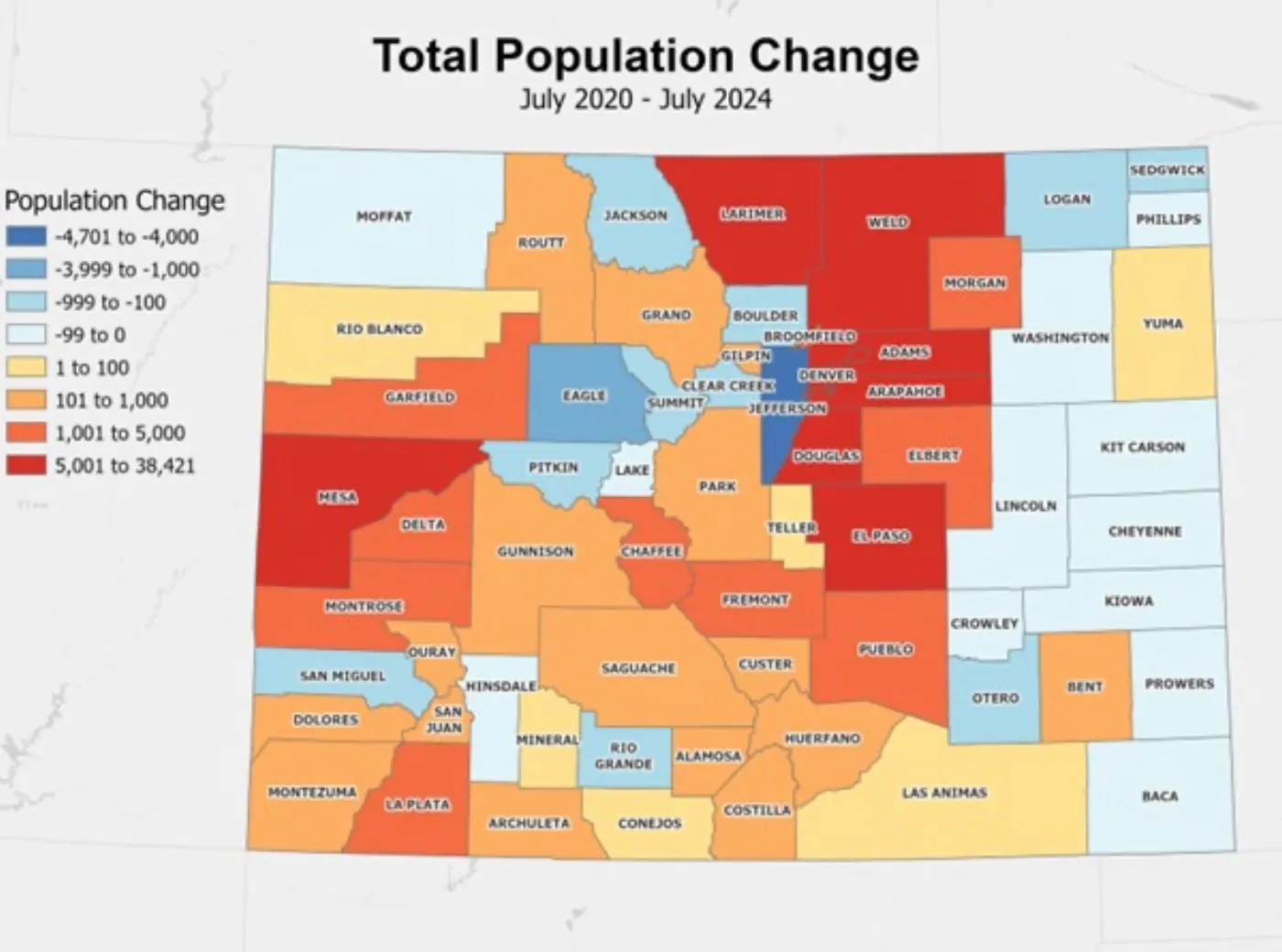
Gedeon’s charts also show a distinctly slowed growth during the time of covid. It also provides numbers of immigrants from outside the United States.
How does Colorado compare with its neighbors? Here are the population totals of those states immediately adjacent to Colorado:
- Wyoming, 588,753
- Nebraska, 2.01 million
- Kansas, 2.97 million
- Oklahoma, 4.12 million
- New Mexico, 2.12 million
- Arizona, 7.62 million
- Utah, 3.53 million
Also of note is the population of California, which lost 200,000 people although it still has 39,355,309 people.

- Xcel Energy gets a very big green light - February 19, 2026
- Data centers in Colorado, yes, but on what terms? - February 18, 2026
- Compromise is so terribly, terribly hard - February 17, 2026