

President Trump calls Crow and other members of Congress traitors. But an Army captain who refused orders in 1864 today is remembered with reverence for his defiance.
by Allen Best
The Sand Creek Massacre comes to mind in reading about U.S. Rep. Jason Crow, a decorated combat veteran who declared that members of the U.S. military must refuse illegal orders.
“No one has to carry out orders that violate the law or our Constitution,” said Crow and five other members of Congress, all of them veterans of our armed forces or intelligence services, in a video posted last week.
President Donald Trump went ballistic, branding them as traitors. “HANG THEM GEORGE WASHINGTON WOULD !!” said a social media post that Trump shared. He later backtracked, saying he didn’t actually call for their deaths. Not sure what hanging short of death looks like. Crow and other legislators did report death threats.
Denver’s Channel 7 talked with a former U.S. Army officer, Joseph Jordan. His law firm specializes in defending service members under investigation, cited the Uniform Code of Military Justice, which says service members must obey orders, unless they are “patently illegal,” such as one that “directs the commission of a crime.”
But the code says those who disobey orders risk facing a court martial. A military judge decides if an order was lawful.
Writing in the New York Times, David French, an attorney who served in Iraq, as did Crow, parsed details of the relevant federal law. Shooting a prisoner is unambiguously illegal, said French. Bombing a home that is thought to contain insurgents is not.
Looming large is the legality of Trump’s orders to kill those on boats in the Caribbean who may — or may not — be carrying narcotics. Trump, said French, “has put the military in an impossible situation. He’s making its most senior leaders complicit in his unlawful acts, and he’s burdening the consciences of soldiers who serve under his command.”
At Sand Creek, on Nov. 29, 1864, Captain Silas Soule and Lieutenant Joseph Cramer refused to allow their men to participate in killing about 200 Cheyenne and Arapahoe natives, most of them women and children.
The Great Plains in 1864 were contested territory. Colorado had become a U.S. territory in 1861, but the Cheyenne and other tribes who had migrated over the previous 150 years to build lives around the plentiful buffalo herds were not consulted. Friction was growing. Murders had occurred.
Desperate to figure out a co-existence, a delegation of Arapahoe and Cheyenne leaders had traveled to Denver that September. Colorado’s territorial governor, John Evans, was present but remained largely silent. The natives left, believing they had been assured safety if they remained in place in southeastern Colorado. About 350 of them and various other individuals were camped along the dry creek bed that November.
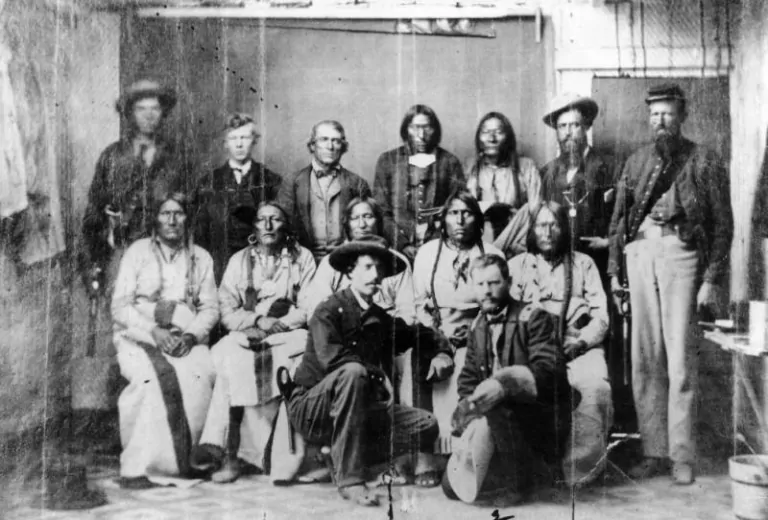
Silas Soule, front right, had been at the Camp Weld gathering in Denver in September1864 where tribal representatives believed they had been assured protection if they stayed in a certain area of southeast Colorado.
Colonel John Chivington had other ideas. He was a hero from an 1864 Civil War battle in New Mexico. He had been at the peace negotiations that September. But perhaps hoping to embellish his reputation and win a seat in Congress, Chivington set out from Denver for Fort Lyons, near today’s Las Animas. There, he detained anybody who he thought would interfere with his plans.
Marching overnight, Chivington and his men arrived at the Sand Creek encampment at dawn. The natives had hoisted the American flag amid their teepees, but it did them no good. A triumphant Chivington and his men returned to Denver hoisting scalps. They were welcomed as heroes.
Some saw them otherwise. Soule and Cramer, horrified by what they had seen, wrote impassioned letters to their commanding officer, Major Edward Wynkoop. The Army held hearings several months later. Soule did not live long enough to be fully vindicated. He was assassinated in Denver the next April. Both Soule and Evans are buried at Riverside Cemetery, north of downtown Denver.
Among many accomplishments, Evans helped found both Northwestern University in Illinois and the University of Denver. In 2014, both universities commissioned reports examining the culpability of Evans in the massacre. The Northwestern report was slightly more restrained, but both found Evans bore responsibility for helping create the circumstances. More than any other political official in Colorado Territory, said the DU report, Evans “created the conditions in which the massacre was highly likely.”
Soule’s grave is marked by a simple white tombstone along with other veterans. The grave of Evans is large and imposing. Last Memorial Day I found flowers, a flag and a testimonial at the grave of Silas Soule. Others had visited, too. As for the tombstone of Evans, I saw nothing. He had remained silent in 1864 when leadership was needed.

- Three glimpses of pivots underway in Colorado - January 4, 2026
- Oh, the irony of Craig No. 1! - December 31, 2025
- Rising temperatures, declining flows and the White River - December 25, 2025





Bravo Mr. Best for asking the painful question about our complicity in the President’s conduct. I am shamed by Donald Trump’s disregard for the law. Thanks for speaking out.
Yes, thanks for speaking out. All the more so in light of the current finger pointing within the administration about the illegal killings off the coast of Venezuela. Our country needs more moral discussion and guidance not less.
With regards to the murders in the waters off Venezuela it must be noted that most of the drugs flow into the US via the Pacific side. It’s a pretext. Few reports mention this fact, or the big prize, the Venezuelan oil reserves. The pretexts in the genocide against the natives in the Colorado Territory were different, but the aims were similar.
A thoughtful piece on Soule vs. Chivington, Crow and Kelly et al vs. Trump (and Hegseth, unmentioned). Thank you for that.
When US soldiers deplaned in Vietnam during the war, we were given two cards roughly the size of playing cards. They described the rules of war, based on the Geneva Convention. The grunts who committed the My Lai Massacre clearly did not abide by those rules.
Post WWII, Nazis were tried at Nuremburg for war crimes. They too followed what were later determined to be illegal orders. I believe that the Nuremberg trials helped inform the current Military Code of Justice, which some level of soldiers appear to have broken when they fired on those two unarmed boat survivors. The question is, how far up the food chain will this inquiry go? Expect a coverup.
None of the higher-level Army officers who were clearly involved in the My Lai Massacre were ever actually tried; the only officers tried were Captain Medina (acquitted) and Lt. Calley (guilty; then pardoned).
Steve, I think it is important for readers to know that you are a veteran of the Vietnam War and that your service was on the front lines. I also wish to mention that I believe you will be soon issuing a “docunovel” based on your time in Vietnam, and that at least one reviewer believes it is very much worth reading once it is published and on book shelves.
Great article and important to tie Crow’s support for the letter emphasizing the military’s duty to the Constitution and not anyone issuing illegal orders to Silas Soule and his actions at Dand Creek