One legislative bill proposes tax breaks. Another says data centers must have 100% clean energy. Part I of a series.
By Allen Best
In 2024, a state senator introduced a bill in the Colorado Legislature that proposed to bestow data centers and other large-volume users of energy with tax incentives. The senator, a Democrat from Adams County, probably expected bipartisan support. It was, after all, an economic development bill in the tech sector. Colorado loves high-tech, and Gov. Jared Polis constantly trumpets economic development.
A year before, it might have moved quickly. This bill never even made it to committee. Colorado’s political and energy landscape had changed. A similar bill in 2025 proposing sales tax incentives for data centers, this time with different sponsors, survived its first committee but was torpedoed in an appropriations committee. By then, Colorado had arrived at the sticky financial situation — where it remains.
Data centers have become controversial. Some see them as a golden opportunity to produce high-paying jobs and new tax base for local jurisdictions. Others see data centers and artificial intelligence as necessary and even useful in solving some of our knotty problems— but only if carefully regulated to avoid unintended consequences.
Sharply differing views can be seen in two bills in this year’s legislative session.
HB26-1030, titled Data Center & Utility Modernization, will first go before the House Energy and Environment Committee. As with last year’s failed data center bill, it proposes incentives that a national lobbying group called the Data Center Coalition insists must be available if Colorado wants to attract data centers. It would award 100% exemptions from state sales and use taxes to data centers who have invested a minimum of $250 million within five years. This exemption period lasts 20 years from certification.
This bill tips its hat at the growing opposition by requiring modest efforts to achieve energy efficiency and water “stewardship.”
The bill’s sponsor, Rep. Alex Valdez, a Democrat from Denver, chairs the committee where the bill will first be heard. Another sponsor, Rep. Monica Duran, a Democrat from Wheat Ridge, is the House majority leader.
Given that Democrats comprise a large majority on this committee, will this bill then sail through? Not so fast. Opponents planned to turn out in droves to testify against the bill.
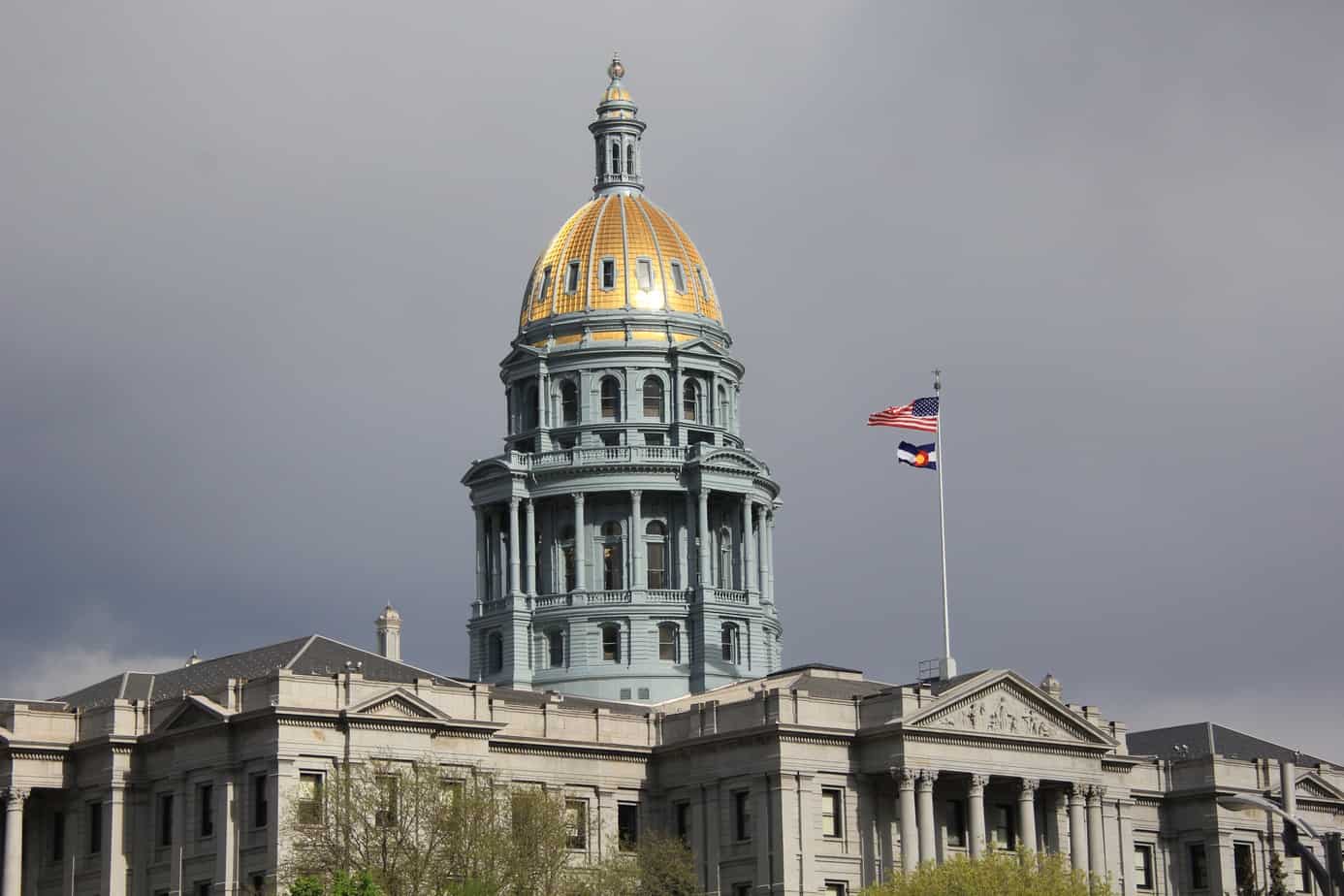
State legislators will be hearing pitches for two very different visions of what Colorado needs to best react to the challenges and opportunities of varioius type of large data centers.
A competing bill, SB-26-102, also has Democratic sponsors. Colorado’s data center debate is an intramural affair. Sponsored by Sen. Cathy Kipp, from Fort Collins, and Rep. Kyle Brown, of Louisville, this second bill offers no incentives. It says large-load data centers need guardrails. It insists that data centers cannot slow Colorado from achieving its greenhouse gas reduction targets. Indeed, it would impose a higher bar yet: 100% emissions-free energy for all new large-scale data centers.
The data center industry expects its need for electricity in the United States to reach 80 gigawatts by 2030, up from 25 gigawatts just two years ago.
Many other issues hover in the background. One is the growing power of tech giants who are directly or indirectly behind this rapid expansion of artificial intelligence. Do some of the wealthiest companies the planet has ever had really need tax incentives?
Fortune in December reported that data center spending had surpassed consumer spending in the U.S. economy — and suggested the spending could crash the U.S. economy. Many have speculated that this furious race to build data centers will collapse, not unlike the dot.com bust of 2000 or the housing bust of 2008, but on a larger scale.
Not least, could data centers play a role to prop up flat or even sagging rural economies, say Craig, or a farming town in eastern Colorado?
We’ve had artificial intelligence for several decades, and Colorado already has at least 57 data centers in operation or planned spread along the Front Range from Walsenburg (BlueSky AI) to Fort Collins (FRII Data Center). Most are in metropolitan Denver, and some are smaller, say 20,000 square feet. But even existing ones tend to larger dimensions. Thornton has a data center of nearly 300,000 square feet. The photo at top is of the CoreSite’s DE3 data center. The 180,000-square-foot now being completed sits at 46th and Race Street in Denver, a few blocks north of Interstate 70.
Hyperscale & humongous thirst
Now, we have entered the age of what some people call hyperscale data centers. Consider the QTS data center in Aurora. As seen from nearby Interstate 70 or E-470, it rivals Denver Convention Center in dimensions. It also has an enormous appetite for electricity, 177 megawatts, for activities under one roof.
One comparison is to Holy Cross Energy, the primary electricity provider for the Vail and Aspen areas. It has a peak winter need for 150 megawatts, declining to 100 megawatts in summer.
Loveland provides another yardstick. In 2025 it needed between 171 and 174 megawatts of electricity, depending upon the season, to supply 35,000 homes and businesses. It has a population of a little more than 80,000.
Three years ago, data centers were becoming big news in some parts of the country, most notably Virginia, Arizona, and Texas. Now, news media across the country carry stories almost daily.
Too, data centers are now being planned in what a couple of years ago would have seemed the most unlikely of places. The Economist in September 2025 noted that Stargate, a $500 billion AI-infrastructure project had begun in a part of Texas with lots of wind and solar energy — and empty space. In southern New Mexico, near Las Cruces, another humongous project was described by the New York Times in December 2025 with this headline: “A Mysterious Company Came to Town With $165 Billion.” The subtext told a broader story that likely applies far beyond New Mexico: “As wealthier areas are pushing back against huge A.I. data centers, speculators are pitching places like Doña Anna County, N.M, on their vision. Local officials are eager for a deal — even if they don’t quite know the terms.”
Something similar may be underway in Colorado. In Logan County, officials have talked with a data center developer about the possibility of a project that could ultimately produce $15 billion in investment between Sterling and the Nebraska border on land now used principally to grow wheat and other dryland and lower-value crops. Although nothing formally has been proposed, county officials indicated they believed that huge amounts of on-site solar generation would be part of the plan.
See: “Growing microprocessors instead of wheat?” Big Pivots, Dec. 16, 2025.
Weld County is also reviewing the potential for a data center that may yield investment of $2 billion to $20 billion located partially on the former Kodak site in Windsor. See: Denver Business Journal, Feb. 5, 2025.
Out of nowhere…
“It wasn’t on people’s radar screens three years ago. Now it’s the No. 1 issue in the country,” says John Gavan, a former public utilities commissioner in Colorado.
Gavan recalls perking up after first paying attention to Chat GPT in late 2022. By autumn 2023, he was alerting this writer and others to the QTS data center in Aurora, a semaphore for what he feared would become a flood with harmful consequences to Colorado’s clean energy goals.

The QTS data center in Aurora. Photo/Allen Best
A year later, in October 2024, Xcel Energy confirmed that a new era had arrived. In filings with the Colorado Public Utilities Commission, the utility predicted growth in electrical demand to accelerate five to six times what it had been over the previous five years. It said that large-demand customers, primarily data centers, would be responsible for roughly two-thirds of the new demand. It wanted permission to obtain a gargantuan amount of new generating capacity.
For many decades, the steel mill in Pueblo and the Climax molybdenum mine near Leadville were Colorado’s largest users of electricity. Both were and are customers of Xcel. Now, data centers will rival and perhaps surpass them.
The PUC commissioners conceded some of this new load growth, but not all. The central question was how much of this projected increase in electricity demand from data centers was speculative? The commissioners last year approved a much less — but still major — expansion.
Gavan has his own very early history with data centers. Around 1996, then living in Colorado Springs, he directed software development teams at MCI Communications. This was before cell phones.
Telephone calling cards were common. So was fraud. MCI was losing hundreds of millions of dollars a year in revenue. The software application that Gavan helped produce, called Sheriff, used a three-layer neural network to identify and eliminate fraud. Far more complex neural networks drive today’s AI products.
Sheriff was awarded a patent, and Gavan’s name tops the list of patent-holders. “This was probably the most fun I had in my working career,” says Gavan, whose earliest work included being a naval officer on a guided-missle destroyer.
Colorado is falling behind
Now, data centers are booming. Tech companies — most of them with well-known parents that include Amazon Web Services, Microsoft Azure, Google Cloud and Meta — are driving the proliferation of giant data centers.
Largest of the data center “campuses” is currently The Switch Citadel Campus at Reno with 7.2 million square feet. In Oregon, the Meta Data Center Campus has 4.6 million square feet. The Meta Hyperion Data Center in Kentucky has over 4 million square feet.
Incidentally, the information in the two preceding paragraphs was rounded up with aid of data centers, although who knows from where.
Gavan reported having breakfast recently in Paonia with a doctor. The physician had a difficult question involving science that he posed to Chat GPT. The AI — an acronym we have quickly adopted without explanation — spit out an enormously detailed response in 20 seconds.
Artificial intelligence, observed Gavan, “could touch every aspect of our lives today, both positively and negatively.”
Two years ago, Gavan began sounding the alarm about the need to provide guardrails. He could not find a Colorado legislator willing to throw themselves into the work. By last year, environmental groups in Colorado were thinking similar thoughts. Work began last summer on shaping the bill introduced on Feb. 11 by Kipp and Brown.
At a virtual news conference in late January, the Data Center Coalition’s Dan Diorio made the case for Colorado offering tax incentives similar to those of 37 other states. HB26-1030, he said, would provide the tax and regulatory climate to make Colorado competitive.
“Data centers are everything we do every day. It’s how we work. It’s how we learn. It’s how we communicate. It’s our bank and financial records. It’s our electronic health care records. It’s credit card processing, payment processing. It is everything from 911, geolocation services and state and local governments to the fun stuff like streaming video and social media. It is the backbone of the 21st century economy,” he said.
Diorio went on to say that an average household now has 21 connected devices, everything from phones and laptops to smart thermostats, doorbells, and, in his case, an oven connected to Wi-Fi. “It’s all of us. It’s consumers and businesses. We are expected to generate twice as much data in the next five years as we did in the previous 10.”
What are we getting into?
The Data Center Coalition argues that Colorado needs to provide a red carpet now to enjoy the rewards of economic development in years to come. Diorio cited a PwC study issued in 2025 that showed that Colorado was an outlier in terms of data center hosting. “Colorado is falling behind. And despite having a strong technology ecosystem, besides having a strong workforce, available power, available land, the state is not yet a strong data center location.”
The battle lines, if you will, are not clearly defined in this debate. Proponents of the incentives bill have enlisted the support of the International Brotherhood of Electric Workers. Environmental groups helped write the guardrails bill.
Where will Polis come down on this? He hasn’t played his cards yet. Nor have many others with powerful voices at the Colorado Capitol.
This race to adopt artificial intelligence and machine learning has been compared to gold rushes of centuries past. Among them was the frenzy to cross the Great Plains in 1859 to create what soon became Denver. Others arrived later and just did fine.
“There are a lot of reasons why businesses want to come to Colorado, and tax incentives would be just one,” says Anita Seitz, of the Colorado Communities for Climate Action, a consortium of 45 towns and counties. “Before we provide such a generous giveaway to some of the most profitable companies in the history of the world, we need to ask why incentives would be necessary?”
Still others say this debate about soliciting data centers and erecting guardrails may be missing the far bigger story. They say AI has us on the cusp of change that we cannot yet fathom. Tellingly, three national writers— Peggy Noonan at the Wall Street Journal, and Maureen Dowd and Ross Douthat at the New York Times — last weekend devoted their columns to artificial intelligence. “Brace Yourself for the AI Tsunami,” said Noonan. “The most spine-tingling technology ever created,” said Dowd.
Few among us in late February 2020 could imagine that a month later we would fear for our lives by merely shaking hands with a stranger. With AI, are we on the cusp of change that momentous or more so?
Next in this series: Data center developers say they have figured out ways to cool their giant machines that require little to no water. Truth? What does Colorado need to think about now as it contemplates the potential for far more data centers?

- Xcel Energy gets a very big green light - February 19, 2026
- Data centers in Colorado, yes, but on what terms? - February 18, 2026
- Compromise is so terribly, terribly hard - February 17, 2026