
OK, the sun produces less in winter. But combined with storage and a major project near Cortez, it’s possible several resorts in SW Colorado could soon be powered by solar on some days.
by Allen Best
Come January 2030, four ski areas in southwestern Colorado could conceivably be supplied principally from solar, at least on some cloudless days.
0
Called the Valley Range Energy Park, the project proposed on lands east of Cortez calls for 125 megawatts of solar energy capacity supplemented by 62.5 megawatts of battery energy storage.
The electricity would be sold to the local Cortez-based electrical cooperative, Empire Electric Association, and three others in southwest Colorado.
Eric Eriksen, CEO of one of the participating cooperatives, San Luis Valley Rural Electric Cooperative, calls the project historic. By late 2029, he said, the cooperative expectsthe project to supply about 40% of its annual energy needs in the San Luis Valley. With other projects and sources, the cooperative expects to get 83% of its electricity from renewable sources by 2030.
In addition, his and the three other cooperatives estimate they will amass savings of more than $20 million over the life of the project.
The San Luis Valley cooperative serves Wolf Creek Ski Area, which matches 100% of its electricity use with renewable energy credits through a voluntary renewable-energy program.
Also promising to buy the solar power are two other cooperatives, Gunnison County Electric Association, which serves Gunnison and Crested Butte and nearby areas; and San Miguel Power Association, which serves Ridgway, Silverton, Telluride and other parts of southwestern Colorado.

Four electrical cooperatives are partners in the proposed Valley Range Energy Park near Cortez.
Ski areas at Crested Butte, Telluride and Silverton are powered by electricity delivered by these cooperatives. Keep in mind, the idea is not that there will be solar fields at the ski areas themselves. Rather, this suggests something that is plausible, the idea of ski lifts powered by sunshine.
Developer of the proposed project near Cortez is Accelergen Energy, a privately held developer of utility-scale battery energy storage systems and hybrid solar storage systems. It is based in Austin, Texas.
A little history puts this project into a broader, longer context. All four cooperatives are members of Tri-State Generation and Transmission, which 20 years ago had 44 members in Colorado and three adjoining states. At the time, Tri-State saw its future being a continuation of past trends. It wanted to build a coal plant in Kansas bigger than the last one.
Two member cooperatives, Delta-Montrose in Colorado and Kit Carson in New Mexico, dissented. They saw opportunities beyond coal. One small example: Delta-Montrose saw potential for local small-scale hydro. They — and in time other cooperatives — felt hamstrung by Tri-State’s policy that limited local generation of electricity to 5%.
As for the massive coal plant near Holcomb, in southwestern Kansas, Tri-State and its Kansas partner, Sunflower Electric, were frustrated by a veto from a Kanas governor. After about a decade, Tri-State and Sunflower prevailed legally. By then, it was a hollow victory. The cost of first wind and then solar had plummeted. With some hesitancy at first, Tri-State began exploring its alternatives. Too, like other utilities, it had ceased to believe that the future consisted of ever-growing demand.
Still, Tri-State’s pivot has been a difficult one. It has coal plants to retire and a shrinking membership. Two of its largest members, Brighton-based United Power and Durango-based La Plata, have been among several members who have left, and others have given notice of plans to leave. They found Tri-State’s pivot too slow, too inflexible and other options more attractive.
This solar project near Cortez testifies to Tri-State’s greater flexibility. It’s part of the Bring Your Own Resource, or BYOR, program. The program allows individual cooperatives to generate up to 40% of their own electricity. The 125 megawatts of solar in this project were among 310 megawatts in three projects involving eight members approved by Tri-State in 2024 in the BYOR program. Other projects and members have not been disclosed.
Tri-State has an additional policy, called 115, that allows cooperatives to provide an additional 20% of their own electricity. These two programs together allow members the flexible opportunity to source up to 60% of their energy.
Crucial, though, is the battery component, which gives Tri-State more flexibility about when it needs to deliver electricity to the cooperatives, said Alex Shelley, a communications officer for the San Miguel cooperative in Ridgway.
This is not the first solar project for any of the four cooperatives. In September, Gunnison County Electric commissioned a 975-killowatt AC, fixed-tilt solar array. Called Gunnison River Solar, the project is expected to produce enough energy to serve the equivalent of approximately 250 homes. This is in addition to the Gunnison County’s previously commissioned Oh Be Joyful Solar array near Crested Butte as well as electricity from the Taylor River Hydroelectric Project.

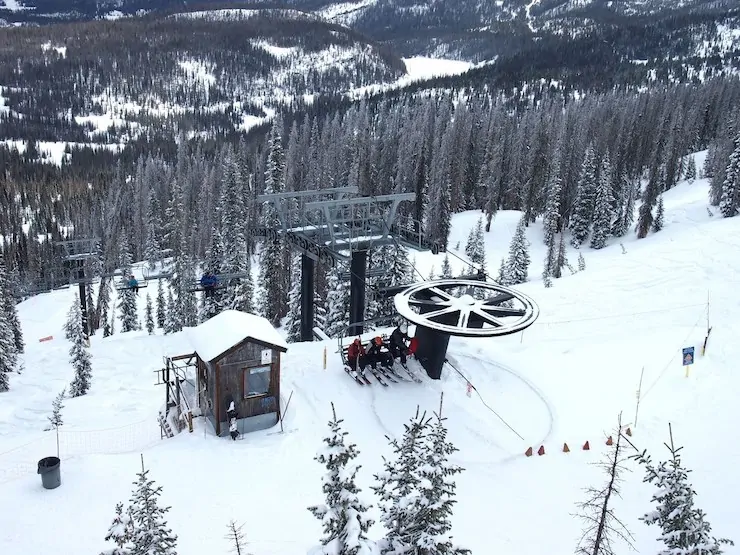
The Penitentte Solar Project has been producing electricity for the Wolf Creek Ski Area since 2017 as well as the San Luis Valley Rural Electric Cooperative. Photos/Wolf Creek Ski Area.
The San Luis Valley cooperative also has access to solar electricity from the three-megawatt Penitente Solar Project since 2017. Partnering in that 2.75-megawatt project is the Wolf Creek Ski Area, which also purchases renewable energy credits for wind power to enable it to honestly proclaim it is 100% renewable power. Here’s more.
The valley, with some of Colorado’s very best solar resource, also has several other solar projects, mostly north of Alamosa. Most of that power is exported from the valley via two transmission lines north across Poncha Pass. Much more could be developed — and several solar developers have projects in the queue. However, existing transmission is maxed out. More must be figured out. One potential transmission line east across La Veta Pass was blocked more than a decade ago by a wealthy landowner.
Eriksen points out that the solar and storage project helps Tri-State achieve the state mandate of 80% reduction in greenhouse gas emissions by 2030 as compared to 2005 levels. Based purely on its Colorado membership, he said, Tri-State expects to be at 89%. The renewables and battery storage also help the economics of his cooperative, reducing upward pressure on rates paid by the cooperative’s members.
For the Cortez-area project, proponents hope to secure approval from Montezuma County by December, allowing construction to begin next year. Proponents have been working with the local residents for two years. Montezuma County’s regulations governing solar were adopted a year ago based on recommendations from the National Laboratory of the Rockies, i.e. the former NREL, and three other counties, said Don Haley, the planning and zoning director.
The Monte Vista-based San Luis Valley cooperative has another forward-looking project underway. Thanks to a state grant, it is pushing forward on a microgrid anchored by a four-megawatt battery. This will be somewhere west of Center, the town that lies in the valley where the name suggests.
That amount of storage represents 4% of the total peak electrical demand. If a transmission line went down, that’s not enough to keep many of the valley’s 3,000 center-pivot sprinklers or the 14,000 wells pumping water. It can, however, help with crucial needs.
The microgrid batteries can also reduce what the cooperative needs from outside the valley at certain times. Eriksen calls this the value proposition. Storing excess electricity during days when the sun is out — which is most days in the San Luis Valley — and providing it at night delivers part of this value.

- Solar-powered ski lifts in Colorado? - October 14, 2026
- Unexpected voices in the national climate debate - October 6, 2026
- Electrical transmission and interstate highways - October 5, 2026

