Meteorologists say Colorado’s record temperatures in March were “anomalous.” Will we shrug it off, like so much other evidence of climate change?
by Allen Best
It was weird, it was wacky. This string of summer days in Colorado that arrived around the first day of spring was extraordinary. Will it change us in some fundamental way?
It’s not like 9/11, the day we saw people jumping from the skyscrapers in New York City to escape an even more cruel death by fire. We knew instantly that the world was different and in a very big way.
But doesn’t this anomaly deserve more than a shrug of the shoulders? As summer arrived in the last days of winter, I heard several people say, “Well, enjoy this nice weather” as you passed through their doors. A well-intentioned pleasantry but detached from a vital truth. Nice weather for Arizona maybe, but this was Colorado.
Winter had altogether been very, very warm. November was the third warmest November on record across Colorado. December the warmest. February also broke records.
Then came March. Alamosa, a town at 7,543 feet in elevation in Colorado’s San Luis Valley, notched 11 record highs during March going into the last weekend. This included nine in a row from March 18-26. Of special note was the record high of 83 degrees recorded on March 21. It broke the old record by 7 degrees. It also was a higher temperature than has ever been recorded in Alamosa in April.
Crested Butte had a high temperature of 68, a full 10 degrees higher than the old record for that date.
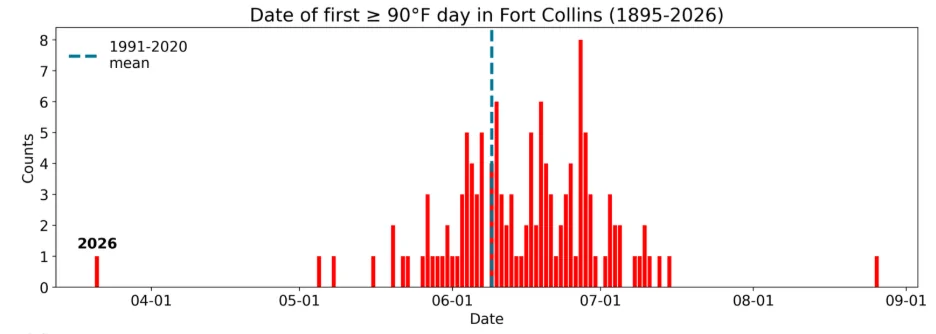
Fort Collins got to 91 degrees, also 10 degrees more than the old record for that date. It was the highest ever mark for March — but also higher than anything ever recorded in April, whose record remains 89 degrees. The average first day for 90 degrees in Fort Collins is June 15.
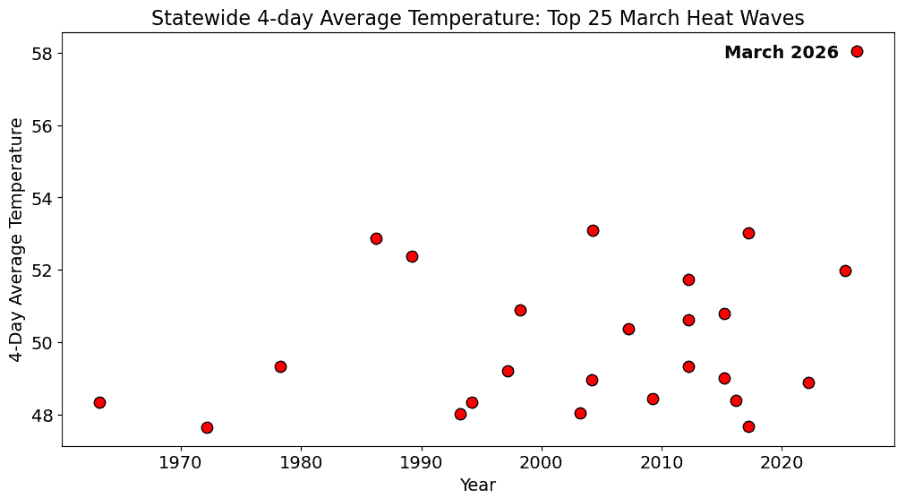
Allie Mazurek, of the Colorado Climate Center staff, posted a report on Thursday morning that defines in numbers what she calls an event “impossible to ignore.” Included in her presentationi s the chart atop this essay that shows how anomalous this four-day streak of heat was compared to others in Colorado during March.
This heat was nearly uniform across Colorado. “There were far more stations in the state that broke all-time monthly high records for March than did not,” wrote Mazurek. “To see monthly records shattered by more than 5 degrees F across numerous stations is truly remarkable. The kind of heat that we saw last week across Colorado is more typical of June or even July.”
Remarkable about theheat in Colorado was not only its intensity but its longevity across four days (March 18-21). “Over that period, several locations set new monthly records every one of those days, with each day being warmer than the last.”
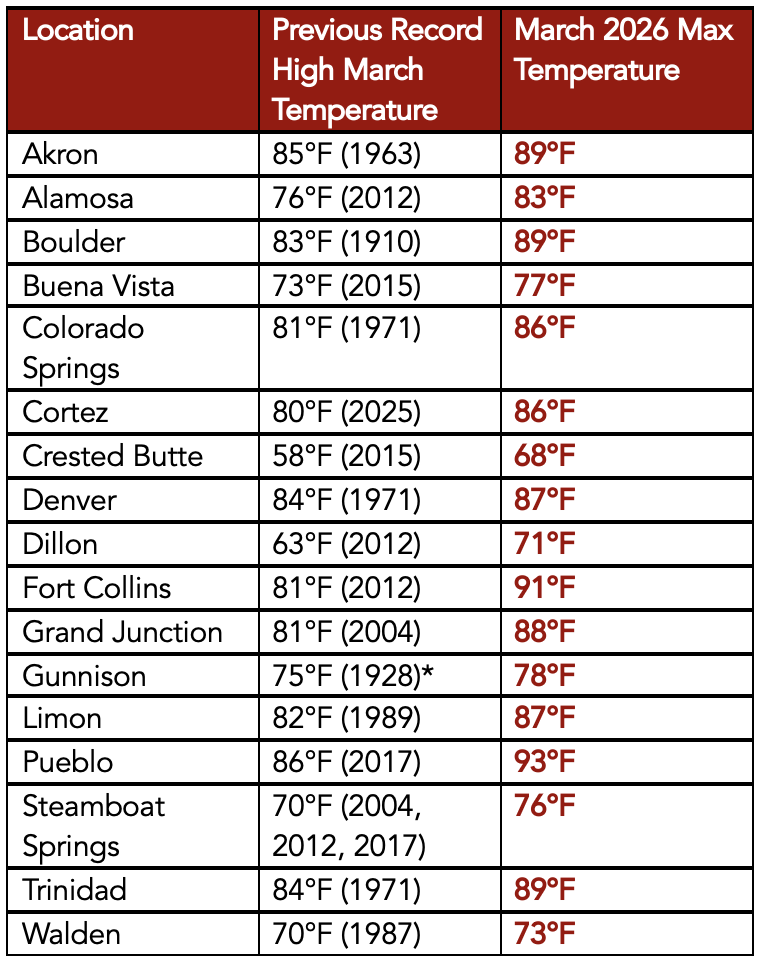
Chart is from the March 26 report by Allie Mazurek, of the Colorado Climate Center
This heat comes at a particularly bad time. The thin snowpack was already melting. The deepest snowpack in Colorado’s mountains has traditionally occurred in early May, because of accumulations at higher elevations.
That assumes a normal of some sort — although it is questionable whether “normal” has any true meaning given how fast the climate is now changing. So take this for what it’s worth: the statewide snowpack this past week sat at 38% of the 1991-2020 median. And what must be noted here — as with the temperature records that were broken — is that we have had an exceptional increase of heat in Colorado in the last 25 years.
Notable in the lifetimes of baby boomers in Colorado were the winters of 1976-77 and 1980-81. This year’s meager runoff will almost certainly surpass those dry years. New is the heat.
High-pressure heat domes can be predicted but are notoriously challenging to forecast weeks or months in advance. They also remain rare, but the warming atmosphere makes them more likely.
“We do have high pressures every year across the West,” said Mark Wankowski, a meteorologist at the Pueblo office of the National Weather Service. “This one was extremely early.”
Writing from Colorado Springs last weekend in an essay in The Atlantic titled “There’s No Way the West Will Have a Normal Summer,” Rebecca Boyle explained that the heat wave was created by a “a bizarrely strong ridge of high pressure in Earth’s atmosphere.” This ridge suppressed cloud formation and brought in warmer air. “Such atmospheric ridges are more common in the summer, but this one would be unusually intense even for that season.
Kaitlyn Trudeau, a senior researcher at the science nonprofit Climate Central, told Boyle this was the strongest ridge ever observed in March. Climate Central has developed a prediction model that assesses how much a warming trend or record high can be attributed to human-caused climate change. According to this model, the western high temps were five times more likely because of elevated greenhouse gas emissions.
I feel rattled by this heat. You may remember the high-pressure cooker that broiled the Pacific Northwest in June 2021. Temperatures spiked to 116 degrees in Portland. People in apartments that were not air conditioned died from the heat. In Multnomah County, the location of Portland, 72 deaths were attributed to heat. Farther north, in British Columbia, the town of Lytton went up in flames after several days of intense heat, including a temperature that reached 121 degrees Fahrenheit.
After that heat, the Colorado Public Utilities Commission asked Xcel to assess how well it could respond to somewhat similar heat in Colorado. The company concluded it had the resources.
But this week, in the wake of the intense spring heat, the PUC commissioners were clearly worried, part of a growing concern about “resource adequacy.” Will Xcel be able to meet critical electrical needs if another heat dome arrives in Colorado this summer? The commissioners asked Xcel to return with strategies for reducing demand from big industrial customers if demand for cooling spikes.
Curious about an on-the-ground perspective from this heat and sparse snow, I called Paul Bonnifield in Yampa. A drought map colors that part of northwest Colorado mahogany, beyond extreme drought and in the realm of “exceptional.” What did exceptional drought look like to him?
Yampa lies at the headwaters of the Yampa River, between the Gore Range and the Flattops. It has a bucolic setting, a place of hay meadows and grazing cattle. Lying upstream are a couple of reservoirs on the edge of the Flattops.
It’s not uncommon for snow to remain on the ground at Yampa, elevation, 7,900 feet, in late March. Not this year. “The ground is hard, just dry, dry, dry,” said Bonnifield.
Bonnifield grew up a few miles away at Phippsburg, a railroad town, and he worked on the railroad himself in addition to spending time teaching and writing at a college in Oklahoma. He’s now in his late 80s and can put this year’s anomalous heat and drought into perspective.
“We are in serious trouble,” he said. “I’ve never seen it like this before.”
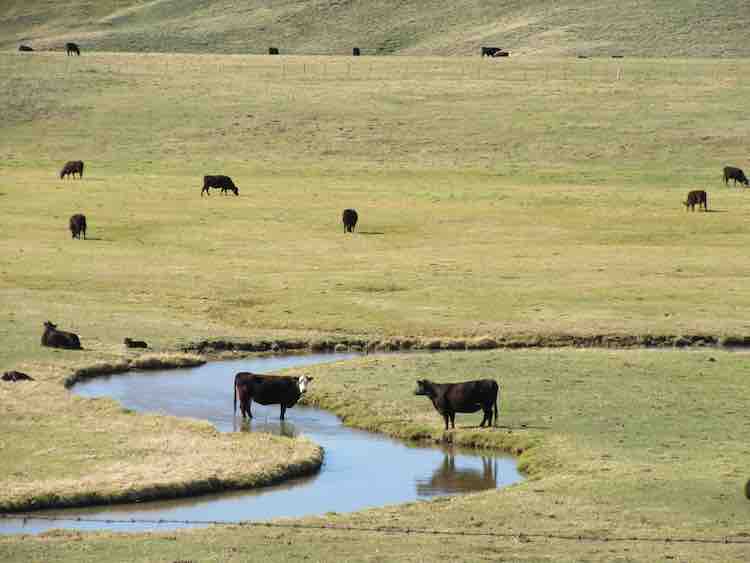
Less water will mean less hay production in Egeria Park, where this photo was taken about eight years ago.
Unless a miracle arrives in the form of spring rain and snow, ranchers in Bonnifield’s area — called Egeria Park — will have to decide what to do with their cattle. There’s not enough water to grow grass. There will be wildfire smoke besotting the sky, dampening tourism. And as for river rafting downstream on the Yampa – not likely. Steamboat Spring has already imposed watering restrictions for lawns.
Denver Water this week adopted lawn-watering restrictions for its customers in Denver as well as those in surrounding jurisdictions. It has 1.5 million customers, directly and indirectly, in the metro area.
Nathan Elder, the utility’s manager of water supply, reported to board members on Wednesday that snowpack levels are at historic lows and melting earlier and more rapidly.
Denver Water diverts water from rivers and creeks on both sides of the Continental Divide. In Grand and Summit counties, at the headwaters of the Colorado River, the snowpack was 53% of normal and the lowest on record for the date, Elder said. The South Platte River has it even worse, just 40% of normal.
“These are really unprecedented snowpack conditions,” he said at the meeting on March 25. During the previous week — the week of the heat dome —Denver had lost 25% of its snowpack in the areas it collects water, he reported.

Denver Water is asking the 1.5 million households and businesses that get water from the utility to refrain from starting to irrigate lawns, including this one in southeast Denver, until mid-May.
Can it get worse? Well, yes, it could. “It’s well documented that, in part, due to climate change, the runoff generated from a given snowpack has declined when compared to the past,” said Elder. “So we can expect even less water from this already low snowpack.”
Might a miracle arrive? After the drought and heat of 2002, metro Denver was stressed. Then, on St. Patrick’s Day 2003, three feet of snow fell. In the San Luis Valley, monster rainfall last fall swelled the Rio Grande, leaving water in the soil that will help even now as farmers begin preparing their fields for early plantings.
NOAA projects continued likelihood of above normal temperatures and below-normal precipitation across Colorado, including Denver’s collection area, during April.
Denver aims to reduce water use 20% by its customers in Denver and in outlying suburbs. It will permit lawn watering two days per week and then after 6 p.m. or before 10 a.m. It is also urging customers to refrain from watering their lawns until mid-May. That’s not an easy ask when it feels like June in March. In April, Denver Water’s board members will be asked to approve “drought pricing.”
Russ Schumacher, the state climatologist in Colorado, is called upon frequently to give programs to water organizations and others. This past week he gave a presentation to the Fort Collins Chapter of the Colorado Renewable Energy Society.
“Wildfire certainly is top of mind,” he said while showing a time-lapse video of a wildfire called High Park Fire that occurred west of Fort Collins in 2012.

Dry and hot temperatures leave Russ Schumacher, the state climatologist, apprehensive about potential wildfires this year. Above photo is from the Longmont area in August 2020, a hot and smoky year when wildfires continued almost into November. Photo/Allen Best
Global warming is a simple proposition, he said.
“If you put a pot of water on your stove you’re not going to be able to predict all those individual bubbles or exactly when it’s going to start boiling,” he explained. “But you know that when you turn that heat on, the water’s going to get warmer and it’s going to continue to warm the more heat that you add. So the physics of climate change is actually rather similar in that regard.”
And, of course, adding greenhouse gases to the atmosphere traps heat, which heats the planet. “When you add heat to something, then it warms.”
Colorado has had outliers of heat before. The Dust Bowl during the mid-1930s was a time of heat and drought. More hot and dry arrived in the 1950s.
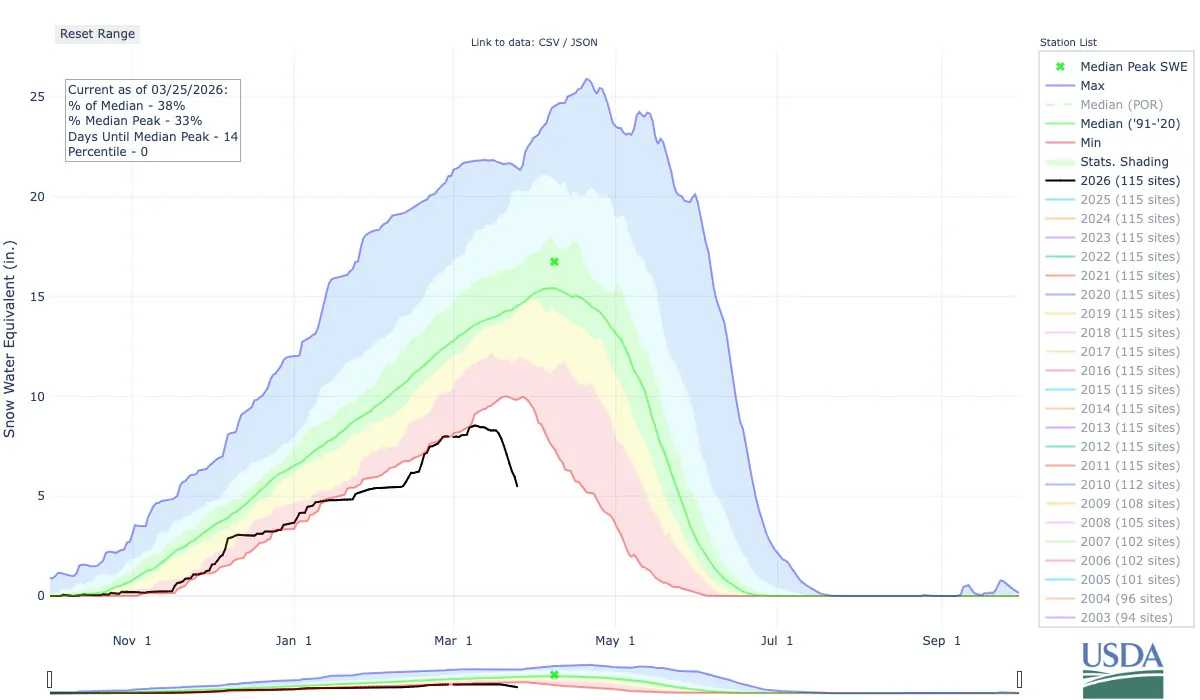
This chart shows snowpack in Colorado. The heat dome caused rapid melting of snow. In the San Luis Valley, heavy rains of last October may allow farmers to survive better than during 2002.
Dry has not changed. The hot has changed. What used to be an extremely hot year in Colorado is now a fairly average year or just slightly-above-average year, said Schumacher.
Citing NOAA data, Schumacher showed a sharp rise of almost 2.5 degrees Fahrenheit since 1980. The heat has been most acute in the summer and fall — although, obviously, recent months spoil that easy narrative.
With a moderate rate of emissions, we can expect another 2.5 to 3 degrees of warming by around 2050. That expectation comes with a disclaimer about uncertainty. It’s a best guess.
Precipitation has been more complicated than temperature in Colorado. As for the future, it remains a puzzle. Could be more, could be less. Either way, it will be impacted by temperatures.
“If it’s warmer, if it‘s windier, it’s less humid, the air is thirstier for water from the soils, crops, forests, reservoirs, wherever.” Schumacher said. “As it gets warmer, that evaporative demand goes up. The air is thirstier for water, and this has big implications for drought and water supply and water resources.”
Might warming occur more slowly? That’s possible, and a possibility tied strongly to whether global emissions of greenhouse gases can be abated. Given the current political climate in the United States, a key player in world politics, this low-emissions scenario looks highly unlikely. More likely are the heat domes.
Like the pot of water on the stove that Schumacher described, we’re certain to see more heat bubbles. Hard to tell where and when they will be, but there will be more of them. That leaves me distinctly uncomfortable. In Colorado I have felt 104 degrees. I cannot fathom the 118 degrees of Portland.

- What about this warm, wacky and very weird weather? - March 30, 2026
- Data centers, extreme heat, and the slowed retreat of coal - March 26, 2026
- Why big batteries are a Colorado game changer - March 25, 2026