
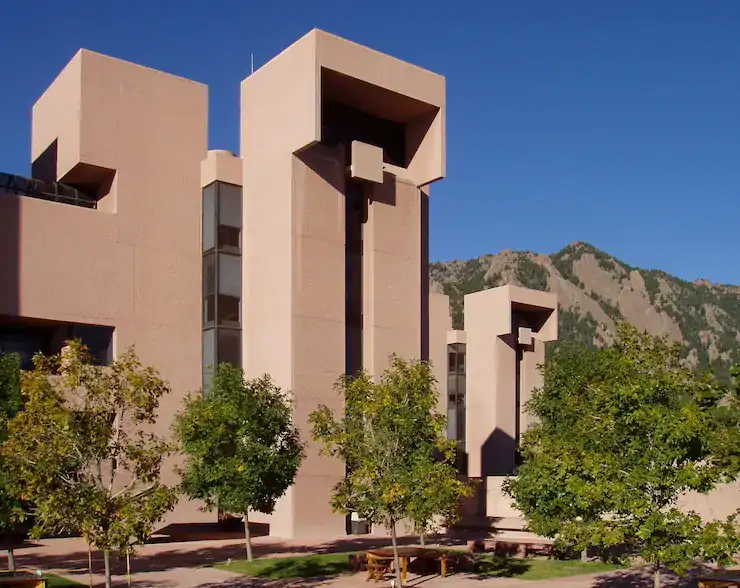
Trump official’s justification for NCAR dismembering flies against the evidence I have seen. But who needs facts?
by Allen Best
The news about the Trump administration’s plans to dismantle the National Center for Atmospheric Research broke on Wednesday evening. Ironically, just hours before, I had reviewed a story from earlier this year focused on research by Boulder-based NCAR.
Boulder was hammered by yet another hard windstorm in April, causing me to wonder whether the warming climate was causing stronger winds. The warming climate has substantially impacted the Colorado River Basin, making it drier and hotter. We must now figure out how to share less.
NCAR already had a wind study underway. It was a small, local-interest project, a question to investigate in spare time. The key researcher told me that the data was showing that Boulder’s notorious windstorms had actually abated somewhat in severity during recent decades. The data set was somewhat limited and compromised, he pointed out, because an anemometer at NCAR had been moved, perhaps impacting wind measurements. See story here.
Does that sound like climate alarmism to you? To me, it sounds like asking questions and looking for answers, the basic quest of science.
“This facility is one of the largest sources of climate alarmism in the country,” Russell Vought, the director of the White House Office of Management and Budget, wrote on X on Wednesday in explaining the plans to gut NCAR.
Too often in our political realm, we create a storyline and then comport the facts to fit that narrative.
Scientists ask questions and go looking for answers. The scientific process strikes me as slow and cautious. The facts often don’t fit into simple narratives.
Just this week, I interviewed a climate scientist about the Colorado River. Jonathan Overpeck had co-authored a study in 2017 that found hotter temperatures were responsible for at least half of the declined flows in the river in this century. They called it a “hot drought.” Less water was making it into the river.
But there were other questions lingering. What role did the warming atmosphere play in reduced precipitation, mostly snow, at the headwaters? New studies “strongly suggest” this cause-effect. Nothing in science is 100%.
As for the science at NCAR, the institution clearly has had a strong record of discovery since 1960 in its mission of atmospheric research.
“I was a postdoctoral researcher there at the start of my career, so I am not exactly an unbiased source,” said Russ Schumacher, a professor in the Department of Atmospheric Science at Colorado State University, when I asked his reaction.
“But perhaps that underscores the point: Nearly every atmospheric scientist interacts with NCAR in one way or another over the course of their career, and it has been the launching point for major advances, and for many scientific leaders across industry, research, education, and beyond. ”
Even Roger Pielke Jr., who has criticized some climate scientists for straying from scientific rigor into activism-tinged science, said Trump had gone too far.
What exactly motivated this dismembering of a scientific institution that has operated since 1960? Does being in Colorado have something to do with that decision?
There has been abundant speculation that the Trump administration wants to punish Gov. Jared Polis and Colorado’s Democratic political alignment for refusing to play along with Trump’s false narrative that he actually won the 2020 election.
Trump’s fact-free narrative wove through Colorado in the case of Tina Peters, the former Mesa County clerk and recorder. A jury of her peers in Mesa County found her guilty of breaking Colorado’s election laws, compromising the integrity of our electoral system. Keep in mind that Trump won Mesa County with 67.5% of votes in 2020.
The president wanted her transferred to a federal prison so he could pardon her, as he has pardoned so many other election deniers convicted of crimes. Polis has refused. Among those urging him not to pardon Peters were several county clerks, including a clerk in Kiowa County, where 88% of votes were cast for Trump in 2020.
Again, maybe this sordid Tina Peters case had nothing to do with the NCAR decision. What I can say is that Trump and his team, more so than president in my life, specializes in fact-free narratives.
After the news broke about NCAR, I asked about various people’s reactions. “Anger,” said one respondent. “Sad,” replied another.
“Ouch, this hurts,” said a woman in Colorado Springs who, as a grade-school student in 1987 had been helped by NCAR on a science-class project.
We need facts we can agree upon, and we need those facts to guide our creation of public policy. We are better navigating our path forward with open, not closed, eyes. Dismantling NCAR is one more way of closing our eyes.
Post script:
After this essay was posted on Thursday afternoon, U.S, Senator Michael Bennet held a press confeence where he had this to say:
“Let’s not forget that back in August, President Trump threatened, quote, unquote, harsh measures against Colorado if we did not release Tina Peters. This is political retribution. It is a coordinated attack against Colorado and the rule of law. Colorado has been a leader in standing up to Trump’s blatant corruption … and we have refused to bend to his will. But when President Trump doesn’t get his way, he weaponizes the federal government to punish states, and now Colorado is that state that he’s put in his cross hairs,” he said.
“We’ll use every tool at our disposal to fight back against this reckless political attack,” he concluded.
In response to questions from reporters, he declined to be specific about those tools might be.

- Unexpected voices in the national climate debate - October 6, 2026
- Electrical transmission and interstate highways - October 5, 2026
- Paleontologist to become next CEO of Denver museum - October 2, 2026


On NCAR, beyond sickening. Kudos to Polis for fighting back but left looking for any tools left in the box. Must fight back against this delusional king, even if lose the battle must aim to win the war.
Thanks, Allen, for your fine reporting.