
Temperatures 5 degrees above average. Precipitation 4 inches below.
With historically high temperatures, low streamflows and reservoir storage far below normal, Denver Water has decided that its 1.5 million customers in metropolitan Denver must end lawn watering on Oct. 1. Hand-watering of gardens and trees will still be allowed.
Until then, the mandatory restrictions in place since April will remain in place: morning and evening hours two days a week.
“The drought afflicting the Denver region and its water supply system has only worsened over the course of the summer, making it clear that we need to take additional steps in response,” said Tyrone Gant, president of the Denver Board of Water Commissioners.
“Formally ending lawn watering Oct. 1 will help stretch our supplies, as we will be entering next spring with storage levels far below normal.”
Through July, Denver metro area has had its hottest year on record. Average daily high temperatures have been five degrees above normal and precipitation has been four inches below normal.
As of Monday, Denver Water’s reservoirs are 72% full. That compares with the historic median of 94% for this time of year.
In addition to the 700,000 residents of Denver, the water agency provides water to many suburban jurisdictions.
While the board’s Stage 1 drought declaration set a target for system-wide reduction of 20% below the five-year average in water consumption, prolonged hot and dry conditions have led to many customers using more water during their permitted irrigation days to keep trees, shrubs and landscapes alive, making the conservation target difficult to achieve.
With drought conditions ongoing, Denver Water staff projects that storage supplies could drop to 60% before the 2027 runoff season.
“Despite the blistering conditions, customers overall have reduced their water use this summer. But with a lack of precipitation and the hottest first seven months in the Denver region we’ve recorded, we must take this additional step,” said Alan Salazar, Denver Water CEO/manager. “It’s critical that our customers turn sprinklers off Oct. 1, so that we can extend our water supply.”
Last week, at the Colorado Water Congress summer conference in Steamboat Springs, there was some speculation in the hallways that Denver Water might need to reduce watering to just one day a week, as is the case in some other places in Colorado. Other jurisdictions, however, have imposed no restrictions at all, as The Denver Post’s Elise Schmelzer reported on Aug. 15. She reported that 13 communities that did not impost mandatory restrictions include Fort Collins, Pueblo and Boulder. Together, the 13 jurisdictions are home to more than 1.5 million people, about a quarter of the state’s population.
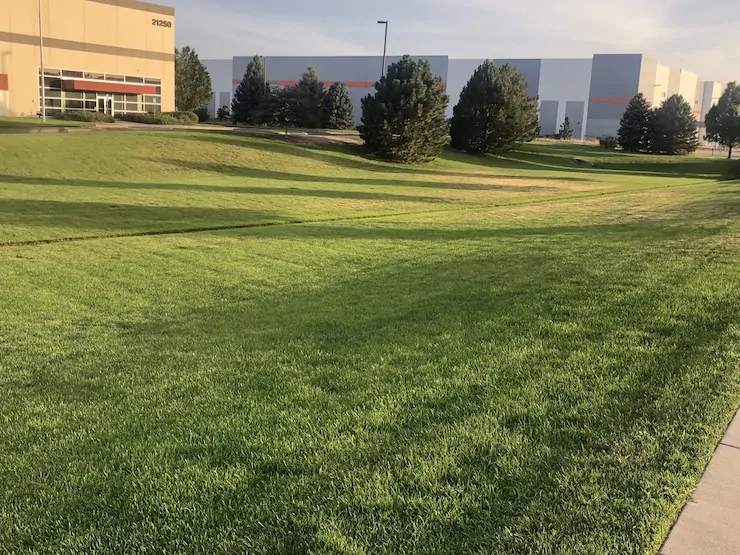
Aurora Water, which is independent of Denver Water, adopted restrictions paralleling those of Denver Water. The lawn outside a warehouse in Aurora seen in this photograph taken in August 2023 presumably is not quite as green this year.
The resolution approved by Denver Water commissioners also says:
- High-traffic, active-use grass areas, such as parks and school fields, may only be watered after Sept. 30, under a Denver Water-approved water budget or variance. Additionally, recycled water users can continue to irrigate any day of the week, following the standard watering rules, as they are relying on reused water supply.
- Trees, shrubs and perennials may be watered any day with a hand-held hose with a shutoff nozzle or low-volume, non-spray irrigation (such as a drip system). They may not be watered by spray irrigation.
- Annuals and vegetables may be watered any day with a hand-held hose with a shutoff nozzle or low-volume, non-spray irrigation, until the first frost. They may not be watered by spray irrigation.
- Grass establishment is not allowed after Sept. 30, except under special circumstances outlined under an approved variance.
- An irrigation system may be operated for installation, repair or reasonable maintenance, so long as the system is attended throughout the period of operation and water waste does not occur.

- Unexpected voices in the national climate debate - October 6, 2026
- Electrical transmission and interstate highways - October 5, 2026
- Paleontologist to become next CEO of Denver museum - October 2, 2026

