

A few paragraphs in a Meeker newspaper triggered a legal brief supporting Boulder in Supreme Court case heard on Monday
by Allen Best
Four paragraphs buried in a story published by the Meeker Herald-Times during mid-June triggered the entry of several Colorado ranchers into the Boulder-Suncor case argued on Monday morning before the U.S. Supreme Court.
The Herald Times is the newspaper of record (and the only one) in Rio Blanco County, which is in the state’s northwestern corner. It’s distinctly rural. Cattle numbers vary by season, somewhere between 16,000 and 25,000. In all seasons they outnumber humans: 6,529 as of the 2020 census.
The newspaper story recounted a June 9 meeting of county commissioners. They heard about agrivoltaics from Longmont’s Byron Kominek (Jack’s Solar Garden) and their county attorney advised them on best legal procedures for setting meeting agendas. The new Colorado State University County extension agent had stopped by to say hello, and the state transportation director for the region delivered an update on highway plans.
In the story’s 32nd paragraph, news was delivered that the county commissioners had agreed to participate in an amicus brief in the Supreme Court case siding with Suncor and Exxon Mobil at a cost to the county up to $17,500.
“The outcome of this decision by the Supreme Court will affect 100 other cases across the United States, so we felt that it was well worth our time and money to try and do the right thing,” explained Commissioner Doug Overton of why Rio Blanco County should add its name to the filing by the Associated Governments of Northwest Colorado.
Deirdre Macnab later read that story at her nearby ranch along the White River. She had a different and visceral reaction as to what constituted the “right thing” in this case.
Unlike many of her neighbors in Rio Blanco County, who have family trees several generations deep, she had arrived in 2020 from Florida and, before that, Manhattan. She has her own Wikipedia entry, which describes her as an “American women’s rights and voting rights activist and sustainable agriculture rancher.”
Macnab decided other voices were needed from Rio Blanco County in this case.
“I called Boulder County and spoke to some of the attorneys there,” she related in a noon-hour session with students at the University of Colorado Law School on Oct. 1. “Would you be interested in hearing from some of the people who are involved in agriculture in the state?” she asked. Yes, they said.
“And it wasn’t very difficult to find a number of ranchers.”
One rancher, a veterinarian, lives near Grand Junction, Macnab told the audience in Boulder, speaking from a remote source.
“She is currently selling her herd of cattle because it does not make financial sense to try to feed her cattle hay through the winter because the heat and the drought this year was so extreme that she was not able to grow the forage that she usually grows. We’re seeing hay prices that have increased by more than 50%. This is just one example of many ranchers that I’ve spoken to.”
Another among her agricultural acquaintances, she said, has pigs near Hayden. “He said his pigs were dying of sunstroke, and he was facing the decision of having to go out of business because for the first time he was having to haul water at a cost of $2,000 to $3,000 a month.”

Meeker and other parts of the Western Slope have been warming at a faster rate than Colorado altogether. And Colorado, of course, has warmed rapidly in the last 125 years, particularly during the last 25. A map posted on the Colorado State University’s Colorado Climate Center website tells the story of temperature increases from 1895 to 2025 in shades of pink, orange and red. Far western Colorado from the San Juans north to Wyoming — including both Grand Junction and Rio Blanco County — is deep red.
Macnab began her comments to the law students with a description of the two wildfires in 2025 that afflicted Rio Blanco County. The Lee, the fifth largest in Colorado’s recorded history, and the Elk together covered more than 137,000 acres.
“I have a neighbor rancher,” said Macnab. “He had 60 cows that burned to death. I had another neighbor and close friend whose entire ranch burned, and she nearly lost her house. There were flame marks on her house. A number of ranchers lost miles and miles of fence.”

Kathleen Kelley in June explained to visitors the devastation of the Lee Fire of the previous summer. Photo/Allen Best
That good friend who nearly lost her house and a great deal of fence, too, was Kathleen Kelley. Kelley had grown up in Meeker and had been ranching since the 1980s, as her father had before.
Like Macnab, Kelley differs from many other ranchers in the White River Valley, where Meeker is located. She drives an electric car. As for the house that didn’t burn, it had triple-pane windows, a rarity everywhere, more costly but more energy efficient. In this case, the triple panes prevented heat from exploding the windows and allowing the flames to leap into the house.
Kelley was unusual in other ways, too. When still in her 20s, she had been elected a Colorado state legislator, the youngest ever female to do so. Now in her 70s, she retired earlier this year after a 20-year stint as a teacher in Meeker. She contributed an essay to Big Pivots in September after the death of Windell Berry. It can be found here.
Being retired, she told Big Pivots, she feels more freedom — and responsibility to speak out. She has had many opportunities in recent months. It began in an account in the The Denver Post last year about the fire. Then, earlier this year, the Trump administration refused funds to aid the ranchers of Rio Blanco County, an apparent case of spite against Colorado. An enterprising New York Times reporter, who had grown up in Colorado Springs, contacted her, resulting in a story in that newspaper this summer.
In recent weeks, she has in turn been contacted first by a reporter from Colorado Newsline and then by other reporters from Los Angeles to Washington D.C. They want to know about her involvement in the lawsuit. Recent days brought more mentions in publications such as Mother Jones and Grist.
Kelley was interviewed by a radio station in Boston in a report that was broadcast on Monday. The radio station also interviewed a county commissioner in Mesa County, which is on the other side of this fence.
These inquiries were not the result of a PR machine. Rather, it appears to have been a case of journalists reading each others’ stories. And it happened very, very quickly..
“I have been involved in a lot of grassroots efforts, but this one was was the least orchestrated one I have ever seen,” she said. It was, she added, not a message massaged by an advocacy group, but rather a group of ranchers saying what they had to say.
“For Colorado ranchers, climate change is not an abstract possibility, but a lived reality that is threatening the economic viability of a way of life that has been central to communities for generations,” says the amicus brief that was filed on behalf of the ranchers.
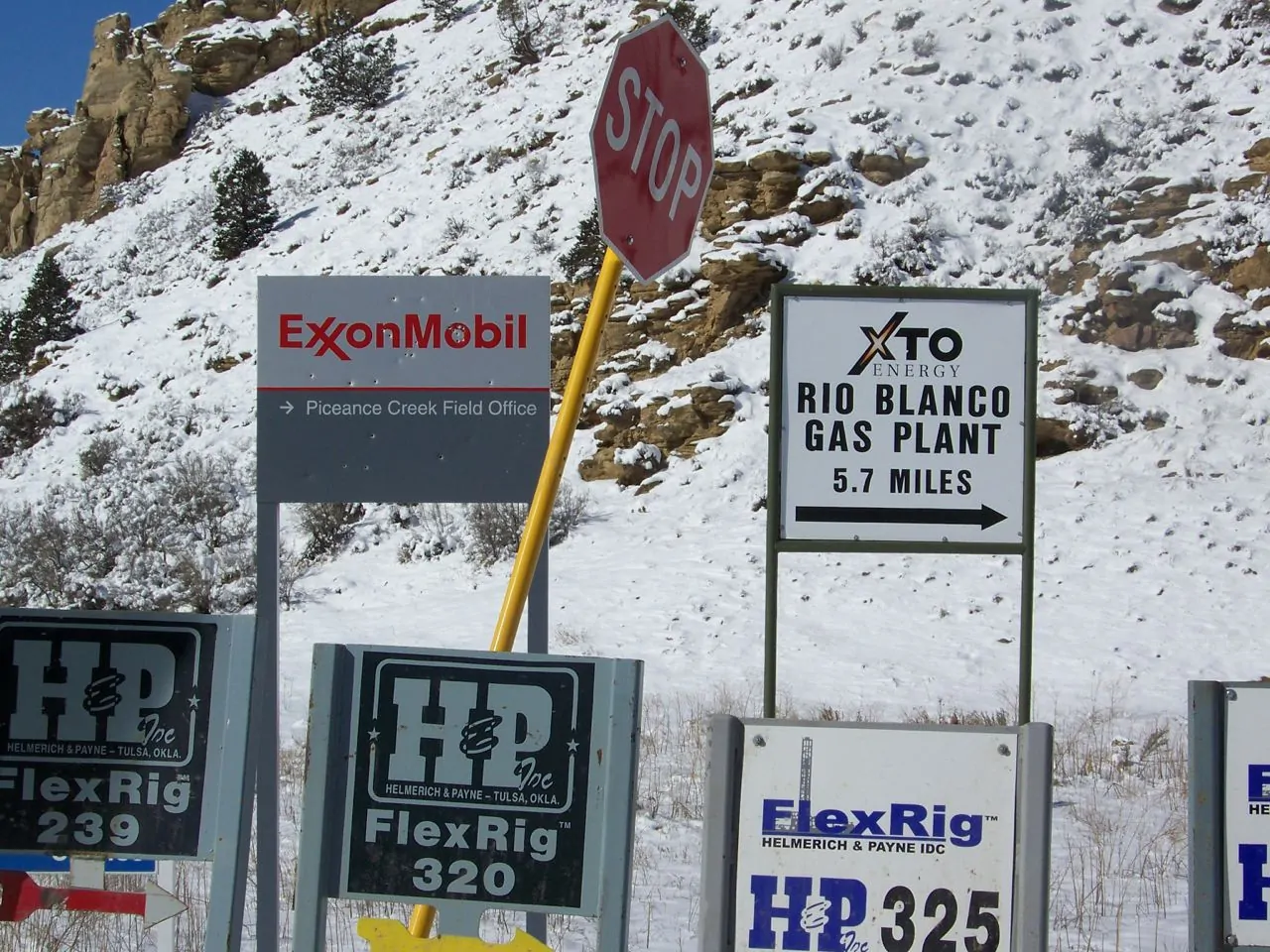
The PIceance Basin in Rio Blanco County was full of drilling rigs in 2007 when gas prices reached $14/million Btu before tumbling rapidly as the recession arrived. Photo/Allen Best
The brief filed on behalf of Rio Blanco County — the government, not the handful of ranchers — also includes seven other Western Slope counties: Archuleta, Delta, Grand, Garfield, Mesa, Montezuma, and Montrose. That brief argues that the economic interests of the counties would be harmed because they depend upon oil and gas extraction. In Montezuma County (Cortez), between 40% and 50% of county tax revenue has historically come from oil-and-gas production,” the brief says. “The potential impacts of this litigation on those counties are staggering.”
A clear exception is Grand County, which has virtually no oil and gas extraction. (This writer used to live there). Apparently, Grand County is just along for the ride.
The Suncor-Boulder case fundamentally involves climate change, although the specific question before the Supreme Court is over jurisdiction. Boulder and Boulder County (and on the coattails, San Miguel County) sued Suncor and ExxonMobil in 2018, claiming monetary damages resulting from warming and other climate changes caused by greenhouse gas emissions. It cites floods, heat and drought.
This filing was in Colorado courts. The fossil fuel companies tried to get the case moved to federal court, but the Colorado Supreme Court ruled in 2025 that the state courts do have jurisdiction. Suncor, ExxonMobil and their supporters want the Boulder case — and dozens of others like it from elsewhere in the country — decided in federal courts.
Lawyers from the law school in Boulder at the noon session last Thursday sorted through the legal twists and turns of this case in the noon-hour session. It’s complicated.
“You may be experiencing what I’m experiencing, which is kind of a Kafka-esque disorientation of confusion,” said Chris Winter, executive director of the Getches-Wilkinson Center at the University of Colorado Law School. The federal government, he said, wants to have it both ways. It is arguing that this is a federal case while it also says it has no statutory authority to regulate greenhouse gas emissions under the Clean Air Act.
“So that’s awfully confusing. I’m confused. I know a lot of you are confused as well.”
The New York Times, in a report published Sunday, said critics had called the federal government’s position a paradox. “The federal government is trying to get out of the business of regulating greenhouse gases, while also saying it has sole authority to regulate greenhouse gases.”
Confusion continued into Monday morning’s two-hour hearing before the Supreme Court. The Times reported that at least two justices admitted to being confused at various junctures in what the newspaper described as a “complex dispute.”
The question arose whether the federal government could have it both ways. “As I understand it, the EPA has disclaimed the power to regulate greenhouse gases,” said Justice Neil Gorsuch. The Wall Street Journal also reported that questions from Chief Justice John Roberts suggested an openness to Boulder’s argument.
That leaves open some potential for a 4-4 vote next year, which would leave the case in the Colorado Supreme Court. Justice Samuel Alito announced on Sept. 28 that he would not participate because of his ownership of stock in oil and gas companies. In the case of a tie, Boulder would win the question of jurisdiction, leaving the case in Colorado.
The decision will likely not be delivered until next June, possibly July, according to the national reporters who camp out at the Supreme Court.
“The argument was harder to read than most,” said the Times’ Adam Liptak. “The three Democratic appointees were likely votes for Boulder, and Justice Kavanaugh was adamant in his support for the energy companies. But the remaining Republican appointees’ questions were more mixed, and Boulder needs only one of their votes to prevail in light of Justice Alito’s recusal.”
But, once again, it’s a complex case deep into the legal weeds.
In question, at least in part, is whether this case has parallels with the litigation against a handful of tobacco companies in the 1990s that ultimately yielded a $206 billion settlement. In this case, though, the sources of emissions are much more diffuse – and importantly, global. Too, as Gale Norton, a former attorney general in Colorado (and interior secretary in the Bush administration) told the New York Times, fossil fuels have benefited people broadly. The same claim for tobacco is a much more difficult case to make.
Bloomberg, in an Oct. 1 story, said that climate suits, unlike the tobacco suits, have had trouble getting off the ground. The Supreme Court closed one avenue, ruling unanimously in 2011 that states cannot invoke federal law to force utilities to cut greenhouse gas emissions.
Boulder has tried a different approach, filing in state law and using traditional tort doctrines in arguing the oil companies misled the public about the risks of climate change while simultaneously contributing to the problem by producing and promoting fossil fuels.
The Wall Street Journal, in an editorial, took a dim view of Boulder’s case. Boulder, it said, “cannot supplant Congress’s power to regulate commerce among the states. Tolerating Boulder’s raid would blow the Constitution’s doors open to laws like those in New York and Vermont that seek to raid U.S. oil and gas producers for alleged damages caused by global CO2 emissions.”
William Barr, the former attorney general, had something similar to say in a guest commentary in the same publication under the headline: “Boulder Has No Business Making Foreign Policy.”
Boulder’s suit, wrote Barr, “asks a state court to impose potentially enormous liability on selected American energy companies for their alleged contribution to a worldwide phenomenon. Yet the overwhelming share of the conduct at issue lies beyond not only Colorado’s borders but America’s.”
The U.S. Constitution, he said, does not allow state and local governments to make that kind of judgement.
These legal abstractions were largely absent in the remarks of Boulder and Boulder Count officials after the oral arguments before the Supreme Court. Instead, Mayor Aaron Brockett issued a statement that talked about “hotter summers and extreme heat, to drought, declining snowpack, worsening wildfire risk and devastating fires. And every time those impacts intensify, our community pays,” he said.
At her 2,000-acre ranch near Meeker, Kelley on Sunday pondered what connected her and the other ranchers who had filed the brief in August. Jay Fetcher, who has been profiled in Big Pivots, has a ranch northwest of Steamboat Springs, where he has continued the observations of his father, who since the late 1940s began noting the date of the last snow on the ranch. Snow has disappeared earlier over the decades — especially so this year. See: “Along the Elk River, earlier springs and more uncertainty.”

Cattle far outnumber people in Rio Blanco County, and when water is available — as it obviously was on this pasture near Meeker in August — the meadows can turn vibrant green. Photo/Allen Best
Another rancher, Mike Callicrate, lives in Evergreen but was a bull rider in his younger days and married a Kansas farm girl and has feedlots there. He has an opinionated website called nobull.mikecallicarte.com, where he inveighs against the “oligarchs and multinational corporations” of our food system.
The common theme among these and others who signed onto the brief, said Kelley, was a belief in regenerative agriculture.
Last week, reviewing the filings with the Supreme Court in this Boulder-Suncor case, Kelley noticed the date the oil companies had asked the U.S. Supreme Court to take the case — arguing that Colorado had no jurisdiction: Aug. 8, 2025.
That same day, she said, she and her family were evacuated a second time because of the Lee Fire, leaving her to wonder whether they would have a house to which they could return.
“On one hand these guys are evading responsibility and on the other hand is my family not knowing whether we will be able to afford the impacts of the Lee Fire on our property.
Kelley confides that she rarely cries, but she did when she saw that date.
“That was like a two-by-four with nails.”

- An astonishing year for heat in Colorado - October 23, 2026
- And what if Ken Salazar had become president? - October 22, 2026
- The miracle of soil and its challenges - October 21, 2026


Allen,
Excellent in-depth article on the Suncor v, Boulder Supreme Court case, explaining the twisted path and legal intricacies, with a great insight of the local climate issues, impact on farmers and ranchers.
Of course it reminded me of the massive, near one million acres of Nebraska ranchland that burned earlier this year, resulting in devastating lack of feedstock for cattle and the severe economic impact on the ranchers and their families.
This court case also reminded me of the mid-1980s asbestos court cases that resulted in a $50 billion ($155 billion in today’s dollars) trust fund being set up and funded by the asbestos building materials industry.
The long-term trust fund was set up as asbestos diseases have very long latency, trust fund paid out over decades as new cases surfaced.
Even now my wife and her sister get an occasional small check from that fund on behalf of their father’s estate who was exposed to asbestos during his time in the U.S. Navy and a long career with U.S. Steel.
At that time, mid-1980s, I was with an environmental engineering consulting company, and I was responsible for dozens of asbestos abatement projects, mostly schools, in Nebraska, San Francisco, New York, and here in Denver.
My main thoughts on the asbestos court cases:
1. The plaintiffs were unbeknown victims, not aware of the dangers.
2. It was done to them, no active participation on their own part.
3. A clear, well-established medical causation by certain asbestos fibers for mesothelioma.
4. Clear suppression of evidence by the asbestos industry for decades.
5. A long history of successful court cases.
6. Last but not least, it particularly affected young lungs, particularly in schools.
Perhaps the Boulder will one of many successful cases.
I will send you a couple documents I put together on this topic including a comparison to the oil and gas industry lawsuits.
Again, thanks, great article,
Robert
Mother Nature is telling us that she can’t handle the pollution from 8 billion people, but humans know better and refuse to listen.