
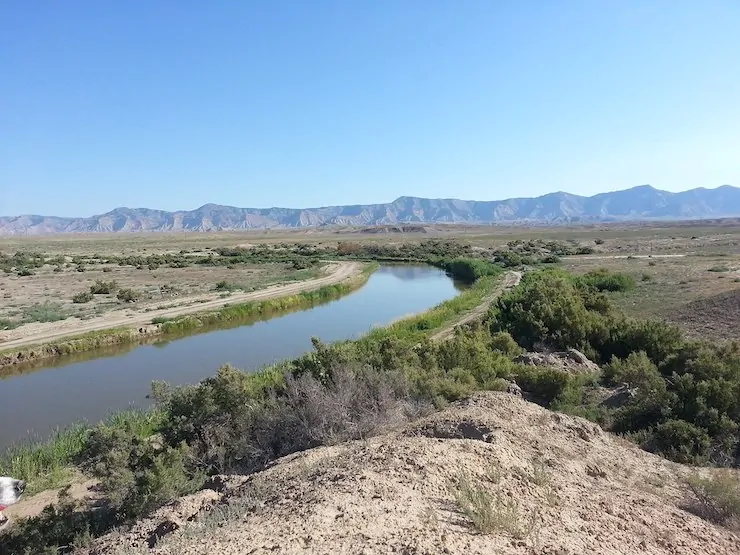
Farmers served by the Government Highline Canal as of today will get no water, a result of last winter’s dismal snowpack and low levels in Green Mountain Reservoir
by Allen Best
The Government Highline Canal has delivered water to farms in Colorado’s Grand Valley during irrigation season for more than 110 years.
Thursday will be a first in that long history. No water will be available in that canal to farmers, even though the growing season has not ended.
“This will be the first time since around 1914 the Government Highline Canal has been at undeliverable levels during the irrigation season, which usually runs until Nov. 1 (and sometimes later),” said Tina Bergonzini, general manager of the Grand Valley Water Users Association.
Water supplied by reservoirs upstream in the Colorado River headwaters has essentially run out.
The predicament on the Colorado River had become apparent by April. Record-breaking heat of March made it extremely likely that runoff would be anemic. It got a bit better in May, but not much.
This was clearly evident at Green Mountain Reservoir, between Silverthorne and Kremmling. The dam had been built between 1938 and 1943, as part of a quid pro quo. Farmers in northeastern Colorado, particularly in the Fort Collins-Longmont-Greeley triangle, wanted to divert water from the Colorado River headwaters.
Western Slope representatives objected. They worried that they would lose irrigation water they needed after spring runoff subsided in June and July. The federally financed dam was the answer. It can hold nearly 154,745 acre-feet of water. Of that, 66,000 is marked for delivery to downstream irrigators, most in the Grand Junction area.
Green Mountain was the quid for the quo of the Colorado Big-Thompson Project annual diversion of between 200,000 and 230,000 acre-feet through the Continental Divide.
It worked — until this year.
In April, the low levels in the reservoir made it clear that the farmers would not get the full amount of water they had come to expect. The Glenwood Springs-based Colorado River District created a plan to ease the shortage.
The district — which had been created to look out after Western Slope interests in the 1930s — looked into how it could tap various pools of water, getting a thimbleful here, a cupful there. Irrigators wouldn’t become whole, but they would get help, said Andy Mueller, the general manager of the River District at the board’s April meeting.
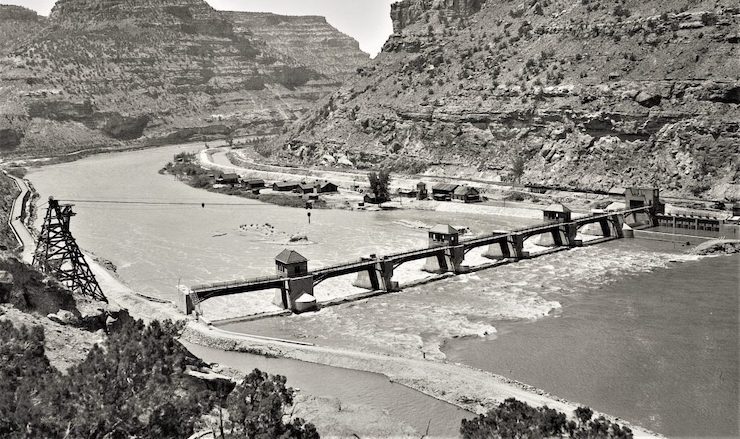
DeBeque Canyon has changed somewhat since this photo of the Roller Dam was taken in 1916. Most notably, now the canyon has an interstate highway. Photo/U.S. Bureau of Reclamation. Top photo: The Government Highline Canal, courtesy of Wikipedia.
Water for the Grand Valley Canal is diverted from the Colorado River at what is called the Roller Dam on the Colorado River just east of Palisade. It continues 55 miles down the valley, mostly north of I-70, ending near Mack, 10 miles from the Utah border.
The canal is called the “government” for a good reason. It was built with federal money via the U.S. Bureau of Reclamation, an agency created in 1902 to help turn arid places like the Grand Valley into gardens and orchards. Accounts vary about when the water began flowing in the canal. Some say 1913, others 1914 or 1915. Regardless, the water has always flowed since before the United States entered World War I.
Until this year.
Early in the irrigation season, irrigators benefitting from the canal agreed to curtail their water use in exchange for getting water from reservoirs near the Colorado River headwaters later in the season.
That sounds simple enough. The mechanics are complicated. Crucial to understand is the seniority of the “Cameo call” at the Roller Dam, where water is diverted. Upstream users have to honor that very senior call.
The call is for 1,950 cubic feet per second. Grand Valley’s Bergonzini said her district lowered the target by 300 cfs and then another 200 cfs, or 1,450 cfs. That left a little more water in Green Mountain. Altogether, the reduced water diverted from the Colorado — combined with the two storms during May — brought the amount of water available in Green Mountain up to 50% of the allotment for the Grand Valley farmers.
This story has endless details. The essential story is that those with rights to water on the Colorado River within Colorado — including a transmountain diverter, Northern Water — have worked with the irrigation district to ensure the farmers in the Grand Valley had some water during the growing days of summer. Water officials stress what Bergonzini calls “teamwork and collaboration between entities.”
Upstream reservoirs tapped included Wolford and Wiliams Fork, both near Kremmling, and Ruedi, near Basalt. An additional 5,000 came from Granby Reservoir late in the season.
Helping out were appropriations of $450,000 from the River District in April and then, in May, $585,000 from the Colorado Water Conservation Board.
Still, farmers dependent upon the ditch only got 50% of the water they normally would from Green Mountain.
Some of the teamwork involves Orchard Mesa Irrigation District. The Grand Valley and Orchard Mesa districts have an agreement to share shortages.

A short distance east of Palisade, water from the Colorado River is pumped up to Orchard Mesa. Photo/Allen Best
Orchard Mesa pumps water uphill from near Palisade to the mesa, site of many of the peaches for which Palisade is famous. Farther down on the Government Highline Canal, other farms grow alfalfa, wheat, and usually corn. This year, however, little corn was grown, yielding to Sudan grass, triticale, and barley, as they are shorter season and can be grown with less water, said Grand Valley’s Bergonzini.
Both peach and grape orchards on Orchard Mesa have done quite well, said Rob Talbott, president of the irrigation district’s board of directors.
The fundamental story, he said, is that “everybody is doing whatever they can to share their water.”
The sharing continues. The peach orchards need water now if they will be productive next year.
“The peach trees (primarily on Orchard Mesa) need water right now to get ready for hibernation whereas my growers (served by Government Highline Canal) can wait for a bit to water in winter wheat and hay. They crop switched earlier this year to shorter season crops, so we have different needs,” explained Bergonzini.
The canal is designed for flows of 730 cfs, not for the 100 cfs now available. As such, she said, it’s better to let the peach trees have the water now.
“Then, IF THE RIVER HAS RISEN SOME,” said Bergonzini, using all-caps for emphasis in her e-mail, Grand Valley will take Orchard Mesa’s irrigation water and augment it with what is available in the river to get some crops watered along the 55-mile canal.
That could happen at the end of September.
“We are planning on running late — perhaps the middle of November if the weather allows without freezing, to assure our growers get good moisture on their fall crops,” she said.
As for Green Mountain Reservoir, according to the Bureau of Reclamation, yesterday it was 14.8% full.

- A first in the 110-plus-year history of this canal - September 3, 2026
- Amid the y’alls, two themes at the Colorado Water Congress conference - August 31, 2026
- Another record for renewables in Colorado - August 26, 2026

