
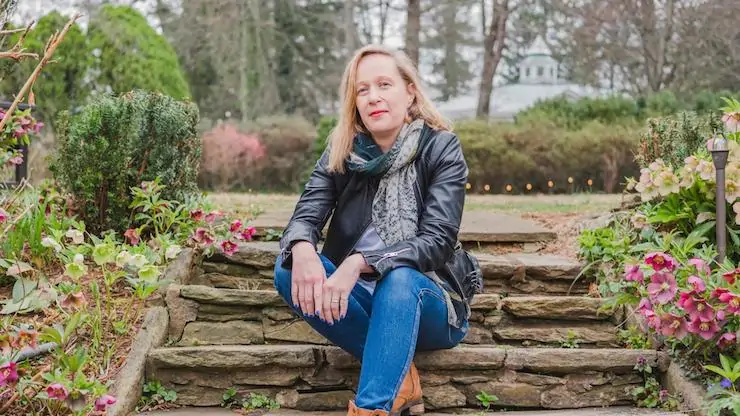
Author and former climate scientist at NASA tells Kansas audience why she sees hope as irrelevant and what courage looks like
by Allen Best
Kate Marvel, the climate scientist now associated with Project Drawdown, was scheduled to be the keynote speaker during late September at the Land Institute’s Prairie Festival.
Marvel wrote the acclaimed book, “Human Nature: Nine Ways to Feel about Our Changing Planet.” In reviewing the book in October 2025, Big Pivots described it as a “serious book that delivers frequent smiles, even some laughs. Plus, you get lessons in Greek mythology and physics, too.”
Weather got in the way of those best-laid plans for her travel from her home in New York City to Salina, Kan., location of the Land Institute. Improvisation carried the day. Taking the stage, the Land Institute’s Tim Crews, the chief scientist and director of the international initiative, prepared the audience for a telephone interview. An assistant placed old-fashioned desk telephone was carried to the podium. “Dd you know how to use this?” the assistant asked.
Then Crews pulled out a cell phone.
“Where are you? Do you need a shuttle?” Crews asked in mock confusion.
“I am in New York City, looking out of my window at the nor’easter ripping branches off the trees outside my window,” she answered in the phone’s speaker held close to the microphone.
“Oh my gosh! Of course you are. Well, how are you doing?
“I’m good. Would you like a long and boring explanation about how climate change is making nor’easters worse?” Marvel replied.
“Well, that would be a start. Yeah, we have time.”
Marvel declined that invitation other than to note that “Climate change is all well and good when it is an abstract thing that happens in computer models, and then it comes for you, and you don’t get to go see the prairie.”
Then came the serious questions. Following is a slightly abridged transcription of their conversation that, you may notice, at times dips into some smile-inducing irony. YOu can also watch the 30-minute segment on the Land Institute’s YouTube channel.

The Land Institute’s Tim Crews begins to pose questions to Kate Marvel by phone at the annual Prairie Festival held in September. Top photo, Kate Marvel courtesy of Project Drawdown.
You have recently written an acclaimed book, but it’s about feelings. Now it’s kind of weird to think of scientists having feelings, but why did you write a book about feelings?
Yeah, I mean the book kind of represents my coming out as a human being. I know it’s a really dangerous thing to say if you’re a scientist, because we are taught to be objective. We are taught that our credibility comes from the fact that we are these neutral science robots who don’t feel anything. But the thing is, like, I am an earth scientist, and that means that I have a conflict of interest because everybody and everything that I love lives right here on this planet.
So when you look at these climate projections and you see one where we keep this under control and we limit warming to well below two degrees Celsius, and then I see another one, and the Earth warms by six degrees and is functionally a different planet. I can’t pretend that I don’t have a preference, right?
I really struggled with that for a while. Then I kind of realized that oh, when we pretend we don’t have feelings, that is not making us more credible because that’s lying, and I didn’t really want to lie. Then I kind of realized that this divide between facts and feelings is just really stupid. Because you can feel stuff, you can feel the whole range of human emotions, and you can still do physics. You can still get the numbers right. There’s really no conflict between those things.
I am feeling pretty down right now about climate change in the world. Having just heard that President Trump, in his speech at the UN, claimed how people questioning AI are the exact same people who are raving about the hoax of climate change. But at the same time, in New York City last week was Climate Week. How are you feeling?
Well, first I want to say something that might shock your audience, which is that President Trump is wrong.
People are getting up. People are leaving right now.
How am I feeling? Two things.
One, I have been realizing that the most powerful motivator for me right now is sheer spite. I look at the people. I look at the people who are going to be happy if I give up, if you give up, if everybody in the audience gives up, and I think, “I don’t want those people to be happy. I don’t want them to have a good day.”
So I think that right now being able to carry that kind of world-class, stellar, gold-plated hatred right now is very, very, very useful.
Another thing that I am feeling right now is, if not hope, at least determination. Because I’m a physicist, right? We have established that it is hard for physicists to talk to normal people because we always want to revert to talking in equations and showing graphs. Which is great. I wish I was there. I would be showing you lots of graphs and equations. Everybody would get up and walk out.
The way that we define power in physics is actually, I think, the way we should define power everywhere. And the definition of power is that it is work across time. Right now the problems are getting worse, but at the same time the solutions are getting better. So I think the No. 1 solution, the only overarching solution to climate change, is to seize the power that we need to do good things. That’s not going to happen overnight, and that’s not going to be easy. That’s why I think of power as work over time. So let’s do it.
All right, I think people are ready here. They’re motivated, but there are some really deep questions about how we’ve gotten into this situation in the first place. At the Land Institute, we have a long history of talking about energy and our relationship to carbon. Is climate change an inevitable consequence of human nature or even organismal nature. I mean, is our drive to appropriate carbon, including fossil fuels, an evolutionary hangover? Are we hardwired like virtually all organisms through evolution to strive for getting energy, getting food, getting carbon, and that with our big brains in our hands, we’ve just gone overboard and done what almost any organism would do if it had the opportunity?
That’s a big question. I know, but it reflects something that we think about in relationship to why we’ve had such a hard time not reacting to the writing on the wall.
Well, thank you for that softball question. I really appreciate it.
Here’s the thing — and this is going to be a really long-winded way of saying I don’t know. But I think it’s important to talk about why I don’t know.
I do the easy stuff, right? I do physics. The reason that physics is easy is that it is the study of stuff that behaves itself. You know, if you look at a ball and I throw the ball, I know what’s going to happen to that ball. I know that it’s going to be acted upon by gravity and air resistance. So I understand the future of that ball because that ball can’t make decisions; it’s just subject to the forces of nature.
When you work on climate models, like I do, you work with things that are subject to the laws of nature, right? Water droplets, parcels of air. You can put those in a climate model, and you can say quite a lot about their future. So if I throw a ball in the air, I know what’s going to happen to it.
But if I were to pick up you and throw you into the air, I have no idea how you are going to respond. That’s because people are more complicated than that. Organisms are more complicated. That’s why I am terrified of biology. It scares me. It’s too hard for me.
So when we talk about human nature, that’s actually something that I don’t believe in. I don’t think that we are bound by these ironclad laws of nature, because I think we are more than just physics.
Regarding the question of carbon and fossil fuels, all I can really say is that right now we have a choice between two different ways of harnessing energy from the sun. One is we use sunlight to grow plants. We let those plants die with kind of the remnant of their last meals still intact. We wait 100 million years and then we dig them up and we set them on fire.
Or we could just directly capture the sunlight using solar panels, and the way that I think about fossil fuels is that they are just solar energy but stupid.
And I I think there’s room for conversations about how much energy do we need, and there’s room for conversations about how do we generate that energy because we’re not plants. We don’t have inbuilt photosynthesis — which, after all of these years as a scientist, I believe is magic. Photosynthesis just works by magic. You take sunlight, you make it into energy.
So plants have that option that works for them. They do it, but we as humans, we have choices about how we generate that energy and how much we use. Was that a nice long-winded way of saying I have no idea?
Or thank you for that physicist’s very honest response. It’s rich. It raises another question. Regardless of our relationship, our evolutionary relationship to carbon, how should humans think of ourselves in relation to nature?
Oh, great! Another softball question.
You know what? I really wrestled with this when writing the book, because I loved, when I was growing up, all of these nature narratives. I would read John Muir. I read (Peter Matthiessen’s 1978) “The Snow Leopard.” I read all of these books about people experiencing nature, and I thought they were beautiful. I loved the way that the natural world was described.
It was only when I was a little bit older that I realized that there’s something about those books that doesn’t really resonate with me, and that’s that they seem to think the best part of nature is the fact that it doesn’t have any people in it. You go to nature to escape the crowds. You go to nature to be alone, to be by yourself.
There’s nothing wrong with that. But I don’t think that the best part of nature is that it doesn’t have any of my friends in it. And then I kind of started thinking more about well, what is my relationship to nature? Well, I am not simply an unthinking part of it, but I’m not completely separate from it either.
So I kind of realize that the relationship that I want with nature, the relationship that I think is healthy for humans to have with nature, is kind of a constant renegotiation, a constant series of making choices.
And then I realized that is what you must do in every relationship. You always must be constantly in dialog, constantly figuring out what is the best thing to do. There’s never going to be a point when you can shut off your brain and say, “I’m not ever going to have to renegotiate anything. I’m not going to have to make any choices, and so that was kind of the conclusion that I arrived at. That is the way that I think about it.
But you know, I would really love your perspective as folks who are scientists but also are deeply connected to the land.
I’m thinking here now that I’ve been asked a question. I thought I was asking the questions, but I can say that your response is very well received. Nature includes humans, and we, as agriculturalists, see our procurement of food as being one of the most direct relationships with nature imaginable between humans and the Earth. Certainly, that motivates this work to kind of repair 10,000 years of eliminating nature when growing our food.
Yet we now find ourselves in a situation that 99%-plus of the energy required to grow food across the Midwest comes from fossil fuels. There was a time just a couple 100 years ago where it was close to zero, and there were a lot, lot more people on the landscape doing very arduous work, to kill all those plants every year and knock back weeds, go and get nutrients, do all of the things required to grow crops. And there’s people that look at this organization as basically trying to turn the clock back to that reality, especially as we advocate a reduction in that 99% fossil fuel dependency to grow grains.
It’s a little different. The conversation around growing vegetables is easier in some ways because humans have not been so radically displaced by fossil fuels, and so the population of the whole Midwest in rural areas reflects that level of dependency on fossil fuels. We recognize how hard it’s been for people to grow food in the past and why they would shift.
We do think that there’s a place for renewables, and photovoltaic-run batteries, biofuel batteries that can run tractors. We also think there need to be more humans, just like what you were saying, in relationship to nature and growing our food.
So this is a dilemma. It’s something that motivates our work (to create) an agriculture that actually can grow itself more, that can fertilize itself more, that doesn’t need replanting every year, that suppresses weeds, and that has a promise of a better life for a lot more people to inhabit this land.
That’s such a fascinating point. That essentially the landscape of the Midwest is a product of fossil fuels. I never really thought about it that way before, and it really kind of changes my perspective. I should say that I went to high school in Ohio, so the claim that Kansas is the Midwest is fighting words. Were you in the Big 10 in the 1980s? That’s the Midwest.
Well, now we’re getting down to the crux of the conversation. Just a couple more questions here. They’re kind of beach balls. The first is: Is there any hope?
I don’t like that question because for me, the question “Is there any hope?” is kind of like asking, “Do you hope you can clean the bathroom? “Like I don’t know. That’s a weird question. You know what to do? Just clean the bathroom, right?
When we talk about climate change, we know that we have so many solutions, right? Replace fossil energy with renewables, electrify our industry, grow our food in different ways, protect our forests and our seagrass meadows and our other ecosystems.
When you start to really dig into the solution set there are so many verbs: build, protect, steward. None of those verbs is hope. Almost everybody working in the climate space has a very fraught relationship with the word hope, because it’s so obvious to me that we know what to do. If hope helps us do it, so be it. But we know we have the answers already. We don’t necessarily need to hope.
If hope is not really germane, then it seems like courage might be. What does courage in this moment look like?
I wrote an essay years ago, arguing that we don’t need hope; we just need courage. I would probably amend that now to say courage is nice, but honestly, spite will get us a very, very long way. I do think that.
I have been honestly shocked by the full-scale assault on science that we are seeing right now. I, as a climate scientist, was fully expecting that they would come after us. But what I didn’t expect is that they would go after pediatric cancer research first. My dad has Parkinson’s, and he was due to start a clinical trial, and clinical trials were canceled because of this large-scale assault on science. It’s not just science. We are seeing attacks on journalism. We’re seeing attacks on history. Just like science, they are ways of finding the truth and telling people about it.
So I think right now it is extremely important to say no. It’s important to tell the truth, and even if the truth is we don’t know or we haven’t found that out yet, it’s important to say that because science has many flaws. It’s not the only system of finding the truth out about things. It certainly has excluded a lot of folks who are female, who are not white, who are not rich, throughout its history. But at the same time, I prefer science to the alternative, which is making stuff up.
What courage looks like, is standing up and saying no. We know what the right thing to do is.
As a kid, I read a lot of books in which there was a good guy and a bad guy. And then when I became an adult, I started reading books where the truth was far more nuanced, where there weren’t necessarily sharp lines dividing the bad guys and the good guys. Now, as an even older adult, I’ve realized that sometimes there really are just bad guys. I actually appreciate it that the bad guys are so dedicated to being bad about everything, because it does make it easy to figure out what the right thing to do is and to be confident in yourself that this is the right thing to do. So, props to the bad guys out there. Thank you for being so overwhelmingly evil.
Wow. We really, really appreciate this conversation. Before we wrap it up, though, I would love to hear if what’s on your docket going forward. Are you unemployed right now? What’s coming next?
I think you’re alluding to, I flounced out of NASA earlier this year because I got really sick of the political interference. All I can say is that if you’re going to quit your job, quit your job. I actually I had a lot of fun writing a very angry resignation letter. I still talk to my colleagues who are still at NASA. There’re still people holding down the fort doing incredibly good work.
Right now I’m on the outside. I work for a nonprofit called Project Drawdown, which is trying to evaluate scientific solutions to climate change and sort of figure out what the truth is, tell the truth, and then update that when new information comes in.
We have something called the Drawdown Explorer, which I feel no shame in promoting because I didn’t make it. It’s really my colleagues’ work, and I think it is the finest example of science communication I’ve ever seen. So I highly recommend everybody check out the Drawdown Explorer because it just lists all the climate solutions.
It makes me actually feel really hopeful, because it can be really overwhelming when you think, “Oh, to solve climate change, I have to confront the polycrisis and fundamentally reimagine my humanity in a system of blah blah blah. And actually, you look at it, and it’s like, “Okay, but get a heat pump.”
For me, the sheer boringness of climate solutions is incredibly comforting, and the fact that we don’t know how to get all the way doesn’t mean that we don’t know how to get started right now.
Well, Kate, I will let you get back to the storm. Is it raging right now?
It’s very nice to be inside right now, but we’re seeing these curtains of rain falling down, which we know that warm air holds more water vapor, about 7% per degree of warming. We know that there’s more water in a warmer atmosphere that can be dumped on us, and it is being dumped on me right now.
Okay. Well, stay dry, and thank you so much.
Postscript: For more on Marvel’s resignation from NASA in March, see also this March 25 account published by the New York Times.

- Kate Marvel on spite as a climate strategy - October 28, 2026
- An astonishing year for heat in Colorado - October 23, 2026
- And what if Ken Salazar had become president? - October 22, 2026

