

Manager of Colorado River District agreed to talk to farmers and ranchers in lower Arkansas River Valley. He had a reason.
by Allen Best
Rocky Ford has long been known for its cantaloupes, of course. Best in Colorado, and many places beyond.
Cantaloupe season is long past. So why was Andy Mueller willing to drive all the way from Glenwood Springs this week to speak at a water meeting in Rocky Ford?
The simple answer is that because Mueller, the general manager of the Colorado River Water Conservation District, was asked. The ask occurred last winter in the hallway of a conference center in Loveland where the Colorado Cattlemen’s Association was meeting. Mueller’s district includes much of Western Colorado which, other than the ski valleys, remains heavily agricultural.
Making the request was Jack Goble, who has an office in Rocky Ford, headquarters for the Lower Arkansas River Water Conservancy District. He was planning to stage the district’s first water summit, and he thought Mueller would be a valuable speaker, to lend perspective.
After all, they share a water source: the Colorado River.
Colorado has four water conservation districts, all of them created by state legislators. The Colorado River District was created in 1939 and encompasses 15 of the 20 Western Slope counties.
Southwestern Colorado also has a conservation district, as do the San Luis Valley and the Republic River Basin. They are charged with protecting and developing their water resources. In all cases, with diminishing river flows or, in the case of the Republican River Basin, declining groundwater levels, protecting is the operative word.
Conservancy districts, in contrast, can be formed by local communities, subject to approval of district courts. They are typically formed to build, finance, and operate local dams, reservoirs, and other water infrastructure. Colorado has more than 50 water conservancy districts, and sometimes there are several within the confines of a conservation district.
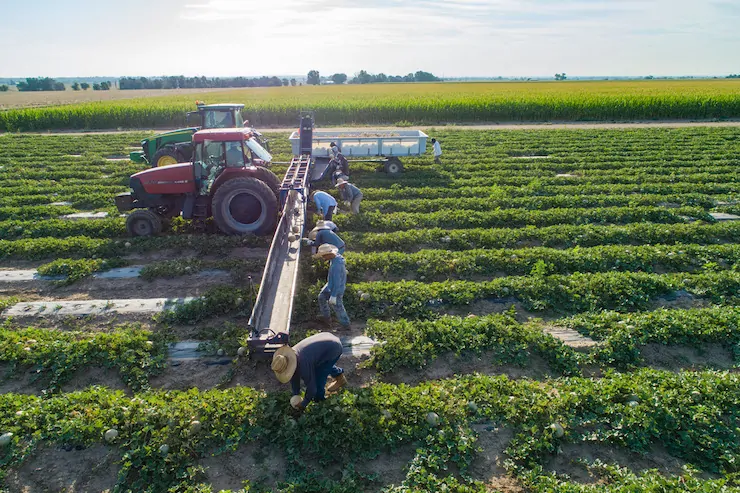
Cantaloupes gett harvested in lower Arkansas River Valley. Photo/LexNichols
The Lower Arkansas River Water Conservancy District was formed in 2002, a notorious drought year, but in response to what even then was a growing concern.
Since the 1970s, Front Range communities have looked covetously at the water flowing down the Arkansas River to be used for agriculture. Crowley County, located northeast of Pueblo, has become the post child for buy-and-dry. See above photo.
The cities — including Colorado Springs but also Aurora — have found willing sellers from among the farmers. But taken together, the communities in the district worry about being left with only enough water to flow into Kansas as necessary to meet the compact obligations governing the Arkansas River. That would gut their already thin and struggling economies.
The inaugural Ark Valley meeting drew maybe 150 people, reported Goble, including farmers and ranchers up and down the valley but many from outside the district. State Sen. Cleave Simpson, the manager of the Rio Grande Water Conservation District (and Senate minority leader), was there from Alamosa, as were Jim Yahn and Joe Frank from Sterling.
In creating this water summit, said Goble, the intent was to “help those in Lower Arkansas River Valley get engaged and informed on water issues, because it will determine our future, what happens with water.”
The Colorado River District holds similar meetings. The first was held in 2004 and attracted just a few dozen people. It now attracts about 300 to Grand Junction each September with dozens more watching remotely.
In Rocky Ford, Russ Schumacher, the state climatologist, spoke about the warming and mostly drying climate. Sean Cronin, manager of Boulder County’s St. Vrain and Left Hand Water Conservancy District, also spoke.
A highlight was the unveiling of a new interactive website called “When Water Leaves: The Story of a Buy-and-Dry in Colorado’s Lower Arkansas River.” The website is part history lesson, part polemic. It tells the story of how communities took root in the 19th century, how canals were built, how farms were created.
It also tells about how more than 100,000 acres of historically irrigated farmland have dried up in the five-county area from Pueblo downstream to the Kansas border. Of those, 40,000 acres dried up due to water that now goes to Front Range cities.
The StoryMap identifies 40,000 additional irrigated acres at high risk of permanent dry-up. Models provided by The Freshwater Trust estimate $184 million in lost economic output.
“One community should not be sacrificed for the growth of another,” said Goble in the press release that was issued concurrent with the meeting in Rocky Ford. “Colorado should not grow its cities by drying up the agricultural communities that feed them.”
The website is nifty. If you are at all curious about the Lower Arkansas River Valley, you will want to check it out.
The Arkansas River originates near Leadville. There, the flows of the river are augmented by several transmountain diversions, most of them small in quantity but two notably bigger. Largest is the Fryingpan-Arkansas Project, a federal diversion launched in 1963 to divert 55,000 acre-feet annually (on average) from the Fryingpan River above Basalt. The somewhat older Twin Lakes project diverts 38,000 acre-feet from the Roaring Fork River headwaters above Aspen.
Water imported into the Arkansas River Basin is prized because it can be used without having to deliver return flows into the river. In other words, it can in turn be diverted out of the basin to Aurora, for example, which can then recycle the water. Colorado Springs, too, can recycle the water.
These diversions use Colorado River water, which is where Andy Mueller comes in. At his district’s annual meeting in Grand Junction, speaker after speaker has laid out the science of the warming climate.

Andy Mueller, general manager of the Colorado River Water Conservation District, has used the district’s annual forum in Grand Junction as a way to convey the need for planning for a time of less water.
Mueller himself said two years ago that those who depend upon the Colorado River need to start planning for the day that it delivers only 9 million acre-feet. During the 20th century, it delivered an average 15.2 million acre-feet. In this century, the annual average has been 12.5. In recent years, it has fallen further to 10 million acre-feet.
The question then becomes: where will cities get their water? The simple answer is from agriculture, which uses 75% of the water in the Colorado River.
After returning from Rocky Ford, Mueller told me that his Western Slope district has policies focused on protecting agriculture, especially within its 15-county district. “But identifying the threat to agriculture in our state is really important,” he said.
The seven basin states have infamously come up short in agreeing how to address the reality of a river that is dramatically underdelivering what was assumed by the 1922 compact and the infrastructure subsequently built to deliver the water to farms, especially, but also cities.
Consider, for example, that two tunnels from the Colorado River headwaters (Roberts, from Dillon Reservoir, and Moffat, from Winter Park) deliver roughly half of Denver Water’s supply for its 1.5 million customers in Denver and suburbs). These diversions are junior to the 1922 compact.
If the disagreement between the seven basin states ends up before the Supreme Court, how will that court rule?
“There is a risk that the Supreme Court will disagree with us,” explained Mueller. “And because of that risk, I am concerned that water mangers throughout the state will need to go look for replacement water for their Colorado River Water.”
That gives the Glenwood Springs-based conservation district commonality with the farmers in the Lower Arkansas River as well as those in the Rio Grande Basin and the South Platte.
“I don’t want the lower Ark to be dried up, and I don’t want the lower South Platte to be dried up, and I certainly don’t want the Colorado Basin to be dried up,” said Mueller.
“I will also say this: The River District does its best work when it builds coalitions of like-minded partners, and I think the areas I just mentioned all have values very similar to the River District policies in terms of preserving agriculture. We are only impactful when we operate in coalitions.”
Mueller worries that the negotiations among the states will erupt into overt bitterness. “It will make the battle over the wolf reintroduction look like child’s play,” he said, referring to Colorado’s intra-state dispute.

- Why did Andy Mueller drive to Rocky Ford? - November 6, 2026
- How much delayed retirement for Xcel’s coal-burning unit? - November 5, 2026
- Crazy times in Colorado’s energy world - November 4, 2026

