
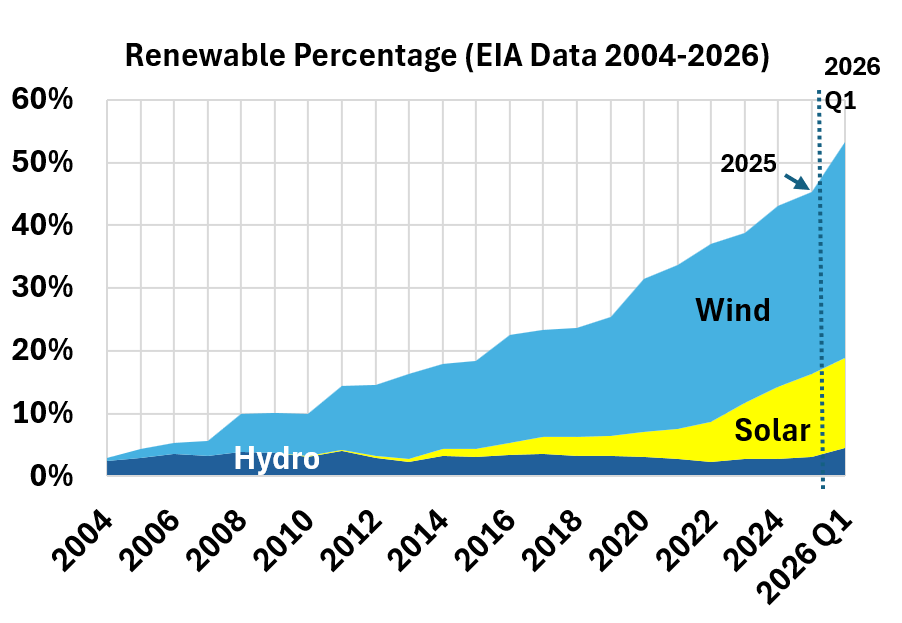
More than half the state’s electricity came from wind, solar and hydro during the first months of 2026. Higher levels yet are coming, but should 100% be the goal now?
by Allen Best
Colorado achieved an energy and climate milestone during the first quarter of 2026. During those three months, 53% of electricity in Colorado came from renewable sources, up from 43% in 2025, according to an Energy Information Administration report filed in May.
Ron Sinton, an entrepreneur in Boulder who alerted Big Pivots to this report, said he believes Colorado will end 2026 with more than 50% for the full year.
This 50% figure leaves much work for Colorado to do by 2050. The roadmap to much higher levels of renewables by 2030 is reasonably clear. Much of the wind and solar needed to get that far has already been planned and approved. It’s just a matter of execution. “No miracles required,” said Sinton.
Achieving the 2050 goal of 100% net-zero emissions set by state legislators will be a greater challenge. The technology exists today, but not at acceptable costs. Innovations in technology and perhaps economic models will be necessary.
As for this milestone, it is to be celebrated — especially for an idealistic scientist in the 1980s who had lived through the oil crisis of the 1970s and found solar electricity to be a technically interesting topic, said Sinton, speaking in a semi-autobiographical note.
A fourth-generation Coloradan, Sinton earned a Ph.D. in applied physics (solar cells) from Stanford University. In 1991 he founded Sinton Instruments, a company that creates and applies new tools to the development of manufacturing silicon solar cells.
Just 2.6% of Colorado’s electricity came from renewables in 2004, most of it hydroelectric from dams in the Colorado River Basin.

In his successful campaign for governor in 2006, Bill Ritter Jr. ran an advertisement in which he called for more renewables, using the backdrop of a wind farm in southeastern Colorado as the backdrop. His advisors wanted him to do a spot in which he was being friend with locals. Photo courtesy of Bill Ritter.
By then, a major wind farm was operating near Lamar, in southeastern Colorado. State voters were ready for more. They approved Amendment 37 that November, requiring Xcel Energy, the state’s largest utility, and other utilities with at least 40,000 customers to achieve 10% renewables by 2015.
Xcel spent at least $1 million trying to defeat the amendment, grumbled a bit, then set out to comply. Rapidly declining wind costs made that a relatively easy task. The price of solar followed a similar downward trajectory starting in about 2010. Aided by federal tax incentives renewables supplied 18% of Colorado’s electricity by the end of 2014.
Pivotal was the response to Xcel’s solicitation for new energy announced in December 2017. By then, the utility and others had learned how to accommodate larger and larger levels of renewables without imperiling reliability. The jaw-dropping bids by renewable energy developers gained national attention — and not just in the trade press. Soon after, Jared Polis announced his candidacy for governor. A central plank of his campaign was a call for 100% renewables for electrical generation by 2040.
After the election, state legislators in 2019 passed laws mandating that Xcel Energy, most importantly, and other “large” providers for electricity reduce emissions associated with power production 80% by 2030 as compared to 2005 levels. Further legislation delivered the same requirement to other utilities.
Chicken and egg
Sinton and others emphasize the pairing of economics and policy that enabled Colorado’s milestone. It also helps, said Sinton, that Colorado has abundant sunshine and, on the eastern plains, strong winds.
Chris Hansen, now the CEO of Durango-based La Plata Electric, a cooperative, was a state legislator who wrote many of the bills around goals for decarbonization of electricity and the economy altogether.“What was clear to us in the legislature from 2018 to 2024 was that the economics were improving year by year,” he said.
That has generally continued, despite recent price increases for renewables plus the reversal of federal policy support during the second term of President Donald Trump.
“Wind, solar and batteries are still the cheapest options in the marketplace,” said Hansen.

Grain elevators are the most notable feature of Amherst, in northeastern Colorado, a few miles from the Nebraska border, but Amherst will soon also gain lithium-ion batteries to help Highline Electric meet peak demands. Photo/Allen Best
Batteries, if still somewhat expensive, are having price declines similar to those earlier of wind and solar. They provide utilities with the ability to have reliable power with higher levels of renewables. (See, “Why big batteries are a Colorado game changer.”)
Will Toor, CEO of the Colorado Energy Office, has been a key engineer of this pivot. “To some extent, the policies were possible because the technology and economics were aligned,” he said.
In setting out to reduce greenhouse gas emissions, the Polis administration and state legislators chose to go after the electric sector first. That choice was both practical and strategic.
First, decarbonization goals had to be achievable. Electricity was the lowest-hanging fruit.
“As we were setting the emissions reduction targets for each sector (of the economy), there’s a reason that our electricity target was 80% by 2030 while (the target for the) oil and gas section is 60% and industry 20%,” said Toor. “We were looking at how quickly could you move in a way that really made technical and economic sense.”
Decarbonization of electricity came first for another reason. Low-emissions electricity could then be used to replace oil and gas. That obviously applies to electrification of transportation but also to buildings and other sectors.
Demand management is also part of the equation. For example, might we charge our electric cars at midday, as Sinton recommends. He points out that sometimes more than 50% of mid-day electricity in Colorado now comes from solar.
Where does Colorado rank?
As of 2024, Colorado ranked 13th in the nation in its percentage of renewable energy. It was easily surpassed by states with access to high volumes of hydroelectricity. For example, lightly populated South Dakota, with over 80% of its electricity coming from wind and the Missouri River dams, led the nation in percentage of renewables.
By another measuring stick, total volume of renewable energy, Colorado ranks 10th. Texas leads that category.
In still another category, that of former coal-dependent states, Colorado ranks higher, although it is not a leader. There, formerly coal-reliant Iowa stands out, now getting 60% of its electricity from wind.
Colorado has been in no danger of running out of coal, given its own reserves and the proximity to the Powder River mines of Wyoming and Montana. But coal-fired generation has become the most expensive option. And, as the breakdowns of Comanche 3 and of the Hayden units show, coal plants have their own problems with reliability.
Global trends are similar. Ember, a research firm that focuses on electricity markets, reported in April that for the first time in more than a century, renewables produced more electricity (34%) than coal (33%). Most of that new growth came from solar. Operating costs for solar have dropped by 90% since 2010.
The International Renewable Energy Agency reported that renewable power made up almost 50% of the world’s electricity capacity in 2025. It, too, cited a record increase in solar installations.
The Economist in April pointed to a reason for using local renewable energy. Once installed, solar panels and wind turbines work regardless of geopolitical turmoil, albeit not regardless of the weather.
What about Holy Cross?
Some may wonder about this fuss provoked by Colorado achieving 53% renewables when one of its utilities, Holy Cross Energy, achieved 85% during 2025. During select months, the Glenwood Springs-based cooperative has achieved 96% to 100%.
Holy Cross has been nimble under the leadership of Bryan Hannegan, the CEO since 2017. As Hannegan is first to note, Holy Cross has enjoyed a sweetheart deal since 1991 that allows it to import electricity across the Continental Divide at low cost using Xcel Energy transmission capacity. It previously used that transmission to import coal-fired electricity from Pueblo and now wind and solar from Colorado’s eastern plains.

Holy Cross Energy CEO Bryan Hannegan has guided the cooperative to 85% renewables but warns against pursuing 100% at the exclusion of affordability. 2020 photo/Allen Best
What also matters is its size. The electrical cooperative serves 60,000 meters compared to the 1.6 million of Xcel Energy or the 120,000 of another cooperative, United Power.
“I celebrate their success, but I also know that I have to solve this puzzle for La Plata in a different way,” said Hansen, whose directors in southwest Colorado more recently have adopted goals similar to those of Holy Cross.
“I think utilities are in a lot of different places in terms of where they are and where they think they’re going to be by the end of the decade,” said Toor.
Xcel, though, is the biggest by far, alone responsible for 52% of the state’s electricity sales.
“When you think about the near-term procurement that we did with Xcel Energy, where there’s basically four gigawatts of renewables and storage that will be built between now and 2028, we’re just going to see electricity getting cleaner and cleaner as these relative low-cost resources come onto the grid. I think that’s going to be key to enabling other sectors to electrify,” said Toor.
“Colorado’s reaching 50% renewables energy is more important than any city or small utility in isolation,” said Sinton.
As for the coal, Holy Cross still has an asterisk hanging around its neck. It has consigned output of its production from Comanche 3, the coal plant in which it owns an 8% interest, to other energy suppliers.
100% is not the immediate goal
Where will Colorado be by the end of the decade? Two years ago, the Colorado Energy Office was projecting Colorado’s electrical sector would achieve an 87% reduction in greenhouse gas emissions by 2030 as compared to 2005 levels. Now, the office projects an 82% reduction. “Not a lot of room to spare,” said Toor.
Important to note: Colorado’s percentage reduction in emissions from electrical production is a different metric than the percentage of electricity from renewables. If not apples and oranges, they are at least Jonathans vs. Granny Smiths. No branch of Colorado’s state government seems to know where this 82% reduction in emissions by 2030 will leave Colorado in terms of percentage of renewables.
Chuck Kutscher, an individual consulted for this story — and a story himself: “Wrong turn at the renewable energy laboratory” —pointed out that Xcel had been targeting 81% renewable electricity in 2030. It has recently reduced that to 77%. But he points out that the state has 22 electrical cooperatives and 29 municipal providers.
How would Colorado altogether fare by 2030 — and how would it compare with other states then? For that research, he consulted Claude, the AI guy down the street.
After lots of back-and-forth exchanges, including pointing out oversights and mistakes by Claude, AI came up with a final rough estimate: 66%. That estimated 2030 average for the state is pulled down from the 77% for Colorado’s largest utility by many of the small utilities.
But 66% would still put Colorado in the top six states for percent of renewable electricity in 2030 — at least according to one AI model.
Of course, with changing political incentives and with electric grids suddenly experiencing rapid growth due to data centers, electric vehicles, and building electrification, any estimate for 2030 should be taken with a grain of salt.
More important than this precise statistic is how cleaner electricity can help Colorado’s economy-wide decarbonization goals.
Hannegan, despite his success at Holy Cross, has warned against a singular focus on complete decarbonization of electricity. He expects natural gas to be part of the mix even at mid-century.
Sinton agrees that pursuing perfect electrical generation could spoil broader economy-wide good.
“We can get very close to 100% clean energy (90–95%), but we should be optimizing the details on an economy-wide basis with a focus on cost of electricity to enable electrification where big gains in carbon dioxide reduction are still available,” he wrote in an email.
“It is not a compromise to optimize for fastest reductions of emissions,” he added. “Lowest cost of electricity motivates the largest possible fraction of Coloradans to further support clean energy.”
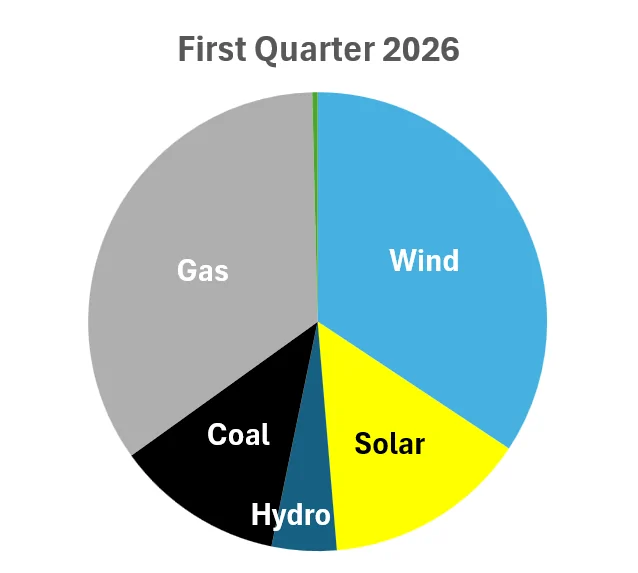
An AI application suggests that Colorado will hit 66% renewables by 2030 as solar, in particular, replaces coal generation. Charts/Ron Sinton
Sinton points to modeling commissioned by the Colorado Energy Office that found a 94% reduction in emissions could be achieved with a lowest-cost plan.
“One-hundred percent renewables at higher cost is not the right result in the big picture if 95% at a lower cost has a bigger effect on pollution in Colorado,” said Sinton.
Others agree. “We need to be careful about how, if, and when we meet that last 5% to 10%,” said KC Becker, director of the Colorado Solar and Storage Association and a former state legislator who helped craft the landmark legislation in 2019.
Becker said she believes new technologies will be developed to provide more options while preserving affordability, part of the triumvirate of goals: clean, reliable and affordable. “In the meantime, there is no shortage of other things to work on,” she added.
She also points out that reducing greenhouse gas emissions and dependence on fossil fuels, while important, is not the only goal. Also important is reducing air pollution. “The state is always thinking about this as well,” she said.
What’s around the corner?
As for new technology, there are many promising fronts. “Super interesting,” said Toor of Xcel’s partnership with Google in Minneapolis in a pilot iron-air storage project. Xcel has plans for a parallel project at Pueblo. This storage technology has limitations but a key virtue of providing electricity for 100 hours compared to the four to eight hours of lithium-ion batteries.
Enhanced geothermal — generating electricity from heat deep underground — may not be ready for prime time, but Hansen, Hannegan and other utility executives believe it’s not far from center stage. Ditto for Polis, who in 2024 said he expected it to be responsible for 4% to 8% of Colorado’s electricity by 2040.
Another fan of geothermal is Energy Secretary Chris Wright, who otherwise is a proponent of fossil fuels. Wright also said he believes small modular reactors will become economically viable relatively soon. Others think it’s a more distant prospect, if viable at all.
In Durango, Hansen said he believes that trying to eliminate the last few percentages of greenhouse gas emissions with today’s technology would be very expensive. “But, by the time we get to 2040, that will not be true.” He points to improved access to regional markets — partly a result of legislation he authored —as one reason.
Even within electrification, large questions remain. Most significant is how will the arrival of large-load data centers impact Colorado’s decarbonization? If data center developers build gas plants, how well can they be regulated to minimize additional greenhouse gases?

The growing electrical demand from data centers such as this one in the Denver neighborhood of Swansea is among the questions going forward. Photo/Allen Best
Growth in demand from data centers threatens both retirements of coal plants and Colorado’s climate goals, said Clare Valentine, senior policy advisor for Western Resource Advocates.
For example, recent modeling from Xcel Energy in its large-load tariff filing shows that significant large-load growth “could increase emissions over the next 15 years by nearly one-third, relative to the status quo,” she said. “Sophisticated state policy and regulation will be imperative to prevent emissions backsliding.”
High-voltage transmission is another constraint on renewables. It’s hard to get permitted and built. While local generation is to be prized, as Holy Cross has demonstrated, it’s useful to have some resources that may not be developed easily in your service territory.
That is particularly true of wind.
In Brighton, at the headquarters of United Power, Colorado’s fastest growing utility, CEO Mark Gabriel would like to add more wind to his mix. He cannot, he says, because of transmission constraints.
What is available is natural gas. “I could be wrong here, but I think natural gas will be the alternative for the next 20 to 30 years. It’s cost-effective. You can turn it on quickly. And it balances out what you have with solar or wind.”
That comes with an asterisk. Supply chains have become very long and the gas plants may within a few decades become as antiquated as a 2015-era iPhone in 2026.
Opportunities — but also challenges
Others celebrate this milestone in electricity but then describe the difficulties of decarbonizing other sectors of the economy. Even having the emissions-free electricity won’t be enough.
For example, about 80% of buildings in Colorado are heated with natural gas. The federal government during the Biden administration, awarded the Denver Regional Council of Governments $200 million to help augment or replace electric-powered heat pumps in the nine-county metro area. And lately, Lennar has been adding geothermal to nine new housing developments in the metro area.
Still, hundreds if not thousands of new houses are added each year with natural gas furnaces. Replacing the gas units will be difficult.
In other words, after a toast with champagne to this 53% achievement, it’s back to work.

- Jared Polis on money spent on wildfire risk - October 15, 2026
- Xcel’s Robert Kenney on storage and other thoughts - October 14, 2026
- Solar-powered ski lifts in Colorado? - October 14, 2026


And here we are. So much progress, yet the smoke swirls into our lungs.
Thanks once again for your illuminating piece, Allen.
The transportation-driven ozone is worse than the smoke today in my town. That needs to come down as well!