
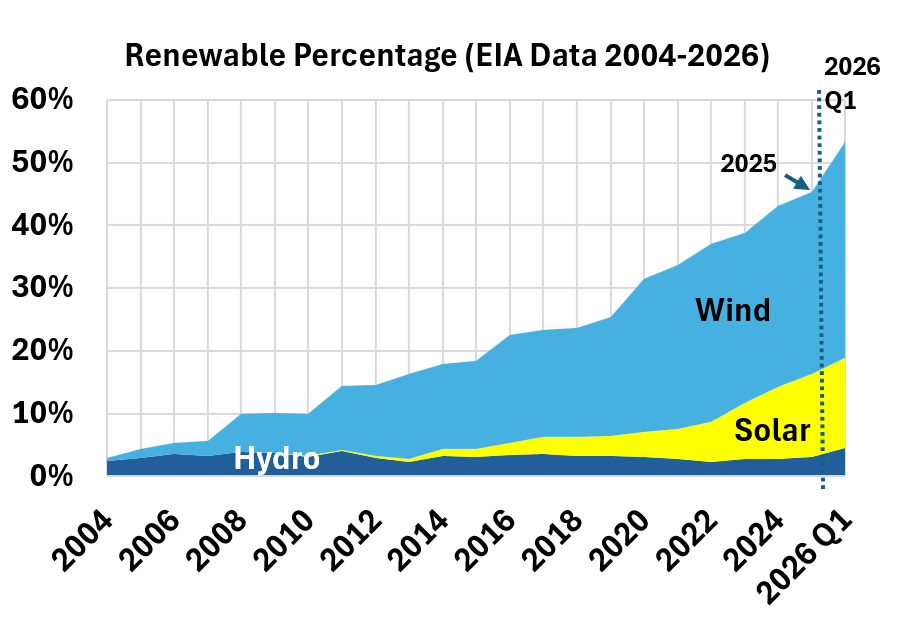
State got 53% of its electricity from renewable sources in first quarter of 2026. We will go much higher, but for an affordable 100% we still need some answers.
by Allen Best
Colorado this year achieved a milestone in its energy transition. During the first three months, according to the Energy Information Administration, 53% of all our electricity came from renewable sources. We should easily end the year above 50%.
Just 2.6% of our electricity came from renewables in 2004, almost entirely from hydroelectricity from Colorado River dams. That same year, Colorado voters adopted Amendment 37, requiring Xcel Energy and other larger utilities to get 10% of their electricity from renewables by 2015.
Xcel Energy, the state’s largest utility, fought that mandate, grumbled a bit when it passed, then set out to comply. Helping it do so were tumbling prices of wind energy. Beginning in 2010, solar prices have slid by up to 90%. Lithium-ion batteries are now enjoying similar price declines, enabling utilities to meet peak demands with more renewable energy.
The Trump administration has tried to slow the transition from fossil fuels to renewables, but with limited success. “Wind, solar and batteries are still the cheapest options in the marketplace,” said Chris Hansen, a former state legislator who is now the CEO of Durango-based La Plata Electric, a cooperative.
Colorado as of 2024 ranked only 12th in the percentage of its electricity from renewables. Lightly populated South Dakota gets 80% of its electricity from renewables, mostly wind and hydroelectric. Iowa, a former coal-heavy state, now gets 70% of its electricity from wind.
Globally, renewables are rising, too. For the first time in more than a century, they produced more electricity (34%) than coal (33%), according to Ember, a research firm. Most of that new growth came from solar.
But what about the amazing progress of Holy Cross Energy? Last year, 85% of the electricity delivered by the cooperative to members in Vail, Snowmass Village and other areas came from renewable sources. Holy Cross has been nimble but also enjoys lower-cost transmission to deliver electricity from eastern Colorado while developing local sources, too. Also, demand has been relatively flat, unlike some places along the Front Range.
“I celebrate their success, but I also know that I have to solve this puzzle for La Plata in a different way,” said Hansen, whose cooperative directors have adopted goals similar to those of Holy Cross.
“Colorado’s reaching 50% renewable energy is more important than any city or small utility in isolation,” said Ron Sinton, the founder of Sinton Instruments, a solar industry research company based in Boulder. Colorado has 22 electrical cooperatives and 29 municipal utilities in addition to Xcel and Black Hills Energy, also an investor-owned utility.
Sinton and many others working hard to decarbonize electricity warn against letting perfect electricity imperil broader decarbonization. Existing technologies can achieve maybe 90% emissions-free electricity without causing higher cost. Other answers are needed for 100%.
“We need to be careful about how, if, and when we meet that last 5% to 10%,” said KC Becker, director of the Colorado Solar and Storage Association and a former state legislator who helped craft the 2019 legislation.
But aren’t renewables causing utility bills to skyrocket? Energy Secretary Chris Wright and others make that argument. They are selective in their facts. Causes are complex. They include the increasing wildfires — at least some of them the result of global warming.
To be clear, natural gas remains a vital component of our electricity. Mark Gabriel, CEO of Brighton-based United Power, said he believes natural gas will be part of the mix for another 20 to 30 years. “It’s cost-effective. You can turn it on quickly. And it balances out what you have with solar or wind.”
Unclear is what technologies will emerge to allow Colorado to achieve 100% without great costs. New storage technologies are being tested. Xcel, for example, plans a 100-hour iron-air storage pilot at Pueblo. Nuclear has its fans but cannot compete on cost. Many utility executives believe enhanced geothermal — drilling deep to produce electricity — will become cost competitive far sooner.
Demands posed by hyperscale data centers is a wild card. “Sophisticated state policy and regulation will be imperative to prevent emissions backsliding,” said Clare Valentine, senior policy advisor for Western Resource Advocates.
Even without data centers, oh so much work remains. Somewhat incredibly, we’re still building houses to be heated by burning natural gas. To meet our goals, we will have to replace those furnaces with geothermal or air-source heat pumps at some point.
In other words, after a toast with champagne to this 53% achievement, it’s back to work.
This was extracted from a more richly explained version, i.e. the coffee-cup version. Find it here.

- Jared Polis on money spent on wildfire risk - October 15, 2026
- Xcel’s Robert Kenney on storage and other thoughts - October 14, 2026
- Solar-powered ski lifts in Colorado? - October 14, 2026


Allen, speaking of heat pumps. Have you heard about the Airspool, DIY, 120volt, solar powered heat pumps? They’re truly a DIY, about 2 hours to install, depends on getting the 120volt plug in to the compressor. They’re 12,000 BTU, so 500sqft heating or cooling, and they’re set up to hook to 1500watts of solar panels, so run for free when the Sun is shining. Really neat. Airspool.com. Ward
Allen,
Anybody interested in the dynamic nature of Xcel’s grid can now see the forecast for renewables as a fraction of load for the upcoming week. The PUC ordered that Xcel do this 2 years ago in June and it launched late last year.
This is available from Xcel, at https://chargingperksre.xcelenergy.com/ The same data is displayed in a user-friendly and free public service web or phone app at https://www.sintoninstruments.com/chargebug/
This is optimized for anyone that might be able to shift some of their flexible demand (like EV charging or other high loads) to hours with abundant renewable power. Using more of the available renewable power in the hours when it is in excess will enable the acquisition of even more to push us towards the goal of clean energy.
Others may simply be curious about renewables on the grid.
Nothing surprising here. Solar drops off at night and a lot of times there is no wind generation to fill the deficit.