

Agreement clears way for passenger trains between Denver and Fort Collins in 2029. The last time a passenger train ran on those tracks was 1967.
by Allen Best
Listening to plans for thrice daily passenger trains between Denver and Fort Collins beginning in 2029 has triggered childhood memories. I will date myself here.
As a child in northeastern Colorado I was deposited on a Union Pacific passenger train by my grandmother in Sterling for delivery to my waiting mother in Fort Morgan an hour away. That was during the 1950s, in the waning days of passenger train service in Colorado. The decline had begun in the 1920s and continued in the 1930s as Colorado, like other states, began building roads for automobile traffic. A seminal moment was 1930, when the state began clearing Berthoud Pass of snow, the first road available for winter crossing of the Continental Divide.
During World War II, with the rationing of gasoline, rail passenger traffic grew again but ebbed once more after the war. Then came the interstate highways authorized by Congress in 1956.
President Dwight Eisenhower is often credited with the interstate highways. He certainly supported the bill that provided 90% federal funding for creation of 41,000 miles of four-lane highways across the country. He had seen the value of Germany’s autobahns during the war. But desire for big highways was a broader vision than one person. Congress in 1938 had ordered study of constructing six superhighways across the nation. Colorado by 1944 had begun envisioning a four-lane highway along the Front Range.
Interstate 25 reached Fort Collins by the mid-1960s. That made it an easy hour’s drive to Denver. That ease of automotive travel spelled the clear end of passenger rail between Fort Collins and Denver. On Sept. 2, 1967, the last Colorado and Southern passenger train rolled between the two cities — and Loveland, Longmont and others along the way. The same year the last passenger train ran from Pueblo through Salida, Leadville and Eagle. The next year, the last passenger train left Craig for passage through Steamboat and Granby before arriving in Denver.
Except for the ski train, some tourist trains and Amtrak, Colorado has had no inter-city passenger trains since Lyndon Johnson was president.
By around 2000, though, thoughts returned of restoring passenger trains. At a forum in Denver on Saturday, Herman Stockinger, deputy director of the Colorado Department of Transportation, recalled that he was at the Colorado Capitol in about 2003 when a state legislator from Pueblo wanted to know when we would have Front Range rail once again. “It’s way past time,” the legislator said.
“Probably not in our lifetimes,” the then-executive director of C-DOT answered. The agency a decade before had formally ceased being the Department of Highways, but highway expansion seemed to be the pragmatic solution to increased traffic.
Population growth has been part of the story. The population of 1.4 people of my birth year had now topped 6 million. Nearly 85% of us live somewhere along the Front Range. The State Demography Office projects slower population growth in coming decades but sees a state population approaching 7 million by mid-century.
It’s not just more people, though. It’s also far more cars and trucks and more travel altogether. While Colorado’s population grew 106% between 1980 and 2024, vehicle miles traveled grew 145%. We have more cars and trucks, and we are driving them more. As Matt Frommer, the transportation and land use policy manager for the Southwestern Energy Efficiency Project, points out, buying cars and fuel for travel from distant locations is a very expensive way to grow.

Freight traffic, i.e. the “Beer Train” to Golden, and passenger rail in the form of the FasTracks G-Line commuter train share a corridor in Olde Town Arvada.
FasTracks has given us a glimmer of the possible. The commuter rail approved by Denver-Boulder metro voters in 2004 is far from perfect. For example, it’s far easier for me to drive than to take rail from my home in Olde Town Arvada to the Anschutz Medical Center. But I can imagine no easier way of getting to DIA than taking the trains. And the trains are packed for Broncos, Rockies, Avalanche and Nuggets games.
Now come the first passenger trains under the auspices of the Front Range Passenger Rail District. The district was created by state legislators in 2021 with the blessing of Gov. Jared Polis. Polis speaks frequently of the need for efficient high-density housing tied to mass transit as Colorado looks to mid-century. In places, you can see that happening with FasTracks.
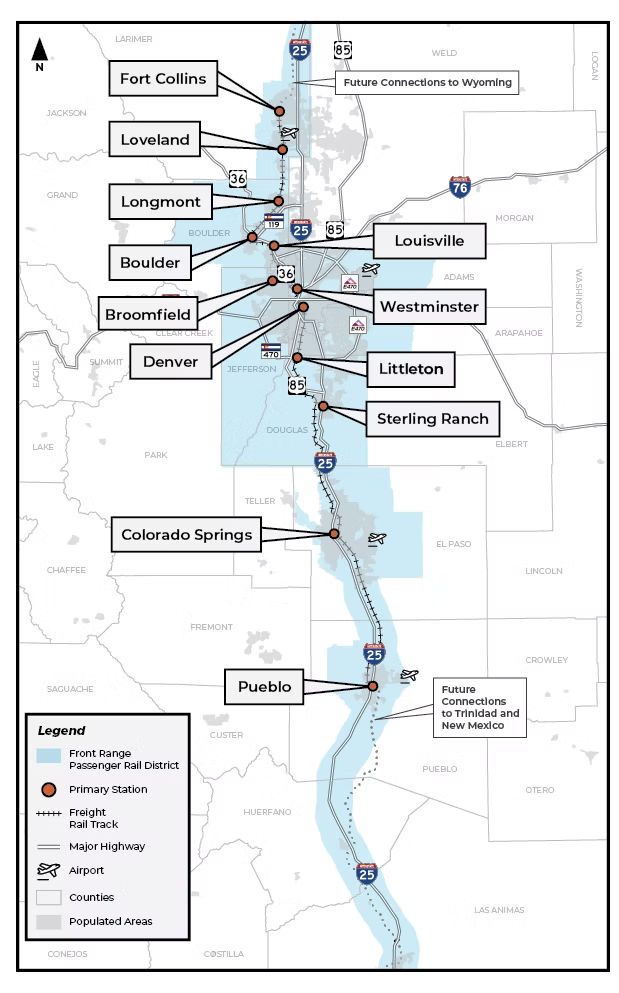
This rail district for 13 counties along I-25 (and nearby rail lines) extends from the Wyoming to the New Mexico borders. The rail district hopes to eventually connect rail from Wyoming to New Mexico. District directors chose the most heavily populated northern Front Range first, with 13 stops currently planned from Denver to Fort Collins for three round-trip trains per day.
In time, the district plans to offer daily trains between Denver and Pueblo, eventually extending the trains to Trinidad. By 2045, the district contemplates 10 round-trip trains daily along the Front Range.
Crucial to this Denver-Fort Collins passenger train service was an agreement between the rail district and BNSF Railroad that was announced last week.
“Fifteen years ago, when we were thinking about Front Range rail, we were thinking about virgin track. It was $15 or $20 billion, and it was pie in the sky,” said Stockinger at the town hall in Denver. “It was never going to happen.”
Building virgin track has stymied other passenger rail plans. Most prominent is the story of California’s efforts since 2008 to create high-speed rail (speeds up to 220 mph) between Los Angeles and San Francisco, a 494-mile route. Costs have now elevated to between $89 billion and $128 billion. Building new infrastructure costs big bucks.
In Colorado, thoughts of creating high-speed rail on the I-70 corridor from Denver into mountain communities were stymied by the projected costs of $21 billion believed necessary given the geographic constraints.
The Front Range plans, in contrast, do not envision building substantial new rail.
Fewer coal trains are part of this story, too. Coal traffic has diminished significantly in the last 15 years. Just how much, the railroads don’t say and state officials, who are privy to the information, won’t say either.
What can be easily observed is reduced numbers of coal trains from mines on the Western Slope. They rarely emerge through the Moffat Tunnel now — although freight trains carrying crude oil from Utah have become common. Coal trains from Wyoming, if reduced, are still abundant on tracks east and through downtown Denver.
This acknowledged decline in coal and other freight traffic has created what Stockinger cautiously describes as “perhaps” an alignment of stars. “We’re not making any assumptions that the coal (traffic) drops off to zero,” he added.
Trains can be expected to deliver coal to Xcel Energy’s Comanche station at Pueblo through 2030. Colorado Springs wants to keep burning coal at its Ray Nixon Plant until 2035, even later. Some coal trains travel beyond Colorado.
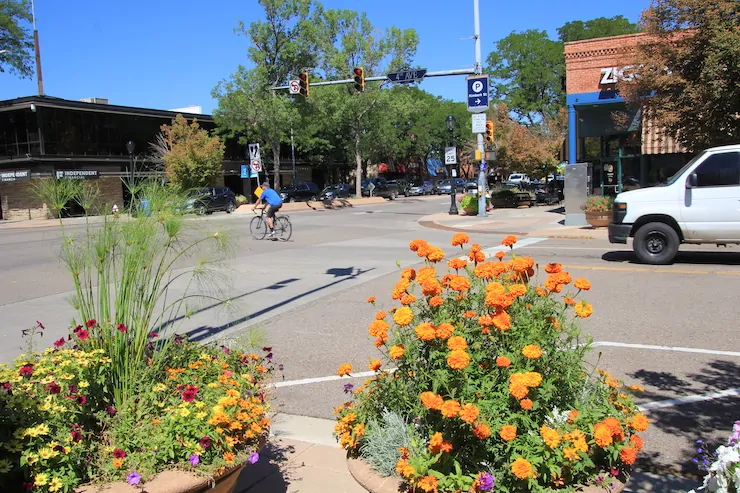
A stop in downtown Longmont, a few blocks from this intersection on Main Street, is planned, one of 13 from Union Station to Fort Collins.
As for the trains north from Denver, the rail district believes it has sufficient resources to pull this off. To get trains to Pueblo, though, the district plans to go to voters for a tax increase.
Reading of these plans, some will be inclined to scoff. People everywhere have been reluctant to give up the freedom of cars and trucks, even if they sometimes get imprisoned within miles-long traffic jams. And with that many stops along this northern Colorado route, can it be fast?
Too, there is what transportation planners call the last-mile problem. It’s fine to get from Denver to Fort Collins without having to growl at the guy who just cut you off with inches to spare. But what do you do once you get to Longmont or Loveland? Your ultimate destination is unlikely to be within walking distance of the train stop. How do you get there?
This came up at the town hall meeting in Denver. Planners pointed to Boulder’s HOP buses, which follow a circular route around portions of Boulder every 12 minutes. At the Colorado-based Southwest Energy Efficiency Project, staff members devoted to transportation are studying how automated cars may play a role. Cost and efficiencies of energy technology are rapidly changing. The same is true of transportation. Many of us wonder how automated driving may allow us to make better use of our existing highways. They’re terribly inefficient now, with people on a highway with 65 mph limits driving anywhere from 60 to 105. With automated driving, need for spatial gaps can be reduced.
A final component is the climate challenge. Transportation currently constitutes the largest single sector of Colorado’s greenhouse gases. For Colorado to meet its 2050 goals, it must figure out solutions in this difficult sector. This strikes me as one partial answer.
Returning to 19th century technology, if updated somewhat, to solve 21st century problems may seem like an odd thing to do. But in energy, we have done something similar. All the prairie homesteads had windmills for pumping water. Now we have very big windmills to produce electricity. This isn’t the same, but it’s not altogether different, either.
Additional Front Range Passenger Districts listening sessions are planned as follows:
Wednesday April 15, Boulder
East Boulder Community Center, 5660 Sioux Dr., 6 p.m. – 7:30 p.m.
Thursday, April 16, Loveland
Pulliam Community Building, 545 Cleveland Ave, 5:30 – 7 p.m.
Friday, April 17, Colorado Springs
Kinship Landing 415 S Nevada Ave., 5:30 p.m. – 7 p.m.
Wednesday, April 22, Denver
Denver South High School, 1700 E Louisiana Ave. 6 p.m. – 7:30 p.m.
Saturday, April 25, Denver
Rodolfo “Corky” Gonzales Branch Library, 1498 Irving St,, 1:30 – 3 p.m.
Tuesday, April 28, Pueblo
Senior Resource Development Agency, 230 N Union Ave., 2 p.m. – 3:30 p.m.
Wednesday, April 29, Westminster
Westminster City Hall, 4800 W 92nd Ave. Westminster, CO 80031 6 p.m. – 7:30 p.m.

- A data center compromise? - May 4, 2026
- Natural gas plant planned by Tri-State a no-go - April 30, 2026
- Bill would delay coal retirement until 2032 - April 29, 2026





Great reporting, Allen.
Besides climate change, cars are major contributors to local/regional air pollution.
And getting back to climate change: we can see how serious people are about addressing climate change. It’s futile to eliminate gas heating but not gas driving.
Is there anything in this agreement about electrified rail at this point? It seems like a bare bones plan, so I expect diesel (though all diesels have been “hybrids” for a while. If that RTD B-line is used, it’s electrified but that’s a tiny fraction of the distance. Some searches mention “hybrids” but there are lots of variations on that. In this context probably electric on the section with catenary, then diesel the rest of the way. But if the catenary only runs for 5% of the miles someone may balk at any extra cost for that.
The Euros have a few trains that have gone from “hybrid” to battery recently. They have sections of catenary, and sections that “can’t” get the wires in. So with modern batteries, the trains power the motors plus charge under catenary, then battery->motors for a few miles, then switch again.
The main reason for doing Denver Fort Collins first is that the line can be made available. Real estate developers had their way with the south access at Union Station and the single track on the Palmer Divide and it is going to require more work to get trains set up for travel Denver Colorado Springs.