

Lawsuit says Trump team has frozen review of project near Sand Creek Massacre site in tax-starved Kiowa County
by Allen Best
Eads, a small town on Colorado’s windy eastern plains, has been shedding population for many decades. Defense Secretary Pete Hegseth isn’t helping any.
Federal law requires the developer of wind projects with turbines higher than 200 feet to submit plans to the Federal Aviation Administration for review. The FAA, in turn, refers those projects to the Department of Defense to assess whether they could affect military operations, radar systems, flight paths, or national security.
In August 2025, Hegseth’s department slowed those reviews. In April came reports that the laggard pace of reviews had stalled entirely.
In Colorado, this stall has impacted at least one project, the 500-megawatt Towner Wind Energy II (or West) Project. A twin project, the similar-sized Towner Wind Energy I (or East) project had already received clearance and is now under construction.
Colorado Attorney General Phil Weiser in July joined 17 other states and the District of Columbia in seeking to intervene in a lawsuit that contests what they call a freeze on reviews. They say the unresponsiveness of the Department of Defense is politically motivated and violates federal law.
“Since President Trump took office in 2025, his Administration has attempted to halt wind projects through presidential memoranda, secretarial orders, agency instruction, permit denials, sudden reversals of established policies and practices, unlawful settlements, and a host of other actions,” says the motion to intervene.
At least $2.687 billion in private investment and 7,124 jobs are at risk in Colorado, according to the court filing. Big Pivots was unable to identify other wind projects in Colorado that may be in limbo because of the federal freeze. Nationwide, according to American Clean Power Association, 150 wind projects have been affected.
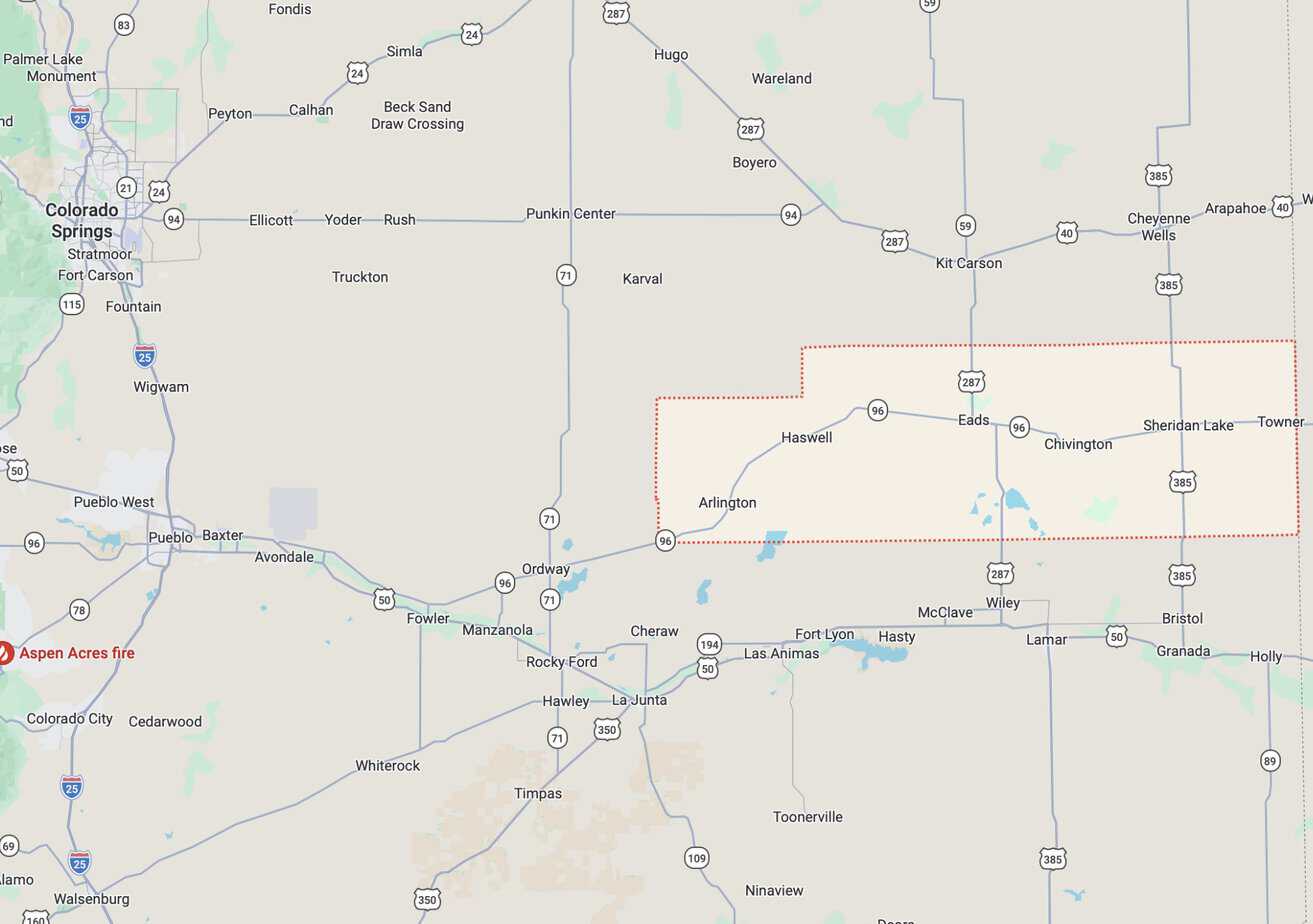
With little irrigated land and virtually no oil and gas installations, Kiowa County has the lowest assessed valuation of Colorado’s 64 counties.
In Eads, at the Kiowa County courthouse, County Administrator Tina Adamson has been looking forward to when the two Towner wind projects go on the property tax rolls. The county has an assessed valuation of $39.4 million, lowest among all of Colorado’s 64 counties. Several mountain counties in Colorado also have relatively small assessed valuations. Mineral County (Creede) has $55.7 million, Hinsdale (Lake City) $58.1 million, and Jackson (Walden) $101.9 million.
Kiowa County, which is much larger in area, gets far less federal assistance called Payment in Lieu of Taxes, or PILT, compared to the mountain counties. The property tax is correspondingly far, far higher: a mill levy of 46.5 compared to 15 to 22 mills for the small mountain counties.
In short, Kiowa County needs tax base. The two big wind farms will help. Because of the federal freeze, according to Weiser’s court filing, only one is moving forward.
The county has a population of 1,446 as of 2020, almost exactly half of its population in 1950. It is bisected by Highway 287, which produces a steady stream of trucks at all hours of day and night. In Eads, the Love’s station produces a healthy — for a very small town — stream of revenue in sales taxes. Less frequently, travelers stop for a meal while visiting Sand Creek Massacre National Historic Site, 23 miles east of Eads.
Neighboring counties along the Kansas border benefit from the higher property taxes levied against oil and gas operations and lands with irrigated agriculture. Kiowa County has little or none of either. Most land is used for livestock grazing or growing wheat, milo or other crops that need little moisture.
“We have such a small population and a pretty large area, all ag,” Adamson said. “We have very, very little oil and gas.”
With such a small treasury, keeping employees is hard. Neighboring jurisdictions pay higher salaries. As for upgrades of any sort, they’re out of the question unless Adamson can secure a grant — and sometimes two or more — to help pay for the project.
Work on Towner East is already underway, the Kiowa County Independent reported in February. Adamson said pouring of concrete for footers began in July and installation of towers has now begun. That project is to have 115 turbines east of Eads. The original permit identified Vestas towers that are just above 600 feet. That compares with the 714 feet of the Republic Plaza, Denver’s tallest building.
Invenergy, the project developer. on its Towner Energy Center website projects that Towner East will yield more than $120 million in state and local tax revenues over the life of the project. After construction is completed, it is expected to yield roughly 15 full-time jobs. The project is now owned by Xcel Energy.
At the Kiowa County courthouse, Adamson said she expects far less annual revenue than the $1.25 to $1.5 million annual boost predicted by the developers. Based on evidence from other counties in eastern Colorado, she expects no more than $500,000 in new annual revenue. Even so, that amounts to a substantial boost for the county budget.
Towner West, the second project, is to have 148 towers. Weiser’s court filing says it has been frozen by the federal inaction. Invenergy, the developer, did not confirm that, saying only that “planning on Towner West continues” and that the company is “optimistic about its future.” Kiowa County expects that wind farm, if it is completed, to yield another $500,000 in property tax revenues.
Both wind projects are located along Xcel Energy’s 345-kV Colorado Power Pathway, a 550-mile transmission line intended to deliver renewable electricity to metropolitan Denver.

Xcel Energy’s 550-mile Colorado Power Pathway loops around eastern Colorado. The two Towner wind projects are north of the May Valley substation.
An irony of the federal freeze is that Kiowa County has been a strong supporter of Trump. In the 2024 election, for example, he got 744 votes compared to 101 for his Democratic opponent, Kamala Harris. The margins were similar in the 2020 and 2016 elections.
The New York Times, in a story published in May, pointed out Trump’s dislike of wind turbines. He has called them ugly and expensive. “My goal,” he said in January, “is to not let any windmill be built.”
On his first day in office, Trump issued an executive order halting all leasing of federal lands or waters for wind turbines.
Congress in 2011 had adopted a law that said before large wind farms begin construction, developers must apply for clearances from the Federal Aviation Administration, which regulates the national airspace. The FAA in turn refers the application to the Pentagon, which checks to see whether a project might interfere with military radar or nearby air bases.
The Times said that many wind projects in the past quickly received “no hazard” determinations, allowing them to move forward. Some projects do create issues, and they typically need to reach a mitigation agreement with the Pentagon. That might involve the company paying to upgrade nearby radar systems or modifying the layout of its turbines.
This process was for years considered routine and predictable, with deadlines set by Congress. said the Times.
Colorado Gov. Jared Polis, in a June 8 letter to Dale Marks, the assistant secretary of defense for energy, installations and environment, said the clearinghouse method ordered by Congress in 2011 had worked out well. “Unfortunately, in Colorado and other states across the country, (Defense) is not advancing mitigation discussions, issuing draft agreements following completed negotiations or executing agreements already negotiated and signed by developers,” the letter said.
Taken together, he said, the defense department’s actions represent a “de facto nationwide moratorium on all land-based wind energy development — blocking projects critical to maintaining electric reliability, meeting rising energy demand, and lowering energy prices for consumers.”
Asked for comment, the Colorado Energy Office offered this: “The DOD freeze on wind projects hurts building clean energy generation that will drive up energy costs, increase customer energy bills, and impact reliability. Delaying wind projects risks missing out on federal clean energy tax credits and will directly increase costs to homeowners for electricity.”
In June, a coalition of renewable energy groups filed a lawsuit asking a federal court to order the Pentagon to quit doddering. Colorado, and the other states in July have asked to be part of that lawsuit.
In his filing, Weiser said that national security and production of electricity from wind can be successfully balanced. He called the freeze “simply another attempt to unlawfully interfere with the deployment of renewable energy.”
Some wind projects that have already completed mitigation negotiations awaited only final federal approval.
Weiser’s filing also asserts the federal inaction harms Colorado’s pursuit of energy goals. The state has a statutory requirement of reducing greenhouse gas emissions caused by producing electricity by 80% by 2030 compared to 2005 levels.
In the first three months of 2026, this year, wind was responsible for 35% of Colorado’s electricity. In 2025, according to the Energy Information Administration, it had been responsible for 30%.
Kiowa County may add property taxes from other renewable projects in coming years. Three solar projects have been proposed, one for 500 megawatts, a second for 580 megawatts, and the third for 1,025 megawatts.

- Last winter’s snow drought and the thick fingerprints of climate change - October 19, 2026
- Jared Polis on money spent on wildfire risk - October 15, 2026
- Xcel’s Robert Kenney on storage and other thoughts - October 14, 2026


Shameful that the Administration is doing this!