

Panel discussions often are echo chambers. This session sponsored by Colorado Solar and Storage Association was more interesting.
by Allen Best
We live in echo chambers. We gather in our various pews to hear the particular gospel that we have received, to share our particular world views.
A delightful exception to this was an event sponsored in November by the Colorado Solar and Storage Association. The purpose was clear enough: raise money for COSSA. Seats at the noon gathering held at History Colorado did not come cheap. (Big Pivots was given a press pass to listen but bought a burrito down the hall at the Rendezvous Cafe).
The session had four state legislators on stage — including Faith Winter, who died two weeks later in an auto accident. Two were women and Democrats from Denver’s northern suburbs. Two were men and Republicans from more rural areas of northeastern Colorado
It was a classic illustration of Rural vs. Urban. (I am currently reading a book with that very title).
The juiciest part was when KC Becker, the director of COSSA since March and a former state legislator from Boulder, asked questions of Sen. Byron Pelton, the Republican from Sterling who represents areas from Weld County to the Kansas border. Pelton has consistently maintained that rural Colorado has been getting short-changed in this energy transition.
The session suggested some of the arguing points in the upcoming legislative session and perhaps the next gubernatorial race.
The governor’s report
Gov. Jared Polis had opened the gathering with remarks that extolled Colorado’s progress in the transition to clean energy even as President Donald Trump was trying to push the state — and nation — backward.
“Colorado is moving full speed ahead to make it easier, faster and more affordable to build out low-cost clean energy and storage,” he said. “We’re very excited about helping Coloradans save money on energy bills and reducing pollution and creating good jobs of the future.”
Colorado utilities are on track, he said, to achieve 70% emissions-free electricity by 2030, the goal set in 2019.
Polis went on to acknowledge “headwinds” posed by federal policy but also by the cost of needed materials, owing to tariffs first during the Biden presidency and then those ordered by Trump. He also alluded to Trump administration plans to order continued operation of coal plants (as Secretary of Energy Chris Wright so ordered for Craig Unit 1 in late December). Polis said states are “in the best position to plan for resource adequacy, to plan our electric utility system.”

Colorado Gov. Jared Polis said Colorado will be focused on “further breaking down barriers, to make it faster and easier and more transparent to build out the low-cost energy infrastructure we need to meet our goals.” Top photo, from left, State Sen. Faith Winter, two weeks before her death. Rep. Shannon Bird, Rep. Carlos Barron, and Sen. Byron Pelton.
The governor also talked about EVs. “We also recognize the storage capacity that EVs bring to the grid,” he said, noting a new $3,000 additional EV tax rebate for low and moderate-income Coloradans that was recently announced.
And he called out Xcel for its plans to order as much as four gigawatts of new wind and solar before federal tax credits expire in 2026.
Polis nodded toward the coming legislative session when he said that Colorado is focused on “further breaking down barriers, to make it faster and easier and more transparent to build out the low-cost energy infrastructure we need to meet our goals. And that includes transmission.”
Tariffs and supply chain disruptors and the end of the federal tax credits for clean energy will increase costs, he said. “It’s important that we do everything we can to make energy more affordable and by making sure we can reduce costs of permitting transmission and energy projects.”
And again Polis note transmission: “We hope to be even more supportive to make it easier to permit and site renewable energy transmission,” he said.
Speaking of data centers…
The conversations were generally polite, temper evident only in the final moments when Rep. Carlos Barron, the resident of Fort Lupton, said that he has no problems breathing and proudly lives in oil-and-gas country. To that, Winter sharply retorted that her children in Weld County had asthma and other problems.
State Rep. Shannon Bird, who is seeking the Democratic nomination for the 8th Congressional District, a seat now held by Gabe Evans, noted the impact of H.R. One, the bill passed by Republicans in Congress during July. It is also called One Big Beautiful Bill Act, and it basically upends key Biden era initiatives.
Most pertinent to budget discussions in Colorado, that new law changes what the federal government considers taxable income at the state level. “I just want you to know there isn’t going to be a lot of money out there,” said Bird. “So for any of you who are championing legislation, this is something just to be aware of.”
“Any new tax credit that gets approved will, by definition, cut into taxable revenue or tax revenue that the state would otherwise expect to be getting to fund critical services,” said Bird, the former chair of the Joint Budget Committee and hence particularly attentive to budget woes.
That comment was an obvious reference to the proposal to waive sales taxes for new data centers, as is common in many other states.
Legislation to provide incentives for data centers was introduced in each of the last two legislative sessions. The first year, the legislation was dropped, the state senator in question seemingly unaware that data centers by 2024 were seen as a mixed blessing at best.
In the 2025 session, Sen. Nick Hinchrichsen of Pueblo introduced legislation (SB25-280). Three of the four sponsors were Democrats, but that was not enough even in a body dominated by Democrats. It failed to get out of its first committee hearing.
Becker, as the panel moderator, probed deeper. She presented the chicken-and-egg dilemma:
The proponents of the tax exemptions have said if you don’t create those tax exemptions, the revenue (principally property tax) will never come back to the state because those data centers aren’t coming to the state now, she said.
“How is the legislature going to look at that. And what questions do we need to think about when it comes to data centers?”
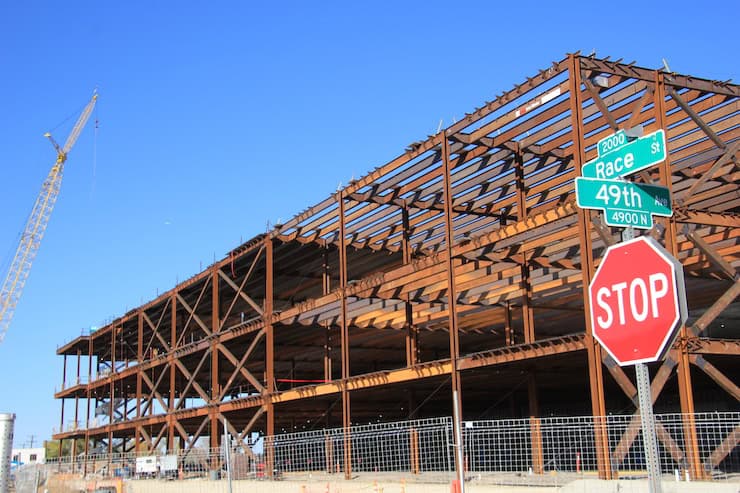
Colorado has started adding data centers but lags behind many other states, including Texas. Above, a data center under construction in the Swansea neighborhood of Denver October 2025. Photo/Allen Best
Pelton was first. ” I had to laugh from the hypocrisy,” he said, because Colorado was willing to give tax incentives to bring the Sundance Film Festival to Boulder but declined to give tax incentives to data centers.
Those data centers will require more energy, and he said he believes the solutions lies in requiring the data centers to provide their own generation. And he suggested he is comfortable with nuclear energy, having served in the Navy, which deploys nuclear-powered submarines.
In some ways, the statements hewed to familiar political contours. Democrats were inclined to dwell upon how to move forward with minimal carbon footprints and without impacts to existing consumers of electricity.
Bird acknowledged justification for lost revenue from sales tax exemptions if it produced more revenue with development. “That being said, the core concern for me as a legislator would be impacts to affordability. I know that I’m hearing in my district over and over a key concern is energy affordability.”
The Republicans talked with less nuance about economic development being paramount.
“AI is going to be the next new frontier, and we don’t want to be left behind with that,” said Pelton. “We want that frontier to come to us,” said Barron.
What do rural counties want?
The meatiest part of the session was the interplay between Becker and Pelton. Pelton would make strong statements, and Becker would challenge him to support what he had said.
Pelton, a master electrician for 20 years whose work has taken him to the Roaring Fork Valley to install solar panels, among presumably other places, is from the Cheyenne Wells area near the Kansas border but has spent his adult life near Sterling. He was a Logan County commissioner prior to his election to the Statehouse.
At the State Capitol, Pelton consistently argues that rural Colorado is consistently being shortchanged. A special beef has been the state money allocated to rural highways. “I represent the best people in Colorado with the worst roads,” he said. (This writer, no stranger to rural roads in Colorado, disagrees with his assessment).
As regards renewable energy, he argued that respect must be shown to local desires. This reflects a tension about whether state legislation is needed to move along local permitting of the new energy infrastructure, be it transmission lines or solar or wind energy siting.
“What the Front Range doesn’t understand all the time is that when you put green energy in my district you are affecting us as well,” said Pelton. “You are taking that land and those power lines and those wind towers and the solar panels off the tax rolls, and then you are making the community … figure out how are we going to pay for our ambulance service? How are we going to pay for our fire (protection)? How are we going to pay for our unfunded mandates?”
Additional tension can be found in the question of how much state authority should override local discretion in permitting of renewable energy projects. A bill introduced in the 2023 session would have substantially expanded state authority in siting but was moderated to provide state aid.

Gov Jared Polis said Colorado needs to make it easier to build the infrastructure necessary to meet its climate goals. State Sen. Byron Pelton said that the approach should be incentive-based. Photo near Johnstown, Colo., Jan. 9, 2025, Allen Best
This debate is not over
Becker said that she read into Pelton’s comments about tax assessment a desire to see greater incentives. As a former county commissioner and now a state senator, what would make communities he represents more amenable to seeing renewable generation and transmission?
Pelton again suggested the tax breaks for renewables was a problem. And, alluding to the comments by Polis about expedited permitting, he predicted strong pushback if a bill is passed and signed into law by Polis.
“Those counties, they can use anything at their disposal to delay those projects, like roads and the health department. I hate to see that happen, because right now we have a really good partnership with the developers,” he said. “We don’t need the state coming and telling the counties what they need to do.”
Becker pushed back. “I’ve heard a lot of support for data centers here. You can’t have a data center without having good transition. What are your thoughts about that process or how we can accelerate transmission build out?
Pelton did not answer directly except to point to a sore spot, Xcel Energy’s contested fifth segment in its 550-mile Colorado Power Pathway. That segment goes through El Paso and Elbert counties, and both counties reject Xcel’s proposed route. Local residents have alleged they were threatened with eminent domain by Xcel
“If eminent domain has to be used, which 9 times out of 10 it shouldn’t be used — but if it has to be used, wait until the permitting process is over before you go there,” said Pelton
Again he pointed to the need for incentives. “Nobody wants to look at it out of their backdoor. You have to make it worth their while.”
And so it went, Becker probing Pelton’s positions about what constitutes middle ground. The discussion didn’t go real deep, but it was more interesting than most in the echo chambers we often assemble.

- Ridding Denver-area homes of gas - February 5, 2026
- Gearing up for data centers - February 3, 2026
- How Colorado sees the Colorado River stalemate - February 2, 2026





Wait, what? Pelton says, “What the Front Range doesn’t understand all the time is that when you put green energy in my district you are affecting us as well,” … “You are taking that land and those power lines and those wind towers and the solar panels off the tax rolls…”
Utility scale wind and solar are absolutely ON “the tax rolls.” Pretty sure transmission is also. At least if Xcel or IPPs own them. If an REA non-profit co-op owns them, then I think not. Not sure how Platte River or Tri-State would be treated.
But I do think the way the state depreciates value for taxation of renewable facilities is excessive, and their value should remain higher longer, yielding perhaps 80% more overall to counties and districts where they are located.
Residential, and maybe small commercial behind the meter solar is exempt from property taxes. Wacky financial engineering applies to “community solar. ” Maybe that’s how he got off track? If he worked on that kind of solar.
A lot depends on the mill levies. The template spreadsheet from the state (https://dpt.colorado.gov/renewable-energy) uses a 75 mill levy and shows a 60 MWac solar farm paying $250,000 per year. That would be $500-1000/acre, which I’m pretty sure is way more than ag would pay.
This is a good example of how Republicans continue to drive the narrative of “urban vs rural.” It is helpful for them to keep driving this wedge because it keeps the actual rural people focused on manufactured controversies instead of realizing that rural people largely face the same issues as urban people, which that we are all getting screwed by the wealthy, we don’t have healthcare, we can’t afford housing, the cost of living is sky high, and wages are crap.
We all also deal with the Colorado political machines of both parties that work to make kings and do what they can to elect people who will support the conservative policies of the wealthy. In rural Colorado we see this in so-called democrats like Dillon Roberts and the Colorado Democratic Party Chair, Shad Murib, who are clearly aligned with the right wing livestock associations. With Democrats, it seems that regardless of who their population base is, money talks. So as recently shown by Colorado Governor Polis, they put on a cowboy hat and do some cowboy cosplaying in what they think is an attempt to “appeal to rural voters.” We are more than a caricature of cowboys and rodeo.
Republicans work hard to maintain the status quo and keep power consolidated in organizations that are essentially arms of the Republican Party that pretend to represent the west slope and rural areas. Two examples of this that I am aware of are Club 20 and Colorado Rural Electric Association. There are of course the various livestock trade associations as well, which pursue the scorched earth approach of wanting absolute power. They perpetuate the myth of the rural cowboy and work to keep the myth of rural ranching and farming as being the economic backbone of these areas. In some places it is true, however these industries on a whole are a net economic loss. They are welfare industries that arrogantly rail against other forms of welfare, but happily take theirs. I am fine with welfare and government assistance, I am not OK with hypocrisy though.
The reality is that most rural people live in small cities and towns and have city jobs not ranching jobs, not farming jobs. We have the same issues with poverty. In rural areas we have the myth is the cowboy and farmer nobly working the earth to feed us all. In the city, the myth is that of the tech worker or someone working in finance. While there are both of those things in their respective areas, they are a tiny minority of the population and both are in the same class of the wealthy resource hoarders that exploit the rest of us to steal the bread from our mouths and force us to work three jobs just to keep food on the table and the rent paid.
Let’s talk infrastructure. The roads, bridges, water lines and other infrastructure on the Front Range is also crap. This isn’t because of some rural urban divide, it is because of TABOR. TABOR is the root of many of our problems. If you cannot raise or keep tax revenue, then you can’t have nice things. This is where Republicans and the conservative democrats like to try and hide the truth about why things like infrastructure are not better. We can also look to how funding is raised for schools, which are tied to property taxes as a source of problems.
One of the things that could be done to help us collectively move past the myths and BS, is to get people on these panels that are more than the aggrieved right wing whackos making outrageous claims that are self serving and self reinforcing. Including the myth that rural people are being left behind.
Which brings me to my final point. No one is getting malicious left behind in rural areas because of urban people. It is because the rural republican politicians keep voting for policies that maliciously hold us back. They kneecap the ability to bring in business like agrivoltaics which can accomplish not only clean energy needs, but also agricultural production which in some areas can actually increase crop production because of the shade provided. These power plants also provide millions of dollar in tax revenue to county governments, free money that rains down from the sky. When public transportation is proposed it gets resisted because “they don’t Denver people ruining their town.”
So they intentionally choose to lose out on new sources of revenue that could supercharge rural economies. Instead, they adopt fantasies of nuclear power and the thinly veiled support of fossil fuels through the so-called “all of the above” approaches to energy. They make outrageous claims of water use by cities when only a tiny amount of water is used by cities and a vast majority of water is used for growing alfalfa, in a desert. They sink their efforts and energy into keeping things the same forever. That doesn’t work.
As someone who has lived in rural areas most my adult life and has lived in cities, I can tell you, most rural and urban people have far more in common than we realize. The divide is a lie made up to keep rural people voting for the bastards that turn around and screw them in return.
It doesn’t have to be this way.