

An aquifer in Colorado’s San Luis Valley keeps dropping. A plan to address this has been challenged. A Q&A with native son Chris Lopez about why he thinks this is the water trial of the century.
by Allen Best
In Alamosa, Water Court Judge Michael Gonzales has been hearing testimony since late June in a complicated but existential case for the San Luis Valley agriculture economy.
The valley’s unconfined aquifer — which is linked to water from the Rio Grande —has been dropping perilously fast. The Rio Grande Water Conservancy District, after much difficulty, has assembled a plan to diminish the pumping by farmers. That plan is being contested in court.
Chris Lopez, a native son of the valley, has been monitoring the testimony almost continuously for the last two weeks on behalf of his publication, the Alamosa Citizen. He agreed to share some of his understandings and observations with Big Pivots.
Prior to the start of this trial on June 29, you wrote a story for the Alamosa Citizen that called this the “water trial of the century.” How is that so?
The streamflows of the Upper Rio Grande and the storage area of the unconfined aquifer of the Upper Rio Grande Basin are both diminishing. The aquifer itself is not stable, if you believe the readings of the Davis Engineering Study, which has been measuring the unconfined aquifer since 1976. It’s a study the Colorado Division of Water Resources values.
It isn’t hyperbole to say the fate of the Rio Grande itself is on trial here. Downstream states are paying attention. This trial deals with the groundwater withdrawals in the richest cash-crop subdistrict in the Upper Rio Grande Basin. Subdistrict 1 produces about $400 million annually for the SLV’s ag economy through its cash crops and supply contracts.
Add in the two-decade plus drought, the documented increase and warming of the San Luis Valley itself, and you have one of the fastest warming and drying regions in the southwest and Rocky Mountains. It’s for those reasons we coined it the “trial of the century,” although maybe “this century” when you consider the AWDI trial of the 20th century. That was a 1991 landmark case when American Water Development Inc. sought to pump 200,000 acre-feet of water annually from the Valley. Its application was denied by the state water court.
What exactly is in dispute in this current case? Who are the protagonists?
In dispute is the Fourth Amended Plan of Water Management. It has been approved by the state engineer but is now facing protests in state water court from local irrigators. The irrigators argue the plan puts them at an economic disadvantage as groundwater irrigators given the $500 per acre-foot over-pumping fee.
How much interest level is there in this trial within the San Luis Valley? Does the average person in Monte Vista or Alamosa understand the dispute?
Everyone who lives here understands because we see the problem in front of us. The lack of snow, the lack of true winters, the lack of spring runoff to fill the riverbed is very evident, and even more so if you have a history of the place.
Our gauge of readership shows great interest among both the insiders to the water world and the lay person who follows Alamosa Citizen and has been following Alamosa Citizen these past five years. Water is one of our bread-n-butters and why we launched Alamosa Citizen five years ago, to track the water of the Valley and life on the Upper Rio Grande.
Everyone who lives in the San Luis Valley understands water is the lifeblood. We’re a desert region. We understand dryness and we are living through a climate period none of us have seen before. Add in the element of groundwater pumping and feelings people have about that versus surface water irrigation, the feelings people have about water rights and Colorado law, and you have a broad audience of interest.
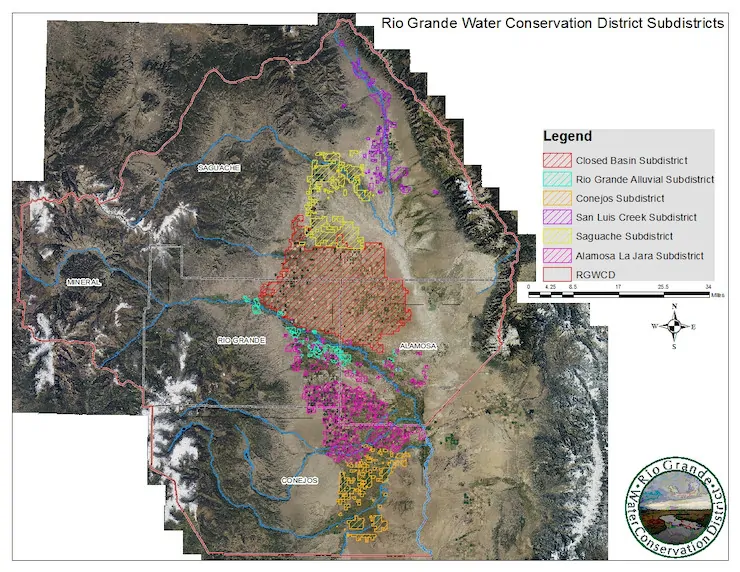
The Rio Grande Water Conservancy District consists of six subdistricts. Subdistrict No. 1 — indicated on this map by orange hash marks — is the largest and most productive. It lies north of the Rio Grande between Alamosa and Monte Vista.
The aquifers of the San Luis Valley confuse me. The principal aquifers that I understand are the unconfined and the confined aquifers. Is this case entirely about the unconfined aquifer? Where does it exist outside of this case?
You’re not the only one confused. The complexities of the Upper Rio Grande Basin as has been testified over the past two weeks are such that this is the most complex of any basin in Colorado and likely will never be fully understood. The shallow-layered unconfined storage area interacts with the deeper confined aquifer. Think of the unconfined as an underground reservoir or storage area. It helps.
Is this case related to the compact governing the Rio Grande between Colorado, New Mexico and Texas, and if so, how?
Not in the eyes of the state Division of Water Resources or state of Colorado. Stream diversions into the Closed Basin area of the Valley takes care of Colorado’s obligations under the Rio Grande Compact and those stream diversions are not part of the subdistrict’s plan of water management. However, those diversions occur due to the overall snowpack and amount of water in the Upper Rio Grande annually. Ask that question of others, and you’ll get a definite yes, that Colorado’s obligations under the Rio Grande Compact are depleting aquifer levels because of the diversions for the Closed Basin.
According to your reporting, Jason Ullman, the state water engineer, said it would be “nearly impossible outside of some kind of biblical flood” to restore water levels in the unconfined storage aquifer where the problems is. He also mentioned a 2031 deadline. What was he talking about?
The subdistrict is operating under a current approved plan of water management and under that plan, the unconfined aquifer is supposed to reach a sustainable level by 2031. That is not going to happen unless, as Ullman testified, we’re hit with a “biblical flood.” By the way, the Upper Rio Grande Basin did receive historic, heavy October rains in 2025 and all that water is gone and did little to nothing to recharge the unconfined aquifer.
Why can’t the farmers just dig deeper wells?
No new wells can be drilled. The basin is over-appropriated from a well permit standard.
So, no water deeper underground?
The closed aquifer is the deeper aquifer and rules governing pumping and sustainability apply.

This maps shows Subdistrict No. 1. Center lies north of Monte Vista.
Let’s define the areas in question. If this case does not cover the entire San Luis Valley, where is it? And why just there?
Subdistrict 1 covers parts of Alamosa County near the Mosca-Hooper area and west, much of Rio Grande County where the big ag contracts are with the likes of Walmart, Safeway, Coors, and the Center area and parts of Saguache County.
The critical matter from the state’s perspective is the complexity of the hydrology and geology of the basin itself and the Valley floor and the impacts a dying unconfined aquifer storage area has on the Upper Rio Grande Basin as a whole.
Since the 1990s, a series of entrepreneurs have proposed tapping the water from the San Luis Valley to export to Castle Rock and other communities in Douglas County. Yet you tell me the unconfined aquifer has declined dramatically in the 21st century. Where would the water for Douglas County come from?
Renewable Water Resources was trying to buy water from different sources in different parts of the Valley and in different subdistricts. Douglas County and its water commission have been having good discussions on how that growing county continues to meet its water needs. It is a county with different water providers that source water in a variety of ways. There is nothing to suggest Douglas County will ever get or needs to ever get any water from the San Luis Valley.
A related question. If there is enough water in part of the San Luis Valley to draw the interest of trans-basin diverters, why can’t this same water instead be used in the two districts within the Rio Grande Water Conservancy District with particular water shortages?
There is no excess water in the San Luis Valley or the Upper Rio Grande Basin that anyone can find. That’s the point of the water trial. The state is threatening mass curtailment in the richest cash-crop district in the San Luis Valley. The state engineer assures the water court that broad well curtailment is next if a new plan isn’t approved.
During the testimony, Craig Cotten, the district water engineer, was asked why many farmers were uninterested in the financial incentives for fallowing their land. “They’re farmers. They want to farm.” Do you understand what he meant by that?
Yes, he was alluding to the fact that some monetary incentives offered through the federal CREP program didn’t draw as widespread of interest as the Rio Grande Water Conservation District and state Division of Water Resources may have thought. The reason, he said, is because farmers want to farm and they don’t necessarily want to get paid not to farm. Remember the subdistrict has been working to recover the unconfined aquifer since 2014.
Were you surprised when the judge in this case, Michael Gonzales, allotted the full month of July for the testimony?
No, this trial has been going through status conferences for two years. It’s also a trial that marries different cases into one, so has protesters who will bring forward their own expert witnesses to offer more testimony for the judge to consider. I’m guessing Judge Gonzales will make his determinations in the case by the end of year.
Where are we in the trial? It seems that all the testimony has come from the state and its subdivisions, including the Rio Grande Water Conservancy District, and none from those opposing the state action.
We are in week three. The state is done putting on its expert witnesses. Now the protestors to the water management plan will make their arguments. The trial was set for five weeks. It doesn’t appear it will go beyond four weeks.
I am curious about your personal history with the water story of the San Luis Valley. You grew up there, I believe. Have your views about water changed over the years?
Born and raised, left in 1984 after graduating from Adams State, returned in 2016 after touring the country in my newspaper career.\
I can see the changes in the river flows from my youth. I can feel the changes to the fall and winter months, all much warmer, pleasantly so for a 65-year-old. I think I’ve shoveled snow twice in the 10 years I’ve been back home. The weather is very nice here year-round. Except for the dying river, it’s been a great reunion with my hometown.
For background on the issue in the San Luis Valley, see this story from 2025 in Big Pivots (and Headwaters magazine): “20th century expansions and 21st realities in the San Luis Valley.”

- Political theater at the Ray Nixon plant - September 7, 2026
- Gaps narrowing between high-speed EV chargers on Colorado’s highways - September 7, 2026
- We can’t build our way out of this ‘drought’ - September 7, 2026


Good reporting; thanks for the updates.
Would like to see others’ comments
The occupants living in the San Luis Valley need to fight to keep the water our watersheds and aquifers contain and produce in the San Luis Valley for our uses and relevant best management practices which require water conservation to be used for agriculture, growth and development of our towns and communities, it is our water, for our essential, common, and wanted needs.
We must promote and implement wise policies regarding water management in order to determine and sustain the identified levels of our absolute needs and uses.
San Luis Valley Water Engineers continue to implement our commitment to an existing Compact, this amount of water from the San Luis Valley Compact is consistent with certain water volume delivery criteria of which the San Luis Valley are to be in compliance with, regarding the States the Compact is pertinent to, ie, New Mexico, Texas,…