

Michael Bowman farmed and ranched in far eastern Colorado. He says the rural-urban divide is a myth concocted by those who want to capitalize on division.
“There are a thousand hacking at the branches of evil to one who is striking at the root.”
~ Henry David Thoreau, “Walden,” 1854
by Michael Bowman
Rural America — and in particular this week our nation’s ranchers — are once again thrust into the equivalent of a “Federal Reserve supervisory stress test.”
A changing climate, droughts, Argentinian bailouts that sent money to their producers, losing foreign markets, diesel prices, tariffs.
It’s been a lot.
There are a lot of strong opinions out there, each from their own perspective.
I’m going to throw mine in as a response to several comments I’ve read across the threads that generally opine: “Trump’s just doing this to try to gain some favor with city dwellers who hate us and want to see us fail!”
We’re once again playing the role of our own worst enemy. Decades of media-causing division between rural and urban America has been masterfully crafted by the monied interests it feeds.
There is no better case study (although it’s everywhere) than my native congressional district, Colorado’s agricultural powerhouse, CD-4. Decades of electeds who can’t speak a coherent sentence without including the words “evil Democrats,” utterly incapable of writing a guest editorial without framing the “us vs. them” as modern day Civil War (complete with plans for secession).
If a college economics class taught one anything, it was that a functioning system demands producers *and* consumers. Then you might have a rogue professor dare to say “the customer is always right.”
I’ve had many blessings in my life. One of them was growing up on our ranch. A 15,000-acre spread home to 750 mama cows. We had a feedlot where we not only finished our own cattle but we were the first to finish cattle for Mel Coleman’s wild idea of “Coleman Natural Meats” (they said it was a fad). We were the first commercial grower of organic alfalfa for Aurora Dairy, who supplied Horizon Organic Milk (they said it would never last); the first to introduce sunflowers into a wheat-fallow rotation to break the cycle of jointed goat grass. The seeds would be the protein source for the cattle (again, they said it wouldn’t work).
In the midst of the ag recession of the late ’80s, early ’90s, our small community pulled itself up by the bootstraps, built a new community center. A new hospital. A new school complex. A retirement home. A potato processing facility.

In 1994 we were named an “All-American City,” the smallest city at the time to win the award. With some irony, that year we beat out Pasadena, Calif., home to my aunt and uncle, now mine.
Our “Wray” story landed on the front page of the Los Angeles Times: we were the “little engine that could.”
We, the “collective we,” thought differently.
To quote Abraham Lincoln, “it’s time to think anew and act anew.”
Yes. It’s time.
Consumers aren’t our enemy, no matter how hard media and your political representatives want to peddle that BS. I’ve been on the other side of the table long enough to know, be perpetually frustrated, that alliances between rural and urban constituents would be an unbeatable political force. Someone needs to dump the Kool-Aid pitcher in the barnyard.
The same dynamic happened with renewable energy in Colorado 20 years ago. Nearly every rural county voted against it. Let that soak in: urban consumers wanted clean energy. They were even willing to pay a premium. They even wanted a carve out for rural projects. Hell, the Colorado environmental community would have locked arms with Colorado Farm Bureau, Rocky Mountain Farmers Union, the Colorado Rural Electric Association and Tri-State G&T and marched to the legislate AND the PUC — and every rural electric cooperative member would have benefited directly because the rural electrics would have owned the systems.
But they hated Al Gore.
They hated the “Boulder Granolas.”
They were instructed to “love their coal.”
None of that had to happen then; it doesn’t have to happen today.
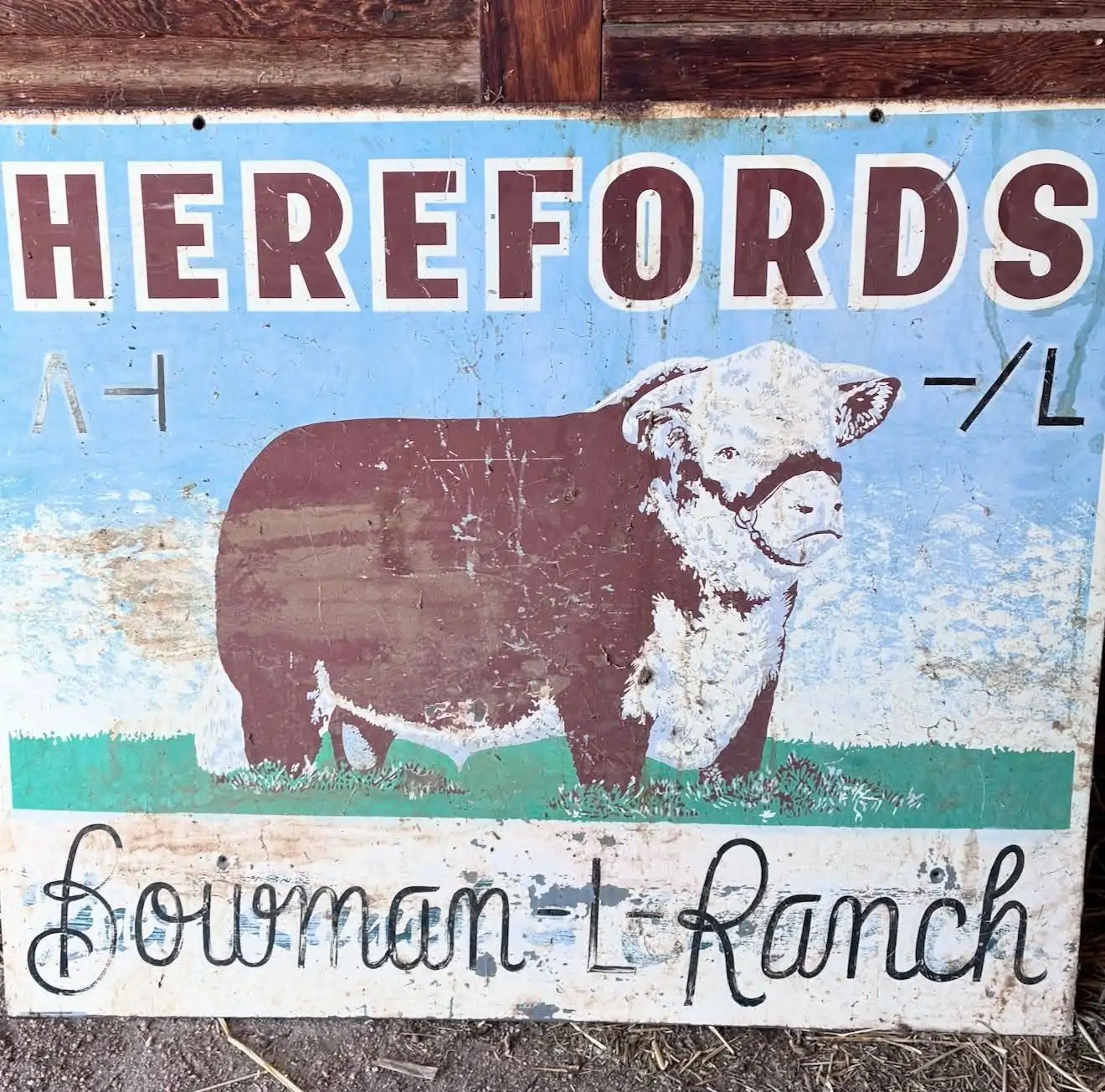
A couple last thoughts: the sign below hung on our barn. It was a source of pride. My parents were the founding, respective presidents of the Yuma County Cattlemen and Yuma County Cowbelles. Dad was the recipient of a prestigious conservation award for the work he did on our ranch.
We knew “our cows.”
We loved cows.
Yes, we should have federal policy that assures longevity of our producers … and guess what? There are environmentalist land steward organizations that want the same thing.
Yes, cows (and hoofed animals in general), are one great component to both regenerative agriculture and, yes, carbon markets. You know who launched the first (and wildly successful) environmental trading scheme?
George H. W. Bush.
He proved “markets” could (and did so) solve our “acid rain” problem.
So think differently: you can want more cows and have a vegan as your best friend (your farm neighbor feeds them). Go to Colorado’s next “Meat Out” day and don’t be a spectacle.
It’s one day a year.
Make a friend. Chill. I’m Catholic; we called that day “Friday” and it happened 52 times each year.
What have you got to lose? Has the gameplay of the last four decades given any of us something we can be proud of.
Rural America is a special place for all … even the visitors.
Let’s treat it as such and act accordingly.
Michael Bowman grew up and farmed/ranched between Wray and Idalia, in eastern Colorado. A graduate of Idalia High School, he now lives in Pasadena, Calif. He originally posted this at Facebook.

- The view of a hinterland native - August 25, 2026


Oh Alan, really enjoyed the Michael Bowman post.
A fine post.
I hate the divisions that have been manufactured for political purposes.
How do these thoughts get to the folks who need to see them?