
Wendell Berry understood what Harvard business professors and at least several agriculture secretaries did not. He understood culture.
by Kathleen Kelley
In 1957, when Harvard Business School professors John Davis and Ray Goldberg argued against Franklin Roosevelt’s New Deal programs, they coined a new term: agribusiness. In doing so, they deftly gutted the most important, life-giving word to farms and ranches.
Culture.
It was a “go to hell” moment for global food and fiber producers. Buried in the term agribusiness was the arrogant assumption that we as people intimately connected to the land should now be driven solely by the market forces of profit. “Agribusiness” was the hybrid of vertical integration and market concentration.
The word ignored an important fact. Culture is wealth.
I was a toddler when my father shared-cropped, building his farming operation, dancing through the politically driven nuances of the time. By the time I was in high school my father was, by necessity, swept up in the “swallow thy neighbor” mantra of Agriculture Secretary Earl Butz (Nixon and Ford administrations). When I was elected to the Colorado legislature in the 1980s, John Block (Reagan’s secretary of agriculture) carried like a war banner, “Get big or get out.”
Dad hated the greed that overwhelmed our culture. He railed against concentration of wealth. He worried over the impact of chemicals and the monster-sizing of equipment. He cursed his office’s ever-shrinking Rolodex of grain buyers. Cargill was a curse word.
At the same time, Dad admired and became part of a myriad of test plots on the ranch of the mind-boggling advances in genetics, kneeling and picking through test plots of triticale and Mexican Dwarf grains right next to their progenitor, Dr. Norman Borlaug, the Nobel Peace Prize laureate. Borlaug, the father of what in 1968 became known as the “Green Revolution,” was his ultimate hero.
As grain production increased, so did cattle size, driven by Davis and Goldberg’s mantra of economies of scale.
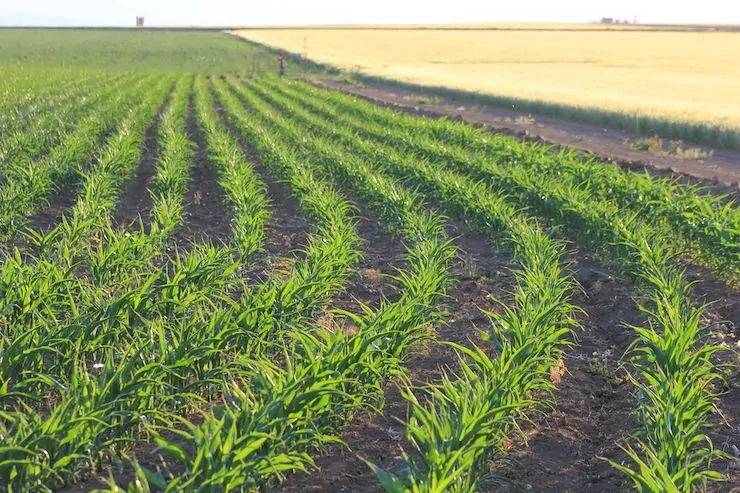
Corn growing in northern Colorado. Photo/Allen Best
Of course. Bigger is better. Think profit.
It’s easy to look back now and think how wrong-headed all of it was. But consider the terror of the time. A rapidly increasing global population and starving children with distended bellies. World War II veterans like my father knew those were the fertile seeds of war. We paid attention to things like famine in those days and worried over the death of a single child. Every parent in America guilted their children into cleaning their plates, “Think of the starving children in Africa and India!” We thought we were doing right by growing more. We didn’t want millions more to die, this time of hunger, after so many had died in World War II in the Holocaust.
Believing that farming was the most noble of professions, my father rose to the pinnacle of his profession. He served as president of the Great Plains Wheat Board, president of the Colorado Association of Wheat Growers, and chair of the Wheat Administrative Committee. In each position he and his fellow veterans warned that the concentration of wealth was going to destroy our democracy and our nation. His peers argued vehemently for antitrust enforcement, while Davis and Goldberg argued trust-busting was as passe and dead as Teddy Roosevelt.
I learned what it was to gavel down a hothead, to encourage the reticent speaker, to drive toward a consensus. I also learned when to compromise and when to be stubborn as hell.
But my father was becoming horrified at the increasing pressure from companies. They bought lavish dinners for board members. They funded retreats at fancy golf courses. Like so many leading national organizations today, boards that should have represented producers instead sold seats to corporations.
My weary, troubled father quit and came home. It was the consequence of severing culture from the earth and declaring it coldly, a business. What he called corruption had become entrenched as “doing business.”
Even watching the frustrations and risks my father lived through, I knew, at the core, I was agrarian. I tried to bury it. Who wanted the high-dollar risk? The tension of volatile markets, the terror of snow or hail on unharvested wheat or a sudden cold snap that killed new-born calves.
Although I loved college, I still needed chaff in my hair and critter sweat in the palm of my hands. I needed open air sunsets and dewy mornings. Axle grease. The rattling splash of wheat in the bin. Squeaking saddle leather. The curling breath of a cow on a winter morning. I just wasn’t sure all the risks were worth it.

Wendell Berry in the 1970s. Photo/Guy Mendes
Then “The Unsettling of America: Culture and Agriculture” by Wendell Berry transformed my life. I was attracted to it in the college bookstore, because it was about agrarian culture. And philosophy. And the angst I felt being separated from the ranch — the “unsettling” we all feel when the new place in which we must exist is irrelevant to our soul. It allowed me to reclaim and own my buried voice.
Concepts, ideas, clusters of thought poured across my lap as I hunched over and read and reread for days. Berry’s words destroyed the hollow corpse of “agribusiness” and redefined culture with depth and life and purpose. He wove the golden threads of agriculture through everything from politics to energy, relationships, to animals, to even the most intimate connections to our soul. I soaked it in…
“The world has room for many people who are content to live as humans, but only for a relative few intent upon living as giants or as gods…The specialists are profiting too well from the symptoms, evidently, to be concerned about cures…one must begin in one’s own life the private solutions that can only in turn become public solutions… you cannot damage what you are dependent upon without damaging yourself…the basic cause of the energy crisis is not scarcity; it is moral ignorance and weakness of character. We don’t know how to use energy, or what to use it for…” (Unsettling of America)
Wendell Berry’s philosophical tome started guiding me in college and has hummed in the background ever since. It was there when my dad called and said, “I’m retiring…do you want to farm?”
Berry’s words pushed the throttle of the combine in harvest, the ear tag on a newborn calf, and the trigger on a rifle when the most blessed alternative was death.
And Berry’s words were right there when Mike Callicrate, Bill Heffernan and I lobbed our salvos against the packers at a crowded South Dakota Beef Conference in 1996. Those words were there in every speech I ever gave at farm shows and farm and ranch conferences as I assumed my own leadership roles in various agricultural organizations from Farmers Union to R-CALF USA.
They were absolutely there when I sat down, researched and wrote a paper I couldn’t get published in Beef Magazine because it wasn’t “peer reviewed.” I laugh about that today. Their peers were the packers. They were Davis and Goldberg “agribusiness.” Of course they weren’t going to publish it. The paper, “Concentration in the Beef Industry,” was later published in the Gulf Coast Cattleman. (https://nobull.mikecallicrate.com/2022/02/11/packer-concentration-in-the-beef-industry-by-kathleen-s-kelley/) My peers were agrarian.
Dang it, Wendell Berry was not there when I had my teaching fellowship in 1986 at Harvard, just across the water from where Goldberg and Davis had coined their term “agribusiness.” Those gentlemen were still at the Business School when I was teaching the “American Farm Crisis” at Harvard. Ironically, I believe they had a hand in creating that very crisis.
I wish Berry had been there when Charles Schultze, Carter’s Chief of his Council of Economic Advisors told me when he discovered I was teaching The American Farm Crisis, “There is no farm crisis! We have a crisis in guts. We need to be getting rid of ⅔ of these damn farmers.”
Perhaps my retort was Wendell Berryian. “Farmers think we should get rid of ⅔ of the economists.” Schultze snorted and stomped off.
I had so wanted Berry to come to Harvard and speak to my study group. But, by then, he was too big of a rock star, nearly impossible to schedule. I wanted him to shout across the water to Harvard Business School: “Hey you! The word is AGRICULTURE!”
Instead, I was able to pull in Wes Jackson, a friend and colleague of Berry’s. Jackson was a self-described scientist focused on creating perennial grains through a slow, tedious process of meticulous plant breeding.
“You know I’ll be dead before I see the first, marketable perennial grain,” he said. It didn’t matter to him. Doing it right mattered more than the length of his life. He created and co-founded The Land Institute in 1976 with that focus. The evening of his lecture, Wes sauntered through Harvard Yard accompanied by myself and my husband, Reed. Our conversation shifted to Wendell Berry’s impact on each of our lives.

Wes Jackson makes a point during the annual Prairie Festival in 2012. Photo/Allen Best
Overcome by the starched, crimson, wistful dignity of a chilly, Harvard Yard, Wes suddenly shouted, “HEY YOU!” The bricks at Memorial Hall shook, and I’m sure Wes, giggling, later told his friend, Berry about his breach of Harvardian etiquette. Jackson looked at us and grinned, “I’ve always wanted to do that!”
Surely John Davis and Ray Goldberg heard his voice …
And perhaps Jackson’s roar is the key: live big in our clumsy humanness. To unapologetically push on flawed, as the struggling, brusquely bumbling creatures that we are until Earth shows us how to live and ultimately how we will die. To fight and rail and shake the ignorance out of the entitled disconnected down to their greedy core. To dig ourselves into the dirt, wallow in it, and love it. After all, isn’t it ashes to ashes? Dust to dust?
So tonight, I tip a little of that liquid earth to Wendell Berry and genuflect to my friends across the countryside who experienced Berry’s presence in the flesh. They saw him at seminars and lectures, at draft horse shows and bull sales, and thankfully, they made a point to share their stories with me recently at the announcement of his death.
I am now eternally jealous of my friends. I only saw Berry in a black-and-white photograph on the back of a book. But here’s the thing, I can go back to that incredible “Unsettling of America…” and read those timeless words and Berry will come alive once again.
And damn it all. I refuse to write that horrible cliche “Rest in peace,” for Wendell Berry. Free those soul-stirring words! In the wind, in the sun, in the rain, and in that black dirt, live! For this:
“The soil is the great connector of lives, the source and destination of all. It is the healer and restorer and resurrector, by which disease passes into health, age into youth, death into life. Without proper care for it we can have no community, because without proper care for it we can have no life.”
― Wendell Berry, The Unsettling of America: Culture & Agriculture
A native of Meeker, on Colorado’s Western Slope, Kathleen Kelley lives on a farm/ranch with her husband, Reed, who sometimes shouts with Jacksonian vigor “Hey you.” As for Wes Jackson, he will be honored at the Land Institute’s Prairie Festival on Sept. 25-27. You can also see and hear Jackson and Berry, along with Wendells’ daughter, Mary, at an event sponsored by the E.F. Schumacher Center for New Economics.

- Agribusiness and its antithesis - September 5, 2026

