
Study used new techniques to conclude that accumulating greenhouse gases likely made last winter’s strange winter 14 times more likely
by Allen Best
Winter in Colorado often has a shaky start. Skiing at Halloween? It has happened, even at places other than Arapahoe Basin or Loveland and before snowmaking arrived. It’s not the norm. Thanksgiving is more realistic, but even that should not be expected.
If the big storms don’t arrive by Christmas, though, people in ski towns get very nervous. Vail, the ski area, debuted in 1962 midway through an anomalously warm and dry December. To help things, co-founder Pete Seibert summoned Eddie Box Sr. from the Southern Ute tribe of southwestern Colorado to perform a snow ceremony.
Vail’s debut occurred three years before the first report about anthropogenic climate change was given to a U.S. president. It was in 1965 that the authors predicted an increase in atmospheric CO2 close to 25% by the year 2000. This, they said, “may be sufficient to produce measurable and perhaps marked changes in climate, and will almost certainly cause significant changes in the temperature and other properties of the stratosphere.”
They over-estimated the increase. By 2000, the atmospheric concentrations had grown by 15%. By now, however, they have increased 34%.
As for how much accumulating greenhouse gases impact our climate, that’s always a challenge to pin down. Without human-induced changes, climates have always had their ups and downs. That includes how much it snows — or does not.
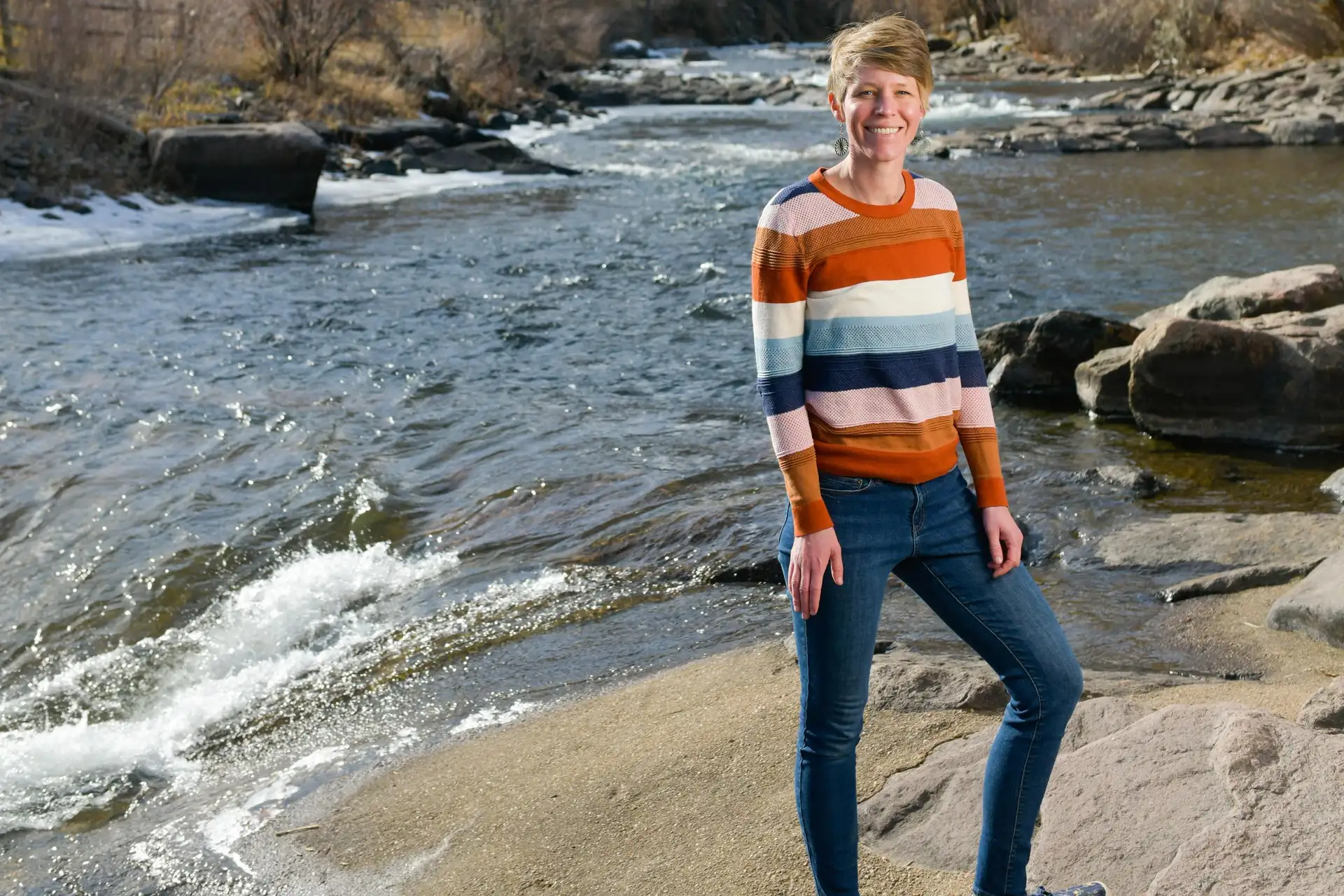
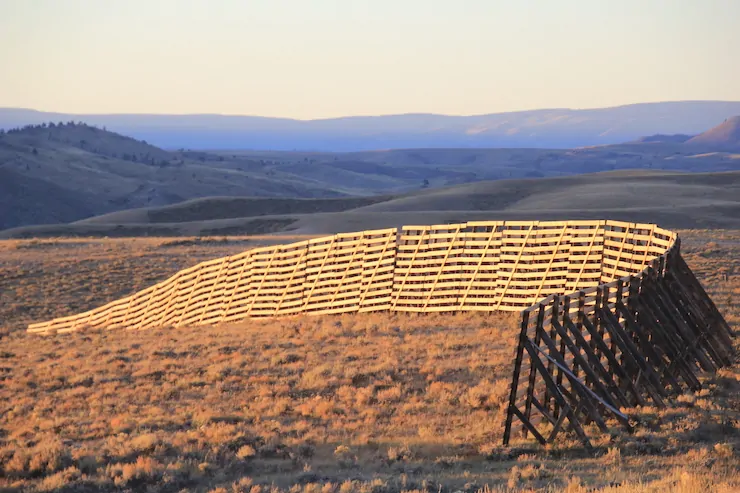
Adrienne Marshall is a “computational hydrologist” interested in snow, ecohydrology, permafrost, and hydropower. Her research interests are united by a desire to understand how climate change is altering water resources, and solutions to these problems from both adaptation and mitigation perspectives. Photo/Colorado School of Mines. Top, a snow fence near the Colorado-Wyoming border. Photo/Allen Best
Enter Adrienne Marshall, an assistant professor of hydrologic sciences & engineering at the Colorado School of Mines. Last December she and three other scientists at universities in mountain states were toying with using relatively new methods for producing probabilistic models about snowfall.
The discipline is called extreme event attribution, and it was first used in the wake of the heat in 2003 that killed 70,000 people in Europe. The question, perhaps obviously, was how much was that heat caused by global warming? A study published in Nature in 2005, found, with a confidence level of 90%, that the greenhouse gases likely doubled the likelihood of heat of that intensity occurring.
This computer-aided work has also been used to analyze the role of human-caused greenhouse gas emissions in other extreme events during the last two decades. But not for snow.
In December 2025, Marshall and her colleagues decided they would do so, using some low snowfall winters of the past. But as the low- and no-snow winter moved through January and then February, they instead decided to use this technique given the snow-water equivalent of March 15.
They asked to what extent was the 2026 snow drought in the Western United States attributable to climate changes that have occurred since the preindustrial period?
The results are shocking. But then, so was the low-snow, very warm winter.
With 95% confidence, they concluded that the snow drought across the West — including California and the Columbia River drainage as well as the Colorado River Basin — was 4 times more likely than in pre-industrial times.
In the upper Colorado River Basin, the snow drought was approximately 14 times more likely. In that conclusion, though, there was greater uncertainty.
Marshall presented her findings in a session in the Geological Society of America conference in Denver on Oct. 14. The study was originally published in July by PNAS, a scientific journal.
Afterward, I talked with Marshall about the study approach and the findings. One question I had was whether the numbers were surprising.
Yes, said Marshall. “There really haven’t been, to my knowledge, snow drought attribution studies. We had no previous numbers guiding my expectations. I was surprised to see signals as strong as we get here.”
Why had nobody done such a study before?
This field of extreme event attribution, still relatively new, is still evolving, she said, but in the case of snow there’s the added challenge of computer models that, while improving, struggle to reflect the topography of mountainous areas.
This is not a new challenge. I have been hearing about it for 15 to 20 years of my reporting in stories about impacts of warming temperatures to mountainous areas of Colorado. The global -scale computer models are easier in flatter areas.
Now, Marshall told me, the resolution of global-scale models has improved, but they still ranges from dozens to hundreds of kilometers. In other words, if the resolution has improved broadly, the improvements vary. Also keep in mind that the sharp edges of the San Luis Valley — the mountains east and west — would barely be suggested in a global climate model.
To overcome this, one of the researchers, the University of Wyoming atmospheric science professor Stefan Rahimi, downscaled the grid to a resolution of nine kilometers. That’s not enough to tell you about individual ski resorts, say Vail or Telluride. “But is fine enough to give us a good idea of how much snow we might expect in total in the mountains.”
Why the remaining uncertainty in the conclusions about the headwaters of the Colorado River? That, said Marshall, is because the snow-water equivalent of mid-March was so extreme. A less dramatic winter, in contrast, would have allowed greater certainty.
Using the same techniques, Marshall and her colleagues also conclude that across the West, the annual probability of a snow drought as severe as that of 2025-2026 would triple by the 2050s and become more common than not by the 2090s.

Even if February, the weather in Colorado was suitable for shorts and displays of mid-drift, as was the case on this Saturday afternoon in Olde Town Arvada. Then came March, with 90 degree weather and new heat records almost everywhere across Colorado. Photo/Allen Best
Of course, the snow year became more extreme yet with the heat dome that settled over Colorado after their chosen date of March 15. In late March, temperatures records across the state were shattered, in many places by wide margins and for multiple days. Fort Collins, for example, had a 91-degree day during that wave, a temperature that had never previously been recorded until May — and even then, rarely. (In early October, Fort Collins again had two 90-degree days — a first for that month).
The paper has been well received by other scientists, according to Marshall. However, some wondered why the study did not use a snow-water equivalent of mid-April, to reflect impacts of the heat dome that evaporated much snow.
The study results also got a lot of press, but Marshall saw that as a two-edged sword.
“It is gratifying that people are interested in understanding how climate change is affecting the world we ae living in,” she said.
But some people, she added, find it overwhelming, leading to a sense of hopelessness. That, Marshall told me, is exactly opposite of what she hopes. The outcomes are not predetermined. Greenhouse gas emissions can be tackled.
Addendum: Adrienne Marshall this summer received a National Science Foundation CAREER Award of $737,140 to research how extreme snowpack conditions are evolving in the West. This work will draw on measurements from as far back as 1950 to expand the picture of how snowpack has been affected by high and low extremes over long periods of time. “We really want to understand how snow is changing,” Marshall said. “It varies so much year to year that the longer record we can have, the better we can understand what’s happening.” See more here.

- Last winter’s snow drought and the thick fingerprints of climate change - October 19, 2026
- Jared Polis on money spent on wildfire risk - October 15, 2026
- Xcel’s Robert Kenney on storage and other thoughts - October 14, 2026

