

Platte River Water Partnership completes a necessary step in effort to capture remaining water entitled to Colorado before it flows into Nebraska
by Allen Best
Ron Redd expects he will be retired when water pumped uphill for 125 miles from the lower South Platte River near Sterling begins arriving at Parker and neighboring communities in Denver’s southern suburbs. That’s likely to be another decade, maybe even beyond 2040.
If things go well, though, he’ll participate in the celebration of the project completion.
“My job is to lay the tracks for others to come in and complete it,” said Redd, the manager of Parker Water & Sanitation District, which delivers water to Parker and also the adjoining jurisdictions of Castle Pines and Lone Tree. “It’s kind of a weird feeling, but I feel comfortable.”
The Platte Valley Water Partnership recently achieved what he and others described as a milestone. The water court in Greeley awarded the water diversion project junior water rights with dates of 2021.
Parker and its partners, Castle Rock and the Sterling-based Lower South Platte Water Conservancy District, have no illusion that the water rights will enable them to store and then use water every year. Instead, they expect to get water in just enough years, even in this time of climate warming, to justify the $780 million to $1.2 billion estimated cost.

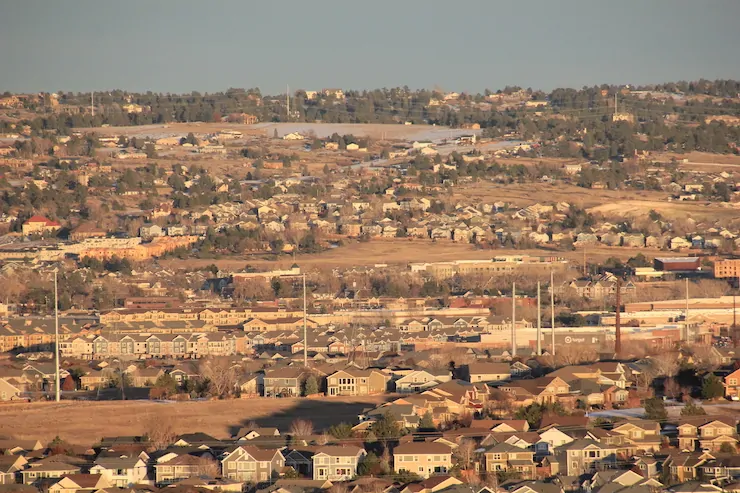
Castle Rock is a partner in the plan to capture flows otherwise flowing into Nebraska but allowed to Colorado use under the interstate compact governing the South Platte River. Photo/Allen Best
South-suburban communities rely heavily on extracting water from several underlying Denver Basin aquifers. Until the 1980s and 1990s, they remained relatively small places. Unlike Denver and most other northern Front Range places, they did not lie downstream from rivers, able to exploit runoff from the mountains. Nor did they need to. The aquifers contain vast amounts water.
But the quantity of water is not so vast as to continue the overwhelming dependency of the now large and still rapidly growing South Suburban communities. In the case of Parker, 20 yeas ago it got more than 90% of its water from the aquifer. Now, it’s 60%, but that leaves Parker Water’s communities in need of diversified resources as their combined population grows from the current 78,000 to 152,000 at midcentury. Castle Rock, now at more than 80,000 residents, expects to grow to 150,000 to 160,000.
The Sterling-based conservation district has no expectations of substantial population growth. Instead, it primarily serves farmers. By working with the South Suburban communities, it expects to add major new water storage and other infrastructure that allow more reliable farming operations.
The rights awarded by the water court in Greeley are distinctly junior, dated 2021, in a place where some water rights date to the 1870s or even before. Securing those water rights took seven years.
“It’s step one of many steps in front of us,” said Joe Frank, general manager of the Sterling-based district. “We are excited to move forward with remaining components of this project.”
Parker Water, under a prior chief executive, Frank Yeager, more than 20 years ago had begun buying farms in the Sterling area, driven solely by the value of their water. Redd arrived at the district in 2014 after a 14-year stint overseeing water operations in Castle Rock.
By 2016, Redd had become persuaded that the best interests of Parker were to work with the farmers in the Sterling area so that there was something in it for both of them. That included not drying up the farms for their water.
Among the components of this project is a new reservoir in a valley near Akron. Fremont Butte is the most immediate geographic feature. There lies a shallow basin with clayish soils that will leak less water into the underground. The plans call for 70,000 acre-feet of storage.
That capacity compares with the 75,000 acre-feet of Reuter-Hess, the reservoir between Parker and Castle Rock that can be briefly glimpsed when driving on I-25. Wolford Reservoir, near Kremmling, can hold 66,000 acre-feet. Cheesman Reservoir, on the South Platte River in the metro area, has a capacity of 79,000 acre-feet.
Redd said Parker has purchased half of the 3,000 acres needed for the reservoir near Akron. Owner of the remaining land wanted to wait until the water rights were awarded by the state.
Much later will come construction of a pipeline from the reservoir near Akron that will extend past Fort Morgan for 125 miles to Reuter-Hess, the reservoir between Parker and Castle Rock, along with associated pumping stations.

The reservoir would be built northwest of Akron, near Fremont Butte, from which this photo was taken. Photo/Allen Best
Underlying this massive investment is the assumption that the river will have enough years of excess flows that there will be additional water for the farmers near Sterling as well as water for the South Suburban cities.
Nebraska has sued Colorado over water in the South Platte River. Central to that lawsuit is an attempt to divert water from the river within Colorado via the long-ago conceived Perkins Canal. The canal would divert water from between Brush and Sterling.
From his post in Sterling, Frank sees the canal, if constructed, causing a “small hit” to the South Platte Partnership plans “but not enough to make a significant impact.”
Might the warming climate reduce flows in the South Platte sufficient to sully the economics? If anything, say the project architects, a warming and drying climate creates an even stronger argument for having more storage.
Frank says the modeling conducted took into consideration low flows during years of the past. What those low-flow years demonstrate is the need to capture and store water when it is available.
As for long-term drying, Redd is skeptical of the value of waiting. The worry about declined flows paralyzes people who have urged the district to wait 20 years to see if the trends recently observed will be ongoing.
Redd sees climate variability as the fundamental story, not a warming and drying climate. “I would argue that 20 years is just a blip,” said Redd. He points to the climate of the 1930s, hot and dry in dimensions only recently surpassed. “This is the best information we have today.”
“We are always looking at the past and projecting the future,” he said. “It does highlight the need for new storage to capture water when it is available.”
Ron Redd hopes to reduce the per-capita water use within Parker by half as new homes with landscaping that requires less water get built. Photo/Allen Best
Parker Water projects an average annual yield of 22,000 acre-feet. At this point, the district needs 9,000 acre-feet annually for Parker and the two neighboring jurisdictions with which it has contracts. By the 2040s, Parker hopes to be entirely on renewable water sources, using groundwater only as a backup.
Part of the plan for both Parker and Castle Rock is reducing per-capita use. Both jurisdictions have taken aggressive steps in recent years.
In Parker, reports Redd, the average use is somewhat less than 16,000 gallonsper month during peak summer months. Three-quarters of that is for outdoor uses.
“I want to cut those numbers in half,” he told Big Pivots. “We will have another 70,000 people show up, and if they use half the irrigation water that is now used, that makes a substantial reduction” in needed water.
Pulling down the average will be done primarily through changes in landscaping in new housing. Parker has incentives to retrofit existing landscaping to use less water. It can be done, but it’s not easy.
“I know people who have changed out their landscaping, and it’s beautiful, but they spend $18 to $20 a square foot.”
Parker is also using prices to discourage high use, incentivizing low-flush toilets, and monitoring use by the 900 large-consumption customers. Excessive use can result in fines. One homeowners’ association had leaks in its system that resulted in loss of one million gallons a month.
The next step for the Platte Valley Water Partnership will be a draft environmental impact statement, which the partners think can be accomplished by February 2027. They hope for approval in February 2028.

- Very junior, but water rights they are - October 21, 2026
- Last winter’s snow drought and the thick fingerprints of climate change - October 19, 2026
- Jared Polis on money spent on wildfire risk - October 15, 2026

