

Retirements of coal units at Craig, Hayden, Pueblo and Colorado Springs all in flux
by Allen Best
Coal plants in Colorado a year or two ago seemed clearly on their way to imminent retirements. Two of the state’s nine units were scheduled to retire at the end of 2025 with all others planned to burn their last loads before the end of 2030.
Now, coal seems unready to exit quite so fast. Utilities may ask for delayed retirement of several plants, one of them until 2033 or conceivably beyond.
A concept called resource adequacy has increasingly entered into conversations when energy people get together. Do we have enough electricity generation as demand grows from EVs, electrified buildings and, most of all, from data centers?
Plants at Craig, Hayden, Pueblo and one near Colorado Springs are all in play.
Front and center are Xcel Energy’s coal-fired plants. The utility had planned to close Comanche 2, its aging plant in Pueblo, by the end of 2025. That would have left Comanche 3 operating with a retirement planned in 2030.
Those plans ruptured last summer when Comanche 3, the largest and youngest plant in Colorado, went down – again. It has been an extremely unreliable source of electricity almost since it went online in July 2010.
Xcel proposed — and the Colorado Public Utilities Commission agreed — to keep Comanche 2 operating. Some in the environmental community suggested just being done with the 750-megawatt unit. Xcel, in a March 2 filing with the PUC, said it hasn’t figured out how to get by without Comanche 3 before the end of 2030. As for fixing the unit, it doesn’t see that happening before August. It has not publicly identified the cost of doing so.
As for Xcel’s two Hayden coal-burning units, they are scheduled to retire by the end of 2027 and 2028. In the same PUC filing, Xcel suggested it might propose to keep them open a year longer or, conceivably through 2030. It is scheduled to make a formal proposal in June.

Xcel Energy says that it cannot get Comanche 3 running again until August, a year after it went down — again. The coal plant is also owned by CORE Electric Cooperative and Holy Cross Energy. Photo/Allen Best
Irony weaves though all this. The coal plants are presumed necessary to ensure resource adequacy, to keep air conditioners, in particular, operating. And, oh, data centers, too.
It’s true that the sun goes down and the wind dies down occasionally in even the windiest places in Colorado. But coal hasn’t had a great track record. Xcel’s coal units at Hayden were shut down on Nov. 29 after an air pollution scrubber partially collapsed. Both units were expected to return to service by mid-March.
The simple math here is that Xcel suffered a net loss of 859 megawatts of generating capacity through winter. That’s well more than half of Xcel’s coal-fired capacity. It is, by the way, the utility responsible for more than half of Colorado’s electrical sales. Yet, Christmas lights stayed on except in places where Xcel shut off power because of worries about wind-spread wildfires.
No wonder some in the environmental community are skeptical of these efforts to delay our exit from coal.
“So, two of Xcel’s three coal plants are broken down for significant periods of time, and what does the company hint that it wants to do next? Rely on more coal to fix the problem that aging coal plants got them into in the first place?” said Eric Frankowski, executive director of the Western Clean Energy Campaign.
“It’s mind-bogglingly backwards thinking,” added Frankowski. “The PUC and state officials cannot allow Xcel to stick Coloradans with the costs of extending the life of coal plants that are already the most expensive and dirtiest sources of power in the state – and clearly not all that reliable, either.”
Xcel, though, has been warning since February 2025 of looming resource adequacy issues during the next few years as it struggles to get replacement generation and transmission assembled. The utility has not, however, shared ambitions of keeping its coal plants operating beyond 2030. That’s the targeted year for Colorado utilities to reduce emissions 80% as compared to 2005 levels.
An emergency in Craig
Then there’s Craig. Since 2016, a coal-burning unit there was scheduled to retire by the end of 2025 because of air quality impacts. That unit went down in December, too, just days before its scheduled retirement.
As such, Craig No. 1 was idle on Dec. 30 when the Trump administration told Tri-State Generation and Transmission Association and other owners to keep the plant available for electrical generation, to ensure adequate supplies in Colorado and adjoining states. Yes, a broken coal plant was needed for reliable electricity.
Secretary of Energy Chris Wright cited the 202(c) provision in the Federal Power Act, a 1935 law expanded in 1977. The law gives the U.S. government authority to intercede in utility operations in emergencies. Wright had previously used that same questionable authority to order fossil fuel plants in Michigan and Pennsylvania to remain open or to resume electrical generation.
Tri-State got the plant fixed by around Jan. 20 but has not yet been asked to fire it up. As for the “emergency,” none has arrived yet. No real surprise there. The organization responsible for evaluating regional electric reliability had said in November no resource adequacy issues were expected this winter. Generating capacity was well within the reserve margins.
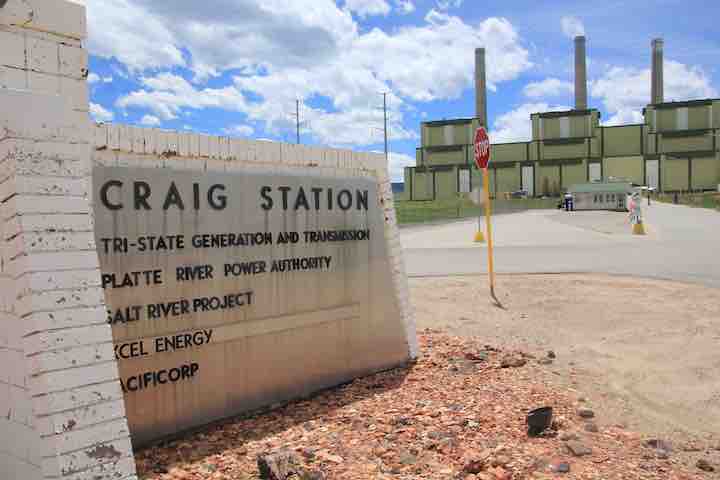
The Department of Energy ordered Tri-State and its co-owners of the Unit 1 to keep it available. Tri-State and Platte River, two of the owners in Colorado, say they are unfairly being burdened with the cost of keeping a unit operating that they do not need. Photo/Allen Best
In late January, Tri-State and Fort Collins-based Platte River Power Authority, one of the unit’s co-owners, appealed the Department of Energy decision. Their essential argument is that they are being saddled with the expense of keeping a plant operating that they don’t need. The federal agency on March 2 denied the appeal.
Wright’s agency also did not respond to appeals by the Sierra Club and other conservation groups. The most exhaustively argued appeal was filed by Colorado Attorney General Phil Weiser. The 92-page document told the federal agency it was out of line. He cited a report by the Colorado PUC last August that found the coal unit “is not required for reliability or resource adequacy purposes” based on the available evidence.
Weiser mentioned the disagreement with the federal government about the Craig orders last week during his speech at the Colorado Solar and Storage Association conference.
“This illegal order — again predicated on a fictional ‘energy emergency’— will result in millions of dollars of unnecessary costs for rural Coloradans already facing high energy bills, while also increasing pollution and harming public health. There is no sound reason to keep this facility open, and I am challenging this action as an unlawful intrusion into state authority to chart our own energy future,” he said.
After his speech, asked for clarification of what he has in mind, Weiser had a one-word answer: “litigation.” As for Tri-State, it has said it is evaluating its options. It has not identified the costs required to reopen the coal unit and keep it available. It has two other units at Craig, so resources are shared.
The 90-day orders for Craig will almost certainly be renewed by Wright, based on what he has done in other states. A bill moving through the state legislature assumes that Wright will also issue orders for the continued operation of other coal burning units in Colorado.
Legislative pushback
The bill, HB26-1226, “Manage Emissions from Electric Generating Units,” would require that Xcel and Tri-State report costs and emissions information to the state’s Public Utilities Commission within 150 days after getting federal 202(c) orders. These reports must include the costs to operate the unit and the amount of electricity generated by the unit as well as resulting emissions. The information must be made available publicly.
This would provide information showing the cost of the federal orders to farmers, ranchers and others in many parts of rural Colorado.
“While we don’t have the authority, unfortunately, to override those orders, the bill tries to manage the cost of environmental impacts, primarily through reporting to the PUC, so we can understand the financial and environmental impacts,” the Sierra Club’s Matthew Gerhardt, the organization’s senior attorney in Colorado, told House Energy and Environmental members during a Feb. 26 hearing.

Two competing bills have been introduced in the Colorado General Assembly.
Essentially, the Sierra Club is betting that whoever follows Trump will not resort to extraordinary use of the Federal Power Act to keep coal plants operating. After all, none had before, either Democrat or Republican.
Currently, half of the coal-burning units in Colorado have the most-effective pollution controls for nitrogen oxides and sulfur dioxide, he said. Of Colorado’s nine coal-burning units, five have no equipment to control release of nitrogen oxides.
Proponents of HB26-1226 have an easy talking point: the the elevated cost of keeping coal plants open. “Federal orders like this raise electricity costs by forcing customers to pay for plants that were already planned for retirement,” said Rep. Jenny Willford, a Democrat from Adams County and bill co-sponsor. “It increases air pollution, particularly nitrogen oxides and sulfur dioxide, which worsen ozone and harm public health. And it undermines, again, Colorado’s ability to manage our own energy.”
KC Becker, a former state legislator, told committee members that when coal plants are slated for retirement, they’re exempt from installing the most modern pollution control devices. “If these coal plants are kept online they should be required to operate with high environmental standards.”
Ray Nixon to 2040?
That takes us to Colorado Springs, also a target of the same bill. The city’s utility operates the Ray Nixon plant. It’s about 20 miles south, near Fountain. The plant had been scheduled to close by 2030. A year ago, Colorado Springs Utilities — commonly known as CSU — began saying there was no way to keep the lights on without keeping the coal burning at Nixon beyond 2030.
At times, CSU has even suggested it needs until 2040 to quit coal. That date has also emerged in a bill SB26-022, “Challenges Meeting 2030 Emissions Reduction Goals.” It is sponsored by three Colorado Springs-area legislators and Sen. Minority Leader Cleave Simpson, a former coal utility engineer from Alamosa.
The case of Colorado Springs came into sharp focus at the legislative committee devoted to HB26-1226. If adopted, the bill would force CSU into installing equipment to reduce sulfur oxide emission from its Ray Nixon plant by 2033. That, the utility estimates, would cost more than $120 million. Or, it could somehow figure out how to survive without the coal plant by that same year.

Colorado Springs Utilities says it desperately needs to keeo the Ray Nixon plant operating until sometime in the 2030s. It had previously agreed to close it by 2030. Photo/Allen Best
At a minimum, this moves the goal post for Colorado Springs three years into the future. CSU, though, professes great unhappiness.
Affordability is the primary argument of the utility in opposing the HB26-216. It says having to install pollution control equipment will strap the utility financially, causing it to raise rates that have already started rising rapidly. It needs time to get the alternative generation it needs.
The Ray Nixon plant is paid for. “We cannot retire that unit before 2035 and maintain affordability and reliability,” said Daniel Hodges, the manager of government affairs at CSU.
“We’re asking for a life preserver,” he said. “Please do not throw us an anchor.”
Platte River Power Authority has much the same argument. It operates the Rawhide power plant north of Fort Collins. “While public power utilities are committed to responsibly retiring coal-fired assets, we are facing serious headwinds and increasing cost pressures,” said the utility’s Leigh Gibson at the legislative hearing. “We cannot retire existing dispatchable generation assets until we have proven resources in place to firm up intermittent renewable generation.
The bill, if adopted, could cause Platte River to spend more than $100 million in pollution control equipment, Gibson said.
CSU has not stood completely still since it closed its Martin Drake coal plant near downtown Colorado Springs in 2022. It has added both solar and storage. But the utility ran into an “economic buzzsaw in about 2024,” said Hodges, when prices for renewable generation came back higher than had been expected. And it needs transmission.
“That’s what we’re asking for, the time for us to get those wires in the ground so we can access more affordable and abundant clean energy resources,” said Hodges.
The obvious question, though, is why some utilities have been able to go forward and CSU had gotten stuck. United Power, the electrical cooperative north of Denver, with 120,000 members, left Tri-State in April 2024 and reports no problems. It probably has Colorado’s fastest growth in electrical demand. It, however, has no legacy coal plant.
Conflicted thoughts
State Rep. Amy Paschal, a Democrat from Colorado Springs, explained her agonized, conflicting thoughts at the legislative committee hearing. She said Colorado Springs does struggle economically. “Affordability is a very real issue for Colorado Springs.”
Paschal also noted that some have said CSU has not done its due diligence. “Yeah, they probably haven’t done everything they should have done, but we are where we are,” she said. “I don’t know where we are.”
So far, CSU has not delivered a plan of how to get beyond coal. Ironically, Paschal is co-sponsoring a bill that would allow CSU to move the deadline to 2040. That bill has not been heard in committee.
She has indicated she is very disturbed by the absence of any semblance of a plan by CSU.
CSU hasn’t said so publicly, but that plan may involve litigation. The Pikes Peak Bulletin reported on March 3 that the utility’s CEO, Travas Deal, said at an employee meeting that the “gloves will come off” if Colorado doesn’t allow CSU to delay closing the Nixon plant. When the Bulletin pressed CSU for what that meant, it got no real answer.
Still unclear is just how much this concern about resource adequacy at Colorado Springs and elsewhere is driven by expanding needs for new data centers. The Bulletin, for example, reports CSU has received requests for 1,370 megawatts of electricity from 10 data center developers. The Nixon plant can generate a bit more than 260 megawatts.
Expect to hear about resource adequacy more and more in coming months — often, in the same sentence or at least same paragraph as data centers.
As for the end of the coal era in Colorado, it will inevitably end because of simple economics. Exactly when remains in question.
Background stories:
Kick the (coal) can down the road. Jan. 13, 2026 Big Pivots
Xcel can fix downed coal unit at Pueblo but at what cost? Jan. 22, 2026 Big Pivots
A hiccup for coal on its farewell tour in Colorado. Jan. 8, 2026 Big Pivots
Oh, the iron of Craig No. 1! Dec. 31, 2025 Big Pivots
Does delaying Nixon retirement make sense? Dec. 9, 2025 Big Pivots
Will feds order Colorado coal plants to remain open? Nov. 3, 2025 Big Pivots

- Unexpected voices in the national climate debate - October 6, 2026
- Electrical transmission and interstate highways - October 5, 2026
- Paleontologist to become next CEO of Denver museum - October 2, 2026


Interesting! What is “adequate?” How is it related to “reliable?” It seems that not long ago we (all over the US) were told that more interstate transmission would allow surplus variable power to be wheeled back and forth. Now this seems to imply that we (here in CO at least) can’t depend on that power. One perspective that these buzzwords are being overused. https://www.utilitydive.com/news/nerc-overstates-reliability-risks-ltra-grid-strategies/814292/
Kinda like “safety” and “security.”
I also seem to recall various “orgs” and the “Consumer Advocate,” not long ago, celebrating the PUC trimming back Xcel requests for a large tranche of wind, solar, maybe batteries and gas backup.
EIA 2025 data is out now. For CO as a state, wind power had a comparatively off year compared to 2024, and solar increased by the smallest amount since 2021, so renewable generation didn’t really budge. Contrary to impressions, total electric consumption didn’t go up and hasn’t gone up since 2018! If peak demand is going up, I guess it’s mostly the increasing heat and AC penetration. Hopefully EV charging is not happening too much on peak. Maybe we need to bump up our game on various peak shaving, TOU rates and response, storage, etc.
I’ve made this mistake before! As far as I can tell, EIA “retail sales” electric, which I call “consumption,” do not include net-metered or behind-the-meter or on-site PV generation which EIA also calls “small-scale” PV.
As of 2025 that’s between 4-5% of total generation. So consumption is 5% greater than sales. Since onsite PV usually produces a fraction of output at summer peak, that makes increasing peak demand much less surprising. It also means that CO electricity consumption has not been flat over ten years, but increased by 5% or so.