
Key sponsor of guardrail bill blames opposition of labor. Others familiar with the debate point to more complicated causes. This debate to be continued.
by Allen Best
State Sen. Cathy Kipp spent nearly all of Mother’s Day on the data center bill that she had worked on for the prior year.
“Oh, we had a nice family dinner,” she said on Monday night as she waited for the Colorado Senate to reconvene.
Nearly all her Sunday, though, and that of others had been devoted to the last-minute work on SB26-102, “Large Load Data Centers.” It was scheduled for review by the Senate Transportation and Energy Committee on Monday afternoon. “Everybody busted their butts all weekend,” she said.
Time was of the essence. By law, the legislative session was to end on Wednesday.
Kipp arrived at the Capitol Monday morning thinking she had the votes to get the bill across the finish line. Soon, she realized she had been mistaken. Emerging from an elevator, she saw representatives of key labor groups lobbying other legislators to oppose the bill.
The labor unions representing electricians and pipefitters had wanted Colorado to adopt incentives to draw large-load data centers. That had not been part of Kipp’s original bill.
It had been the central feature of the bill — HB26-1030, “Data Center and Utility Modernization” — introduced in January by Rep. Alex Valdez, a Democrat from Denver. He couldn’t find the votes to get it out of the committee that he chaired. Several days before, on May 7, he had killed it. The procedure is called postponed indefinitely. PI’d, in the informal jargon at the Capitol.
Kipp’s compromise completed over the weekend would have provided incentives, but not as generous as those in the Valdez bill: just two per year from 2029 through 2034. It would have provided the mechanism to ensure builders of the data center would have to hire union trades.
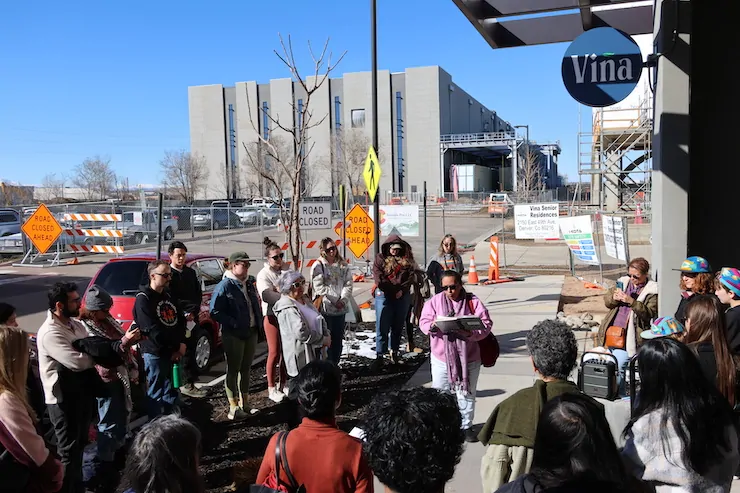
With a new data center in the background, residents of the Swansea neighborhood of Denver and others shared grievances at a March 7 rally. Another meeting two weeks before had attracted hundreds. Photo/Allen Best
Also left intact were provisions spurred by the heartburn in Denver’s Swansea neighborhood when a data center began construction without consultation with neighbors. Community review was to be mandated in this state legislation — a defect that Denver has recently modified in its review process.
Addressing the House Energy and Environment Committee on Monday afternoon, Kipp spoke with frustration tinged with anger and sadness in explaining her request to PI the bill.
“Last year I told everybody at the end of the season that I was planning to run this bill. We have spent a full year working to craft something that works for Colorado’s reality, drawing lessons from other states, responding to feedback, and trying to build something genuinely groundbreaking.”
Kipp mentioned a poll commissioned by Conservation Colorado. The poll in April found that 91% of the 800 likely voters contacted agreed with this statement: “Colorado should implement common -sense rules to protect ratepayers, communities, and our natural resources like air and water from unrestricted data center growth.”
(The poll is somewhat confusing, showing 82% for a “net” agreement with that statement, with Democrats at 94%, unaffiliated voters at 80% and Republicans at 70%).
“I don’t think it’s a stretch to say that 91% of Coloradans also don’t want to write a blank check to some of the richest companies in the world, companies that have reported record profits in recent quarters,” she said.
“We really wanted to ensure that we had accountability and transparency, that data centers were required to pay their own way, that we had support of public benefit programs, that there would be annual reporting on industry wide impacts, including water usage and electricity usage,” she said.
“We tried to put in community protections to make sure that there is public engagement before permitting happens,” she said. “We actually took language out of the other data center bill and put it into ours. We really thought we were threading the needle.”
As for incentives, the most controversial element, she pointed out that positions varied greatly. That was an understatement.
“We’ve heard from many stakeholders who didn’t want an incentive at all, who would have preferred a moratorium or even a ban on data centers in Colorado. We’ve heard from others, including labor, who said an incentive was important. We took both seriously. We worked diligently to design a competitive, limited incentive with real guardrails, one that would bring the best actors to Colorado without putting Colorado taxpayers on the hook. That is genuinely hard to do,” she said.
“We didn’t want to be a blank check forever,” she said.
Colorado’s state government is pinched financially, she pointed out, causing what she said were “heartbreaking cuts to programs people depend on.”
Many states, both those dominated by Republicans and Democrats, have been rolling back tax incentives. “States that offered incentives without guardrails have seen their incentives balloon into the billions.”
Kipp, a Democrat from the Fort Collins area, told the committee members she would return with another data center bill next year. It will include incentives to developers, she said, but she also warned that public sentiment is on her side.
“These companies need to come to the table understanding the harms their operations can cause to the communities and to our grid and be accountable for that. Colorado communities are deeply worried about what this unrestrained development means for their water, their air quality, their electricity bills, their farmland and their neighborhoods. We expect companies that come to Colorado to show up thoughtfully, with respect for the communities that they’ll operate in.”

Nearly all data centers in Colorado are located in urban areas, but developers have shown some interest in rural areas, including this area of Logan County, northwest of Sterling. Photo/Allen Best
Moments later, before the bill was officially PI’d, several committee members credited Kipp with her hard work.
“I know you’ve put a lot of hours into this, a lot of conversations, so I’m sorry to see that it didn’t come together,” said Sen. Matt Ball, a Democrat from Denver.
Sen. Lisa Cutter, a Democrat from Jefferson County, offered the most pained remarks. The data center issue may have provoked the most e-mails to her office she had ever received. “People are overwhelmingly against any kind of incentives.”
The killed bill means neither incentives nor guardrails. “Which is really, really troubling,” said Cutter.
Comments offered by Sen. Byron Pelton, a Republican who represents most of northeastern Colorado, were the most revealing. A former Logan County commissioner, he mentioned the many meetings in Sterling since last autumn centered on disagreements about what the rules and regulations should be governing data centers and the energy needed to power them.
See: “Difficult decisions on Colorado’s eastern plains.”
Pelton said he had found the positions of labor unions puzzling, as they had opposed artificial intelligence but wanted incentives for data centers. It was, he said, “like the trees in the forest voting for an ax because it had a wooden handle.”
“I think everybody’s just not there yet,” said Pelton, “but I think you’re close, so definitely having another year to work on it would be good, especially when it comes to local governments, because I kept getting text messages this morning from county commissioners saying it’s still not there yet. It’s still not there yet.”
Pelton’s mention of county commissioners points to a more complicated mosaic of opposition than the labor unions blamed by Kipp and environmental allies. The pushback was widespread.
I had reached out to a dozen organizations or individuals. I heard back from only a handful, and they were almost exclusively background-only conversations.
“Nobody is to blame for that one being PI’d,” said one source. “Too many concerns with too little time to negotiate fine points. I think a good bill with something for everyone to love (and hate) will likely come together over the summer.”
Labor groups indeed had heartburn about Kipp’s bill. They had felt shut out of the negotiations by environmental groups who had done the hard work of recrafting the bill after a March hearing.
Notable was the absence of support from utilities. Xcel sells roughly half the electricity in Colorado, but there are dozens of electrical cooperatives and municipal providers. One source from this sector said that even those adamant about reduction of greenhouse gas emissions found several provisions problematic. A case in point was the requirement for balancing clean energy requirements on an hourly or daily basis. In the physical world, that is an impossibility.
Then there were the local governments. Kipp, with whom I spoke at length Monday evening, mentioned the opposition of Colorado Counties Inc. I reached out to CCI Tuesday but got no response. But another source said that local governments believed the data center bill intruded on local land-use siting authority.
In her telling, Kipp and her allies had easily a hundred meetings with various parties as they tried to get this bill shaped. That included the labor groups.
“They claimed that we never reached out to them. That is just not true. We have been talking with them the whole time. We were trying to see if we could find a way to give incentives that we could agree with,” she said Monday night. “We walked into the building this morning and it’s not good enough.”
Kipp described the pipefitters as being worried that the clean energy transition will cause them the loss of jobs in the natural gas sector. One issue in the data center debate is the terms for data center developers to build behind-the-meter generation, including gas plants, as they have in some places in the country.
In prior days, after the Valdez bill had died, the staff of Gov. Jared Polis had gone to work to push her bill, Kipp said. This push, though, was too little, too late. “Another week and we could have landed it.”

QTS in Aurora easily falls under the heading of a “hyperscale” data center, and that was before work began on a second huge building near I-70 and E-470. This is what that second building looked like in late March. Photo/Allen Best
What might Kipp do differently for a bill in the legislature’s 2027 session?
In our conversation on Monday evening, Kipp did not offer a clear direction about revised strategies. She does believe, as she had told the committee members earlier in the day, that she has wind in her sails. “People are angry and pissed,” she said.
That anger was evident in sessions held in and near the Swansea neighborhood in February and March. In the case of the former, the room was packed, with 100 people or more waiting outside. E-mails have been dispatched daily laced with anger about data centers. Some opposed to the bill saw environmental groups using the data center issue as a fundraising campaign. I cannot confirm that.
“The preference is to keep quietly negotiating and figuring things out – after the omnipresent end-of-session emotions and lack of sleep subside,” said one source in explaining why he and those he represents did not want to speak on the record.
I cannot offer a complete analysis. That is better done with more distance, perhaps ion July, and with more sources willing to speak on the record. That being said, I talked with enough people to have general impressions:
- First and foremost, this was a big and complicated bill. As mentioned earlier, even some of those who supported the ambitions found provisions troubling.Water wasn’t an issue, as all parties agreed that there was no appetite for cooling that massive volume of water. Instead, data centers would have to use “closed loop” systems that recirculate water, with minimal water needed for topping off. Energy was a more complex conversation.
- As for incentives, it has been pointed out repeatedly that if Colorado imposes limits too high, this just gives data center developers motivation to go instead to neighboring states, most notably Wyoming and Utah. In that case, what exactly does Colorado gain? Striking that balance is tricky.
- The bill that came together on Mother’s Day was a better and more acceptable bill. But sending it out at about 10 p.m. on Sunday evening for consideration the next day was just too late.
- Kipp said she and supporters had held easily a hundred meetings. And she also said that it should be up to groups to reach out of if they have concerns. That said, I understand that “stake-holdering” is a key part of the legislative process. You must reach out to different groups. This was done, but it fell short of what was needed
- While Kipp and her supporters worked to study the successes (and failures) of other states, there may be more learning to do. Might Oregon, for example, have examples of both? Part of this gets into the area of implementation — and the lack of sufficient staff at the Colorado Public Utilities Commission that I hear about. That agency has so much work to do, and I have heard of 20 some vacancies
- The administration of Gov. Jared Polis got involved in trying to broker a deal, but only after the Valdez bill died. As Kipp said, too little, too late.
One final thought. The gubernatorial candidates, to my knowledge, have said little about data centers. I must think that it will be a high-priority item for whoever is elected in November to help influence legislation that can get Colorado across the finish line.
Postscript: The Democratic gubernatorial candidates were asked a question about data centers in their debate on May 7. See more here.

- An astonishing year for heat in Colorado - October 23, 2026
- And what if Ken Salazar had become president? - October 22, 2026
- The miracle of soil and its challenges - October 21, 2026


What always seems to be missing from these deliberations is the broader cultural impact and future disruptive misguided uses of AI including military and education, all in the hands of non-disclosed corporate algorithms.
Recently elected as a Senator, Cathy Kipp proved to be an outstanding Senator. She worked hard for her Northern Colorado community with many bill signed into law. Bravo and thanks to Senator Kipp.