

We need transmission. Growing your own electricity isn’t enough. This imperfect bill in Congress will on balance move us forward.
by Kathy Fackler
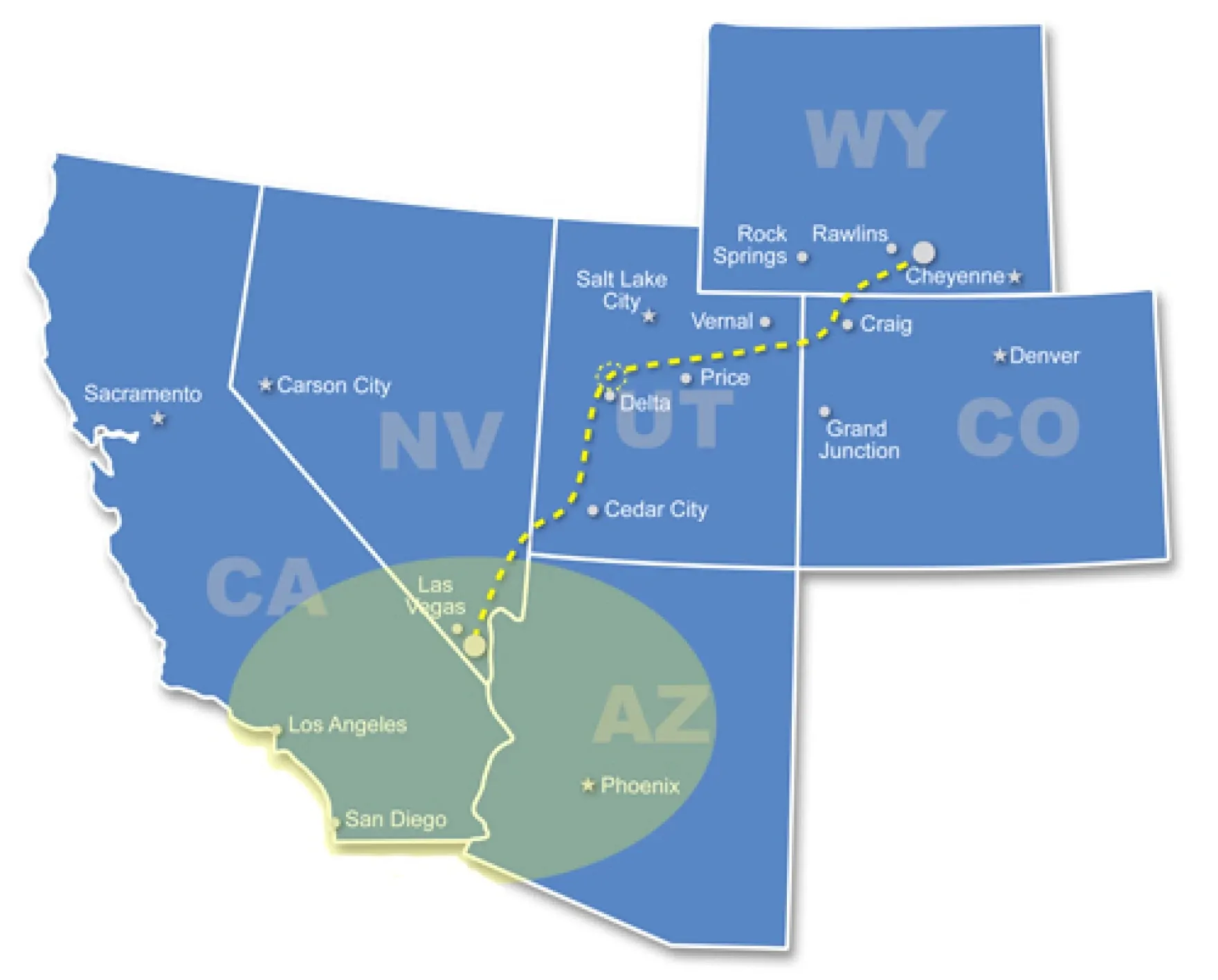
In 2008, a developer filed paperwork with the Bureau of Land Management for a power line from Wyoming’s wind-swept country near Rawlins to the desert Southwest.
Spanning 728 miles, the TransWest Express will have capacity to deliver 3,000 megawatts of Wyoming wind power to customers in California, Arizona and Nevada. The project was designed to bolster east-west interregional grid connections and serve electricity demand from markets like California seeking zero-carbon power.
The project crosses four states, including the northwest corner of Colorado. Its federal environmental review ran from 2011 to late 2016. BLM’s final Notice to Proceed to Construction was issued in 2023. If all goes well, the line will be energized in 2028, two decades after planning started.
Think about how much America’s energy landscape has changed in those two decades. The cost of renewable energy has plummeted, promising new technologies have emerged, and the nation has gone from anticipating relatively flat electricity demand to facing projections of rapid growth.
America’s energy system is running on two clocks. One measures the pace of technological innovation, growing electricity demand and a changing climate. The other measures the pace at which we permit and build infrastructure we need to respond to those changes.
Those clocks are badly out of sync.
High-voltage transmission line construction has slowed to a crawl in the United States, dropping from an average of 2,500 miles per year in 2013-2015 to just 56 miles in 2023, according to the Department of Energy. In its report, the DOE attributes the sharp decline to “deficiencies in planning, siting, and cost allocation processes.”
That matters for the climate. At the end of 2025, roughly 85% of the power plant capacity waiting to connect to the grid was solar, wind, and storage, according to Lawrence Berkeley National Laboratory. The fossil plants of the past are already built and wired in.
 Wind and solar farms are the ones stuck in line, and they tend to sit far from cities, which makes them far more exposed to transmission delays than a gas plant next to an existing substation.
Clean power sources being developed now could have a big impact on our energy mix in the coming years. Over 90% of geothermal resources are located on public lands, including parts of Western Colorado. If the technology proves out, we will need transmission lines to bring that always-on, zero-carbon energy to market. And we’ll need a predictable, efficient permitting system to make that happen.
What should Americans expect from a federal permitting system designed for the 21st century?
I’d start with a few basics. When someone proposes a major energy project, we should expect a thorough analysis of its environmental impacts, meaningful opportunities for affected communities to participate, and a timely yes-or-no decision. A reasonable process for challenging agency decisions in court should exist. And once a project has met the requirements and received its final permits, its developers should be able to rely on those approvals.
Our permitting process may have been able to meet those goals in the past, but it’s grown too complex, slow, and politicized to meet our modern-day needs.
I’ve followed federal permitting reform negotiations since 2022. The problems reported by stakeholders aren’t limited to any one energy technology or political administration. Poorly coordinated and sometimes duplicative reviews can stretch permitting decisions over years. Legal challenges can be filed up to six years after permits are issued. New administrations can obstruct projects favored by their predecessors. The resulting costs and uncertainty discourage investment in the infrastructure Americans need, and the extra cost is largely passed on to consumers like you and me.
Congress now has an opportunity to change that.
A solution called BAAJA
The Bipartisan American Affordability and Jobs Act (BAAJA) is the product of negotiations between Republican and Democratic leaders in the U.S. Senate. It includes policies debated in both the House and Senate over the past several years. The bill, if it becomes law, would modernize federal environmental reviews and permitting procedures, establish clearer timelines, improve public access to project information, and provide greater certainty around final decisions.
Beyond permitting, the bill also addresses electric grid capacity, distributed energy resources, transmission planning, and the costs that large electricity users impose on other customers. BAAJA would require data centers to pay all the costs of connecting to the grid and their share of grid maintenance.
BAAJA is a far-reaching compromise. Some of its provisions have prompted serious objections.
Many environmental and tribal organizations strongly oppose the bill, in part because of the changes it makes to bedrock environmental and historical preservation laws. Too, the Trump administration’s sustained actions to supercharge fossil development and block renewable development, especially wind projects, have eroded trust.
It’s worth noting that the bill’s environmental critics largely support its transmission provisions. The Natural Resources Defense Council, which opposes the bill as written, calls the transmission and grid reforms its “principal strengths.” The Sierra Club says the reforms would level the playing field so that a multi-state transmission line is no longer harder to build than a gas pipeline.
Objections raised by these groups also concern me.
Tribal organizations say that proposed changes to the National Historic Preservation Act undermine tribal sovereignty and weaken longstanding federal protections for sacred sites and cultural resources.
Environmental organization objections include changes to state authority under the Clean Water Act and the Endangered Species Act, limits to the court’s ability to stop a project, and unintended consequences of language intended to stop presidential administrations from interfering with legally permitted projects they don’t like.
Senate leaders amended the initial version of the bill to address some of the concerns, but opposition remains. Opponents are pressing Democrats to block passage and wait until next year when, in their opinion, they will be able to negotiate a better deal.
Is this a surprise attack?
Faced with the choice of passing a comprehensive, bipartisan law this year or starting the whole project over again next Congress with new, more liberal committee leadership and the same Republican president, I believe they should pass the law now.
Jan Rose of Colorado Coalition for a Livable Climate disagrees. She believes Congress is rushing the vote to service the data center and tech industry which, in her view, doesn’t care enough about air quality or a livable climate.
While I respect the deep concerns she has about the AI data center buildout, I dispute her suggestion that BAAJA is a surprise attack masterminded by that industry. This bill, and its end-of-year votes, are the culmination of serious policy work by Democratic and Republican lawmakers over many years with sustained input from a wide variety of stakeholder groups.
I’ve been advocating for clean energy permitting reform with Citizens’ Climate Lobby throughout the last three Congresses, first under full Democratic control, then divided government, then full Republican control. I’ve followed bill introductions and debates, watched committee hearings, and participated in dozens of lobby meetings with Democratic and Republican offices, from Senators Hickenlooper and Bennet to Representatives Buck, Boebert, and Hurd.

While local production and storage of electricity is one answer to future needs, nearly all utility planners agree that we need more transmission lines to meet demands from dispersed sources, including wind turbines and solar farms. Photo/Allen Best
During the last year, anyone following permitting reform negotiations led on the Democratic side by Senators Whitehouse and Heinrich, both staunch climate champions, would have known this timing was a strong possibility. Bill negotiations took longer than hoped, with President Trump’s actions against wind projects and the midterm elections adding complications.
What is moving remarkably fast, however, is the AI buildout itself. Data center developers are operating on a very different clock than Congress.
They want more energy, and they’re determined to get it. I want clean energy to compete for that business.
Right now data center companies are planning some of the dirtiest power projects – in part because permitting delays, inefficiencies, and litigation have kept cleaner projects from being built and kept the grid from expanding to serve increased demand. So instead of connecting to a diverse, balanced supply of regulated grid resources, they’re building massive behind-the-meter power plants on private land, powered by methane gas, spinning up any kind of turbines they can find, including used jet engines.
Wait until January?
Killing BAAJA won’t stop the current private-power buildout. Under the current permitting laws, gas pipelines are much easier to build than transmission lines. Nor will it stop President Trump’s Environmental Protection Agency from blessing such projects.
We are living in crazy times. We’re in a short-term race for new power, and natural gas is winning.
Environmental NGOs like Earthjustice believe there’s a better permitting deal to be made next year under the new Democratic-controlled Congress. They hope for transmission reform without the policies that Republicans demanded this year.
This better deal is unlikely to happen. Incoming Democrats, if now with a large majority, will have a big list of urgent priorities, including health care, inflation, the Iran War, and whatever oversight they decide to do. Permitting reform is divisive within the Democratic caucus. Try to imagine an effective permitting reform bill that Earthjustice supports, Democratic senators from oil and gas states like Texas, Pennsylvania and Alaska could vote for, and Trump would sign.
Congress can restart the legislative clock if BAAJA fails to pass the House vote this year. Energy developers, utility planners and data center companies won’t restart theirs. Nor will the climate.
For Colorado, which has spent years weighing how to join a regional power market and created its own Colorado Electric Transmission Authority in 2021, a more effective permitting system matters. That 2021 law was carried by Chris Hansen, then a Democratic legislator from Denver, and Don Coram, then a Republican legislator from Montrose.
Like highways and railroads
Hansen, who now leads La Plata Electric Association, spoke about the need for a stronger national grid at the American Clean Power’s RECHARGE Energy Storage Conference two months ago. According to reporting by Big Pivots, Hansen compared today’s need to get renewable energy to high demand centers with the national railroad expansion and the national highway system, but with climate change as the problem to be solved. “If you care seriously about better environmental performance, the only way we’re going to get reduced emissions is to improve the national grid.”
He cited permitting reform as a prerequisite and said he was hopeful that the bipartisan effort in Congress could be passed after the midterm elections. “That is what this moment calls for. I’d like to think as a country that we still have the connective tissue to do that, and it’s time for those leaders to step forward, you know, stick their necks out a little bit.”

I-70, shown here near Watkins, east of Denver, is among the nation’s that have allowed Americans to have fresh produce that is actually fresh during the middle of winter. Photo/Allen Best
I’ve heard many people argue that we don’t need long-distance transmission lines. Instead, we should lean harder on rooftop solar, community solar and batteries. Local energy keeps money in the community, avoids new rights-of-way and adds resilience.
This shouldn’t be an either-or proposition.
I have solar and batteries at my Durango home, but not everyone can afford that solution. And there’s not room for that to be the only power solution in dense cities, or in areas that don’t have strong renewable resources.
Hansen advocates a portfolio approach to decarbonization, drawing on a mix of technologies and strategies suited to local circumstances. BAAJA reflects that thinking. Alongside its transmission provisions, it opens wholesale power markets to rooftop solar and home batteries and funds efforts to streamline local permitting for those technologies.
Compromise is not capitulation
A bipartisan compromise, by its nature, will include elements that are hard to swallow. Nobody gets everything they want. But for something as consequential as our energy system, we need a law that represents the will of the broad American electorate and gives the legislation durability across political swings. The Inflation Reduction Act passed on Democratic votes, signed by a Democratic president. Much of it was repealed three years later by Republicans at the instigation of President Donald Trump, before most of the climate policies could be realized.
We can’t sustain an energy transition if we keep rewriting the rules every few years.
BAAJA is long, complicated and imperfect. It’s also been a very long time coming. Permitting reform for transmission has been debated for most of two decades, while lines like TransWest crawled through the process one filing at a time.
Thoughtful people will weigh its trade-offs differently, and the concerns about public lands and tribal rights deserve careful attention. But opposing the whole package because it isn’t perfect means accepting a status quo that builds at most a few hundred miles of transmission a year while the climate clock keeps running, extreme weather events keep stressing our grid, electricity demand keeps rising, and incumbent fossil energy persists.
When TransWest Express developers filed their first paperwork in 2008, nobody could have anticipated the energy challenges America would face in 2026. We can’t predict with any certainty what our energy needs for technology will look like two decades from now. What we can do is establish a permitting system better equipped to respond to change.
We won’t slow the pace of change by postponing permitting reform. We need to get that second clock moving faster.
I urge Congress to pass BAAJA now and build upon it in the years ahead.
Kathy Fackler is a clean energy advocate from Durango. She has been lobbying Congress for bipartisan solutions to climate change as a private citizen since 2017.
For more reading:
Bipartisan Policy Center: BAAJA Resource Hub (includes a detailed bill summary)
American Clean Power Association (ACP): the clean energy and environmental case for BAAJA
Analysis and modeling
Resources for the Future: Projected Effects of BAAJA on the Power Sector
Center for Climate and Energy Solutions (C2ES): Nationwide analysis of BAAJA

- Why waiting for a better deal is unwise - November 28, 2026

